








Kansas Lemon Law for Used Cars
 By Liam Jones
Attorney Advertising.
Your used car shouldn't keep breaking down a few weeks after you drive it off the lot. When a warranty defect keeps coming back, our Kansas lemon law team pursues a refund, a replacement vehicle, or a cash settlement from the manufacturer or dealer.
Start a free case review or call (855) 435-3666.
Kansas has no special lemon law for used cars. The Kansas lemon law covers a new motor vehicle and its original purchaser or lessee, but a used car can still support a claim under the federal Magnuson-Moss Warranty Act, the Kansas Consumer Protection Act, or the implied warranty of merchantability. What usually decides a used car case is whether a warranty was still in force when the defect first showed up.
How Kansas Lemon Law Works for Used Cars
The Kansas lemon law is only two sections long, K.S.A. 50-645 and 50-646, and almost all of it is written for new cars. Knowing what is included in the Kansas lemon law and what is left for other laws helps someone buying a used car understand where a claim can come from.
Does the Kansas Lemon Law Cover Used Cars?
Generally, no. Under K.S.A. 50-645, a "motor vehicle" is a new motor vehicle sold or leased in Kansas and registered for a gross weight of 12,000 pounds or less, and a "consumer" is the original purchaser or lessee, apart from someone buying for resale.
The act covers purchased and leased vehicles alike, but only new ones, so it leaves out most used vehicles. It also omits custom parts added by second-stage manufacturers or converters.
This does not end your options. The next section of the act, K.S.A. 50-646 says nothing in it limits your rights under the Uniform Commercial Code law or any other law, and this is where most Kansas used car claims in Kansas originate from.
What the Kansas Statute Requires for a New Car
For a new car, you report the defect to the manufacturer, its agent, or an authorized dealer during the warranty period or within one year of the original delivery date, whichever ends first. Manufacturers still have responsibility for fixing things even after a year if you submitted your report on time.
The car company then gets a reasonable number of attempts to conform the car to the applicable warranty. Once the manufacturer has actual notice, Kansas presumes that number has been reached in any of these situations:
-
The same defect has been repaired four or more times within the warranty term or that first year and still exists
-
The car has been out of service for 30 or more cumulative calendar days during that same period
-
There have been 10 or more attempts to repair any defects that substantially impair the car's use and value
Kansas has no separate, shorter count for safety defects that risk serious bodily injury. The same tests cover all substantial defects.
If those repair attempts fail, the manufacturer has two options. It has to do one of the following:
-
Replace the car with a comparable motor vehicle under warranty
-
Accept return of the vehicle and refund the full purchase or lease price, including all collateral charges, minus a reasonable allowance for your use
Because of that allowance, a refund isn't a full refund in the everyday sense. The statute ties the allowance to the American Automobile Association's Your Driving Costs, and it counts use directly attributable to you and any previous consumer before the first report of the defect, plus later use during any period the car isn't out of service for repair.
The manufacturer has an affirmative defense if the defect doesn't substantially impair use and value or came from abuse, neglect, or unauthorized modifications. If it runs an informal dispute settlement procedure that follows the federal regulations at 16 CFR Part 703, you have to use it before the refund or replacement remedy applies, and the Kansas Attorney General also has jurisdiction to enforce the statute.
Signs Your Used Car May Be a Lemon in Kansas
The clearest sign is when the same defect is sending the car to be sent back to the mechanic time after time, and repair orders show that the problem persists. Long stays at the dealer also matter, since days out of service can be a significant factor in warranty disputes.
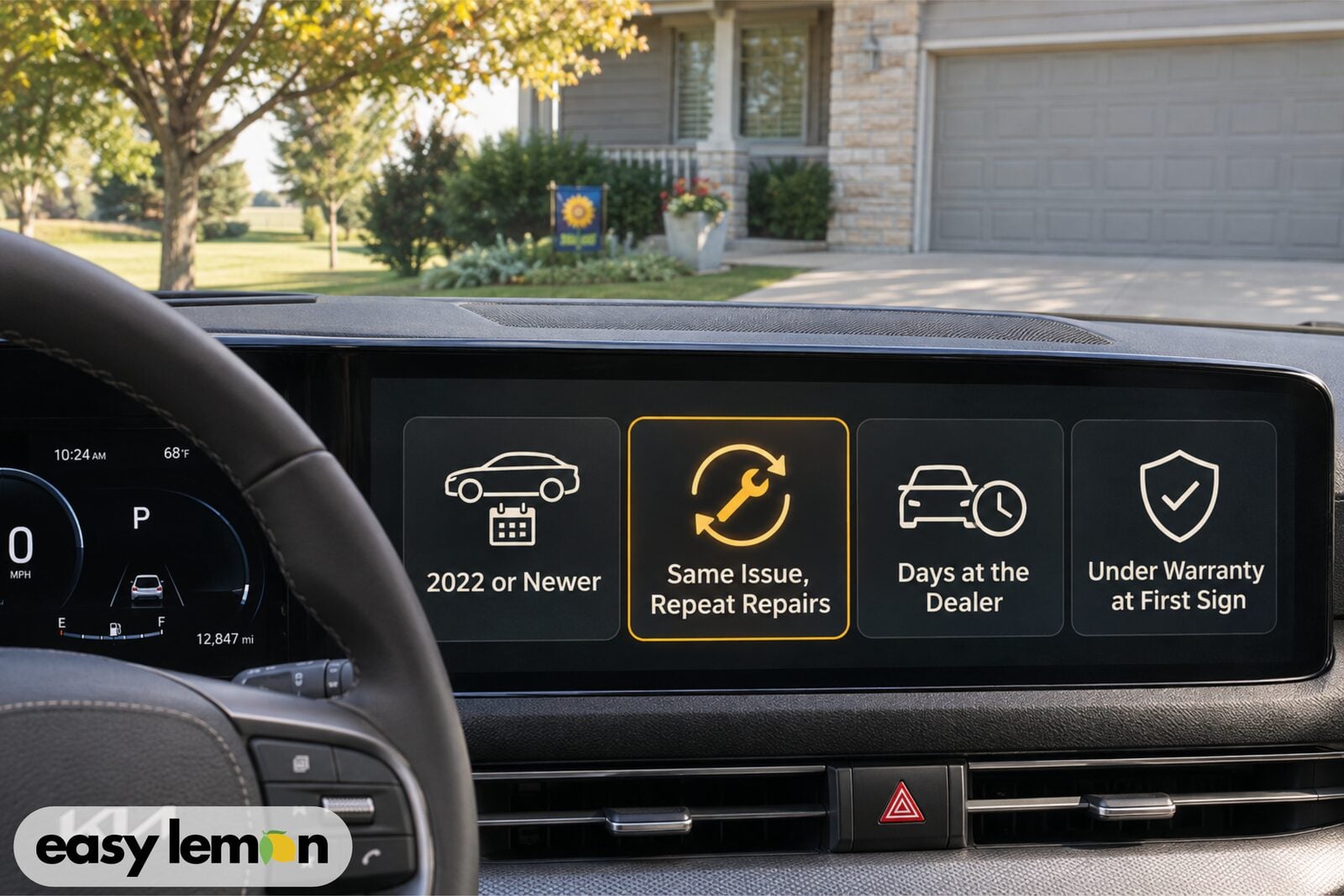
Timing matters as much as the defect, because a warranty often starts at the original delivery date, not the day you bought the car used. These are the lemon law qualifications we first check on a used car claim:
-
A 2022 or newer vehicle
-
Repeat repair attempts for the same defect
-
Days out of service at the dealer
-
Warranty coverage when the defect first appeared
Kansas Laws That Protect Used Car Buyers
If lemon laws don't apply to your car, usually there are three other sets of laws that kick in, and an FTC rule plays a role with paperwork too. It depends on what contract you signed, who sold you the car, and what information they told you.
The Magnuson-Moss Warranty Act
The Magnuson-Moss Warranty Act is a federal law covering consumer products sold with a written warranty, and cars count. If a warrantor fails to honor a written or implied warranty, 15 U.S.C. 2310(d) lets you sue for damages and other relief.
Before suing, you generally have to give the warrantor reasonable attempts to fix the problem, because 15 U.S.C. 2310(e) requires a reasonable opportunity to cure. A consumer who finally prevails may also recover costs and attorney fees based on actual time spent, unless the court finds an award inappropriate. That fee rule is a big reason Magnuson-Moss is often called the federal lemon law for used cars.
Under 15 U.S.C. 2308, a seller that gives a written warranty or sells a service contract within 90 days of the sale can't disclaim the implied warranties. It may restrict them to the duration of a written warranty that is reasonable, provided that this limitation is fair and clearly stated on the warranty itself.
The Implied Warranty of Merchantability
When you buy a car from a dealer, K.S.A. 84-2-314 suggests they provide a warranty that the car is merchantable, meaning it is fit for the typical uses people have for cars. That warranty covers sales from merchants for things of this type but usually does not apply to sales between private parties.
Kansas surprises buyers more than most do. In a consumer transaction, K.S.A. 50-639 bars a supplier from excluding or limiting the implied warranties of merchantability and fitness, and a disclaimer that breaks this rule is void.
The main exception lets a dealer limit the implied warranty for specific defects it shows you knew about, and that becomes the basis of the bargain. Even then, the limit never covers liability for personal injury or property damage.
The rule binds suppliers, meaning businesses that solicit or engage in consumer transactions in the ordinary course of business, so it doesn't reach a private seller. This rule does not apply to vehicles sold by the government that have a posted notice that meets requirements, and sales by lenders of collateral they have repossessed also fall outside the definition of a consumer transaction because they comply with governing laws.
If a dealer used an improper disclaimer and you prevail on your warranty case, the court may add reasonable attorney fees and a civil penalty. Breach of warranty claims under the Kansas UCC generally have to be filed within four years after delivery, under K.S.A. 84-2-725.
The Kansas Consumer Protection Act
The Kansas Consumer Protection Act makes illegal any deceptive actions taken by suppliers in consumer transactions. The list in K.S.A. 50-626 includes representing, knowingly or with reason to know, that a used or reconditioned car is new and willfully concealing or omitting a material fact.
So if a dealer hid known flood damage or a prior major repair that cuts the car's market value, you may have a claim even with no warranty at all. A consumer can recover actual damages or a civil penalty of up to $10,000 per violation, whichever is greater, and if you prevail and the supplier violated the act, the court may award attorney fees once the case ends in a judgment or settlement.
The FTC Buyers Guide
Under the FTC Used Car Rule, a dealer that has sold or offered five or more used vehicles in the past 12 months has to display a Buyers Guide on each used car it offers for sale. The final terms of the Buyer's Guide become part of the sales contract and supersede any other terms in that contract.
Plenty of dealers check the "As Is, No Dealer Warranty" box. The rule itself, at 16 CFR 455.2(b)(1)(ii), says that where state law limits or prohibits "as is" sales, the state law overrides it. Because K.S.A. 50-639 voids a supplier's implied warranty disclaimer in a consumer sale, that box may not end your rights in Kansas, and it's worth having an attorney read it next to your contract.
According to the Federal Trade Commission, there is also no federal cooling-off period of three days for purchases of cars. Whether you can return a used car within 30 days usually comes down to what the dealer agreed to in writing.
Comparing Your Options for a Used Car in Kansas
Each path has its own scope of work, target, and fee rule. The table compares them side by side, and many use two or even all three together.
How Kansas Compares With Other States
Kansas is a new car state, but some states have an extra used car lemon law added separately onto their rules for new cars. New York, Minnesota, and the Massachusetts lemon law for used cars each require dealers to give a written warranty on many used cars, with coverage that shrinks as mileage climbs.
This table pulls the basics from each state's own statute, using the lowest mileage tier for the warranty information. Check the full statute for higher-mileage cars and every exclusion.
Every state writes its own laws and statute specifically. In Kansas, the Kansas statute only apply to vehicles that are sold or leased in Kansas territory. Before buying a car in either New York, Massachusetts or Minnesota, check the laws for used cars in that particular state first.
How to File a Used Car Claim in Kansas
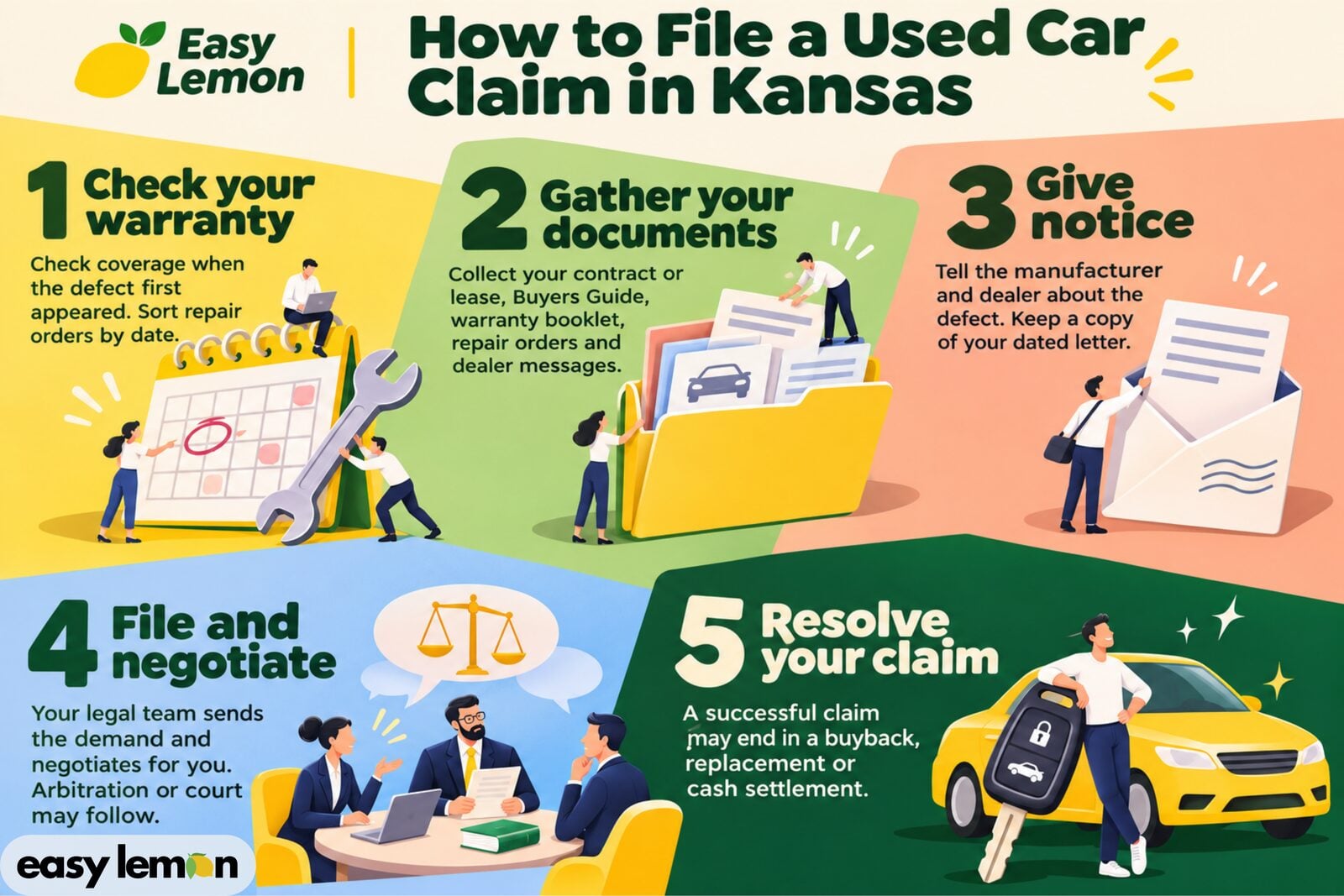
Most of the work in a Kansas used car claim sits on our side, and you can follow each stage of our lemon law process by phone, email and e-signature. Your main task is answering questions and sending the paperwork you already have on hand.
Check Your Warranty and Repair History
First, find out when warranty coverage was active at the time of the defect occurrence. That could be warranty from the manufacturer, a warranty that comes with being Certified pre-owned warranty, a dealer warranty advertised on the Buyers Guide or a service contract. Then put your repair orders in date order, since a mismatched description can make two visits look like two different problems.
Gather Your Documents
Your paperwork is the most important part of a warranty claim. Gather the following documents:
-
The purchase contract or lease agreement showing the full contract price
-
The Buyer's Guide
-
The warranty booklet
-
Every repair order
-
Any texts or emails with the dealer
A quick repair visit on a used car may be listed under the last owner's name or the most recent owner. When that happens, we then ask the dealer for full service history.
Notify the Manufacturer and Dealer
Kansas lemon law turns on consumer reports of the defect reaching the manufacturer, its agent, or an authorized dealer. For warranty claims, K.S.A. 84-2-607 also says a buyer who discovers a breach, or should have discovered it, has to notify the seller within a reasonable time or lose the remedy.
Neither statute spells out a written form, but you should give the dealer a reasonable period to repair. A dated letter sent to the manufacturer or dealer remains the clearest evidence that you have given notice.
File and Negotiate the Claim
We send the demand, deal with the manufacturer or dealer and its lawyers, and take the claim to arbitration or court if needed. The first offer is often low, so we answer it with the repair history and the statute. When the car was bought new, filing a Kansas lemon law claim also brings the statute's repair presumption into that argument.
Resolve Your Claim
If the claim turns out in your favor, you will get the buyback, replacement, or cash settlement that you had agreed upon. You pay no attorney's fees unless we recover for you.
What Compensation Can You Get for a Lemon Used Car in Kansas?
That depends on which law your claim is based on. Under the Kansas lemon law, a qualifying new vehicle gets a replacement or a refund of the full purchase price or lease price with collateral charges, less the reasonable allowance for use.
Used car claims under warranty and consumer protection law more often end in a cash settlement where you keep the car or a negotiated buyback. Kansas UCC damages for breach of warranty are generally the difference, at the time and place of acceptance, between the car's value as accepted and the value it would have had as warranted.
One nearby example is a 2024 Jeep Wagoneer L claim in Missouri, where the SUV was bought new and spent 233 days at the dealer over four repair visits. It settled for $22,500 under the Magnuson-Moss Warranty Act, a total that includes the attorney fees. Past results do not guarantee a similar outcome.
Why Kansas Drivers Choose Easy Lemon
We work on contingency, so you owe no attorney's fees unless we recover for you. Firm-wide, our recent settlements include a $160,264 buyback for a 2024 BMW X6 owner in Florida. Past results do not guarantee a similar outcome.
Don't Let a Used Car Lemon Keep Costing You
You didn't cause the defect, and you shouldn't be paying anymore for it. Call (855) 435-3666 or book a free attorney consultation and have an Easy Lemon attorney from that firm review your repair history at no charge.
Frequently Asked Questions
Our lawyers look at claims for used cars that come in from all over the country, and we keep getting the same few questions about them from Kansas drivers. These are the questions that buyers from Kansas ask us most often.
Does Kansas Have a Lemon Law for Used Cars?
Generally, no. The Kansas lemon law covers new motor vehicles and their original purchaser or lessee. Used car buyers can still bring claims under the Magnuson-Moss Warranty Act, the implied warranty of merchantability, or the Kansas Consumer Protection Act.
Can a Kansas Dealer Sell a Used Car As Is?
Dealers often check the As Is box on the FTC Buyers Guide, but K.S.A. 50-639 voids a supplier's attempt to disclaim implied warranties in a consumer sale. The main exception is for specific defects the buyer knew about that became the basis of the bargain, and that limit never covers personal injury or property damage.
How Many Repair Attempts Make a Car a Lemon in Kansas?
For a new vehicle, Kansas presumes a reasonable number of attempts after four repairs of the same defect, or 30 cumulative calendar days out of service, within the warranty term or the first year after delivery, whichever ends first. It also presumes it after 10 or more attempts to repair any defects that substantially impair use and value.
Do I Have to Notify the Manufacturer in Writing?
The Kansas statute requires that you report the defect and that the manufacturer have actual notice, but it doesn't require a particular written form. A dated letter is still the strongest evidence that you submitted the report.
Can I Return a Used Car After Buying It in Kansas?
Federal law doesn't give car buyers a three-day right to cancel, according to the FTC. A return usually depends on what the dealer agreed to in writing, unless a warranty or consumer protection claim applies.
How Long Do I Have to File a Used Car Claim in Kansas?
Kansas UCC breach of warranty claims generally have to be filed within four years after delivery. Other claims carry different deadlines, so it's worth calling before time runs out.
Disclaimer: The information on this page is for general informational purposes only, does not constitute legal advice, and neither its receipt nor viewing creates an attorney-client relationship. Contacting Easy Lemon does not establish an attorney-client relationship. Easy Lemon and RockPoint Law P.C. are not affiliated with, endorsed by, or sponsored by any vehicle manufacturer; manufacturer names are referenced solely to identify the vehicles involved.
What Our Clients Say
Read More Relevant Blogs

How to File a Lemon Law Claim in Kansas
Kansas lemon law has a presumption trigger almost no other state uses: 10 total repair attempts across any...
Read Full Post →
Experienced General Motors Recall Lawyer
If your GM vehicle keeps going back to the shop for the same problem and nothing actually gets...
Read Full Post →
Ram 1500 Problems: Does Lemon Law Cover Your Truck?
Yes, the lemon law covers a Ram 1500 when the same substantial defect persists after a reasonable number...
Read Full Post →Resolving Your Lemon Law
Case Has Never Been Easier
Our experienced attorneys handle everything — from paperwork to manufacturer negotiations. You focus on your life, we'll get you results.
