







Auto Defect Liability: Who Is Responsible When a Vehicle Has a Defect?


Auto defect liability determines who can be held legally responsible when a vehicle defect causes a car accident, serious injuries, or property damage. Depending on the circumstances, the vehicle manufacturer, a defective component supplier, a dealership, or a repair shop may bear responsibility.
At Easy Lemon, our lemon law team has recovered more than $50 million for consumers across more than 3,000 cases, helping drivers nationwide pursue manufacturer buybacks and cash settlements. Our recent results include a $160,264 recovery for a BMW X6 owner, a $148,749 settlement for a Mercedes SL43R owner, and a $144,550 recovery for a Porsche Macan owner. With years of experience handling defective vehicle claims, we know how to hold manufacturers accountable and maximize available remedies under state lemon laws. If you're stuck with a defective vehicle, contact Easy Lemon today for a free consultation.
What Is Auto Defect Liability?
Auto defect liability falls under product liability law, which governs claims involving products that cause harm because of defects. In the automotive industry, liability may arise when a vehicle or car part is defectively designed, improperly manufactured, or sold without adequate safety warnings. Manufacturers must meet applicable safety standards and provide vehicles that are reasonably safe for their intended use.
According to the National Highway Traffic Safety Administration (NHTSA), manufacturers must issue recalls to address qualifying safety defects and noncompliance with federal motor vehicle safety standards. Recall repairs are generally provided at no cost to vehicle owners. A recall does not automatically prove legal liability, but it can provide important evidence when investigating a defective vehicle claim.
Auto defect liability differs from an ordinary car accident claim because determining liability may require proving that a defect existed and that it caused or contributed to the resulting injuries or losses. Depending on state law, injured victims may pursue product liability claims under theories such as strict liability, negligence, or breach of warranty.
What Types of Auto Defects Can Create Liability?
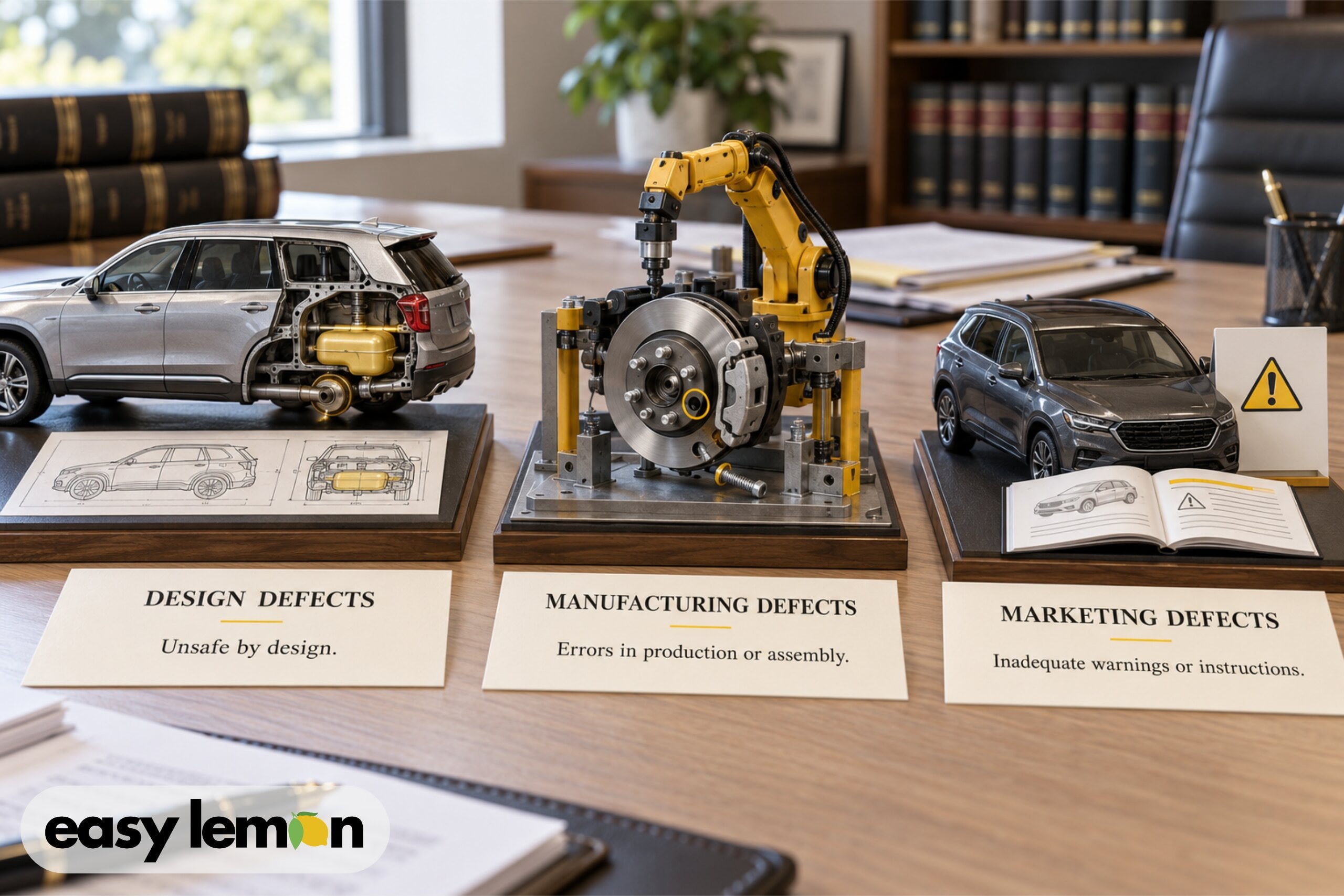
Auto defects generally fall into three categories under product liability law: design defects, manufacturing defects, and marketing defects. Each involves a different type of failure that can make a vehicle unreasonably dangerous.
1. Design Defects
Design defects exist before the manufacturing process begins. They occur when a vehicle's design creates an unreasonable safety risk, potentially affecting an entire model line rather than an individual car.
Common examples include unstable vehicle designs that increase rollover risk, unsafe fuel systems, and steering systems that are prone to failure. Manufacturers may be held liable when a design defect makes a vehicle dangerous and causes a foreseeable injury, subject to the applicable state's legal standards.
2. Manufacturing Defects
Manufacturing defects occur when a vehicle or component departs from its intended design during production or assembly. Unlike design defects, which may affect an entire model, manufacturing defects can involve only specific vehicles or individual parts.
Examples include faulty brakes caused by improper assembly, substandard materials in suspension components, defective tires that experience tread separation, and improperly installed fuel system components. A manufacturing error can turn an otherwise safe vehicle into a defective vehicle that poses a serious risk to drivers and passengers.
The Takata airbag recalls illustrate the consequences of automotive safety defects. NHTSA has confirmed that defective Takata airbag inflators have killed 28 people in the United States and that at least 400 people have reportedly been injured.
3. Marketing Defects
Marketing defects arise when manufacturers fail to provide adequate warnings or instructions about a product's risks. A vehicle may have a design that is otherwise acceptable but still create a legal claim if consumers are not properly warned about a known danger.
For example, a manufacturer may face liability if it fails to warn consumers about a fuel tank fire risk, a dangerous airbag system, or limitations in a safety feature that could affect how drivers use the vehicle. Warning defects can also arise when instructions fail to explain necessary precautions.
Who Can Be Held Liable for a Defective Vehicle?
Multiple parties can share liability in auto defect cases. Determining who is responsible depends on where the defect originated, who supplied the defective component, whether someone altered the vehicle, and which laws apply.
Liability can extend throughout the automotive supply chain, from the company that designed the vehicle to a third-party manufacturer that supplied a defective component. In some cases, an insurance company may cover a liable party's losses, but insurance coverage does not itself determine who is legally responsible.
Manufacturers may face strict liability in states that recognize this theory. Strict liability generally means an injured person does not have to prove that the manufacturer acted negligently, but must still satisfy the state's requirements for establishing a defect, causation, and damages.
How Do You Prove Auto Defect Liability?
Start by identifying the suspected defect and the component involved. Faulty brakes, steering systems, tire defects, airbag malfunctions, and fuel system failures are common areas of investigation. Warning lights, repair records, recall notices, and witness statements can help establish what went wrong.
Next, determine whether the defect existed when the vehicle left the manufacturer's control. Evidence such as photographs, maintenance histories, manufacturing records, and component testing can help distinguish an original defect from problems caused by ordinary wear and tear, poor maintenance, or subsequent repairs.
You must also establish a connection between the defect and the accident. An accident reconstructionist may examine skid marks, vehicle damage, electronic data, and road conditions to determine whether the defect caused or contributed to the crash, rather than driver error or another driver's actions.
Preserving evidence is equally important. Keep the vehicle in its post-accident condition as far as reasonably possible, and retain damaged parts, photographs, repair invoices, police reports, medical records, and communications with the manufacturer or insurance company. Before authorizing repairs or disposing of the vehicle, consult an attorney about preserving potentially important evidence.
An independent mechanical inspection can help determine whether a defective component, manufacturing error, or design flaw contributed to the accident. Complex product liability claims may require engineering analysis, component testing, and expert testimony to establish the cause of the failure.
Finally, consult an experienced product liability attorney to determine which parties may be held liable and which legal standards apply. Depending on state law, your claim may involve strict liability, negligence, breach of warranty, or another legal theory. An attorney can also investigate the automotive supply chain and identify applicable filing deadlines.
What Compensation Can You Recover?
When a defective vehicle causes an accident, injured victims may be entitled to compensation for financial losses, physical injuries, and other harm. The amount depends on the evidence, the type of legal claim, and the applicable state law.
According to Cornell Law School's Legal Information Institute, compensatory damages in personal injury cases can cover medical expenses, lost wages, reduced earning capacity, and pain and suffering. Additional damages may be available in certain circumstances.
Potential compensation in auto defect cases includes:
-
Medical expenses: Emergency treatment, hospital stays, surgery, medication, rehabilitation, and future medical care related to the accident.
-
Lost wages and earning capacity: Income lost during recovery and reduced ability to earn a living because of lasting injuries.
-
Pain and suffering: Physical pain, emotional distress, and loss of enjoyment of life, where recoverable under state law.
-
Property damage: Repair costs or the value of a vehicle that was damaged or destroyed, along with other eligible property losses.
-
Other applicable damages: Depending on the case, additional losses or punitive damages may be recoverable under specific legal standards.
A manufacturer may be required to compensate an injured person when a proven defect caused their losses and the applicable legal requirements are met. However, a vehicle defect does not automatically guarantee compensation, and the amount recovered may be affected by comparative fault rules, available evidence, and other legal limitations.
What Should You Do If You Suspect an Auto Defect?
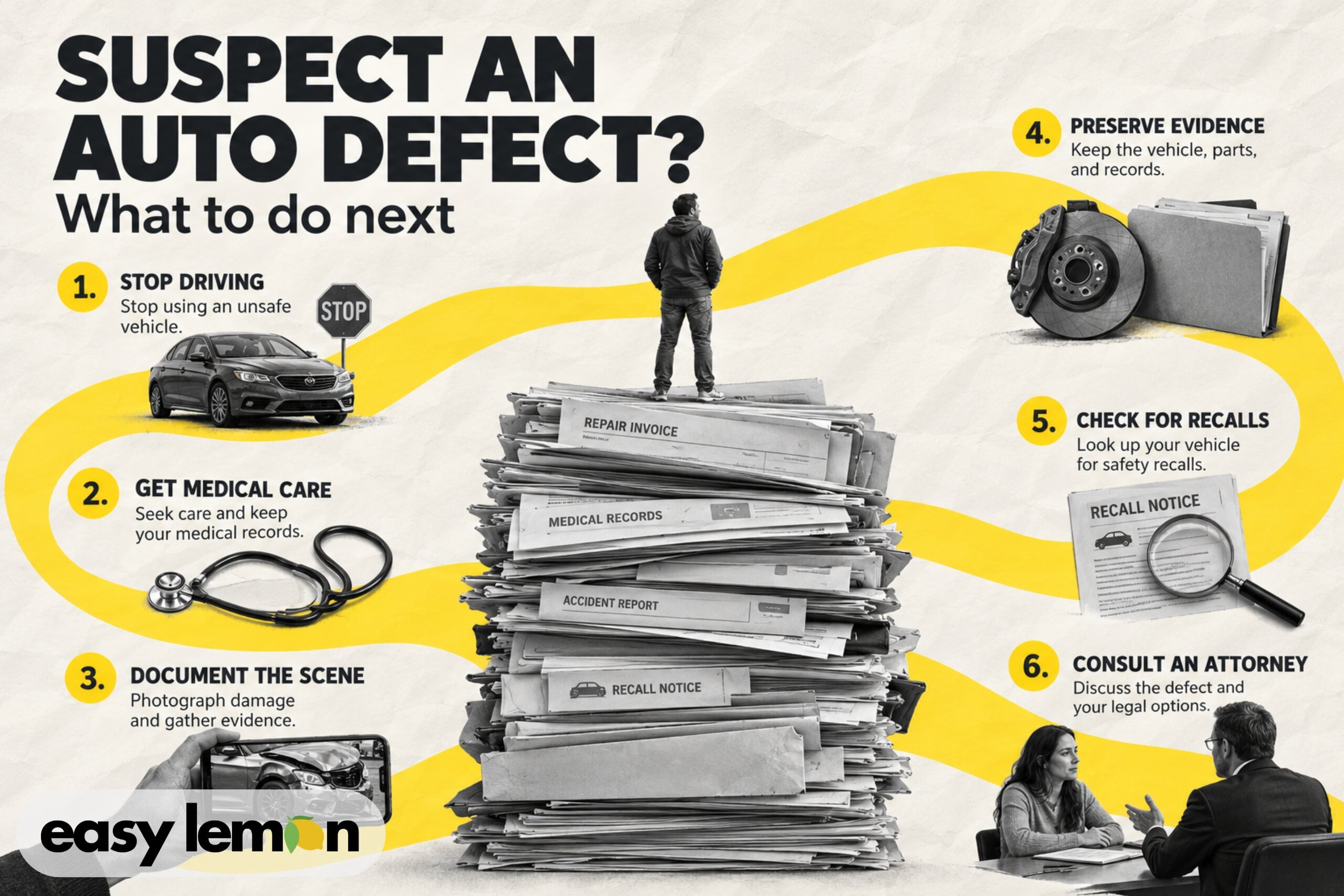
If you believe a vehicle defect caused a car accident, taking the right steps can protect your safety and preserve evidence for a potential legal claim.
-
Stop driving an unsafe vehicle. If you suspect faulty brakes, steering failure, a fuel leak, or another dangerous defect, stop driving when it is safe to do so. Follow any manufacturer safety instructions, including a recall-related warning not to drive.
-
Seek medical care immediately. Get emergency assistance for serious injuries and arrange medical evaluation for other injuries. Keep medical records, treatment bills, and documentation of symptoms that may help establish the extent of your losses.
-
Document the accident scene. Photograph the vehicle damage, damaged components, road conditions, skid marks, warning lights, and other relevant details. Obtain witness statements and request a police report where appropriate. Inform responding officers if you suspect a mechanical failure contributed to the crash.
-
Preserve the vehicle and damaged parts. Keep the vehicle in its post-accident condition as far as possible. Save maintenance records, repair invoices, recall notices, and communications with the insurance company or manufacturer. Speak with an attorney before allowing potentially important evidence to be altered or discarded.
-
Check for safety recalls. Use the NHTSA recall lookup tool to search by vehicle identification number (VIN) or license plate. NHTSA reported 997 vehicle safety recalls affecting more than 29 million vehicles in the United States in 2025. Recall repairs are generally free at an authorized dealership, and a dealership generally cannot refuse to fix a recall on a covered vehicle.
-
Consult an experienced product liability attorney. An attorney can investigate the defect, assess the evidence, identify potentially liable parties, and explain your legal options. Acting promptly matters because evidence can deteriorate, and statutes of limitations or statutes of repose may restrict when a claim can be brought.
A recall is useful evidence, but it is not required in every case to establish a vehicle defect. Similarly, a manufacturer is not automatically absolved of liability simply because a recall repair was offered after an accident. If the same recall or defect keeps sending your car back to the shop, it may also be worth knowing how many recalls can qualify a car under lemon law. The specific facts and applicable law determine the outcome.
Do You Need an Auto Defect Liability Lawyer?
Auto defect cases can involve complex product liability claims, technical investigations, multiple potentially responsible parties, and disputes over whether a defect actually caused an accident. An experienced attorney can coordinate expert inspections, review manufacturing and repair records, investigate the supply chain, and determine which legal theories may support your claim.
If a defective vehicle caused serious injuries or significant property damage, legal guidance can also help you understand the compensation available and the deadlines that apply. Not every mechanical failure establishes a valid claim, so a thorough investigation is important before determining where liability lies.
At Easy Lemon, our legal team helps consumers pursue remedies when defective vehicles leave them facing ongoing problems and financial losses. Many repeat issues, from engine and transmission failures to electrical faults, fall within the types of problems lemon law covers. If you believe your vehicle qualifies for relief under applicable lemon laws, contact Easy Lemon for a free consultation and learn about your options.
FAQs About Auto Defect Liability
Here are some of the most frequent questions we get about auto defect liability.
Can I Sue a Car Manufacturer If a Defect Caused an Accident?
Yes, you may be able to sue a vehicle manufacturer if a defect caused or contributed to an accident and you can establish the elements required by applicable law. Depending on the circumstances, you may pursue compensation for injuries, medical expenses, lost income, and property damage.
Do I Need a Recall to Prove a Vehicle Was Defective?
No, a formal recall is not always necessary to prove that a vehicle had a defect. Engineering evidence, inspection reports, maintenance records, and expert testimony may help establish that a defect existed and caused the accident.
Can I File a Claim If the Defect Caused Property Damage But No Injuries?
Yes, you may have a claim for property damage if a vehicle defect caused damage to your car or other property. However, the available legal remedies depend on state law, the type of claim, and whether the defect and resulting losses can be established.
How Long Do I Have to File an Auto Defect Liability Claim?
The deadline varies by state, the type of claim, and the circumstances of the accident. Statutes of limitations and statutes of repose may impose different time restrictions, so consult an attorney promptly to determine which deadlines apply to your case.
Legal Disclaimer: The information provided in this article is for general informational and educational purposes only and does not constitute legal advice. Auto defect liability laws vary by state, and the outcome of any claim depends on the specific facts and applicable law. Reading this article or contacting Easy Lemon does not create an attorney-client relationship. Consult a qualified attorney regarding your individual circumstances. Past case results do not guarantee similar outcomes in future cases.
What Our Clients Say
Read More Relevant Blogs

Jeep Dealer Refuses Repair? Know Your Warranty & Lemon Law Rights
If a Jeep dealer refuses to fix something you need fixed, write down that denial and keep track...
Read Full Post →
Jeep Wrangler Death Wobble Lemon Law Filing Rights in 2026
Jeep Wrangler owners experiencing death wobble may have Lemon Law rights if the defect substantially impairs safety, value,...
Read Full Post →
Federal Lemon Law Used Cars
Yes, federal lemon law can protect you when you buy a used car. The Magnuson-Moss Warranty Act, often...
Read Full Post →Resolving Your Lemon Law
Case Has Never Been Easier
Our experienced attorneys handle everything — from paperwork to manufacturer negotiations. You focus on your life, we'll get you results.
