








Car Warranty Coverage: What's Actually Protected and What Isn't

Attorney Advertising.
A car warranty covers repair and replacement costs for manufacturing defects and mechanical failures under normal use. It does not cover accidents or normal wear and tear; those things fall under separate insurance coverage for repairs or regular maintenance responsibilities that belong to the owner. Coverage splits mainly into bumper-to-bumper and powertrain protection, each running on its own mileage and time limits.
Easy Lemon has recovered more than $50 million for consumers across more than 3,000 cases and represents car owners whose warranty claims were denied for reasons a manufacturer never proved. The Magnuson-Moss Warranty Act sets the federal floor these disputes turn on, and knowing its exact terms is often what separates a valid denial from an unlawful one. If a dealer or manufacturer has previously denied a claim, schedule a free case review with us today.
Past results do not guarantee future outcomes.
This guide explains what a car warranty is supposed to cover, how it differs from auto insurance coverage, and what to do if an insurance claim is denied.
What a Car Warranty Actually Promises You
A manufacturer warranty is a written promise that comes with your purchase of a vehicle. Federal law considers the warranty a legal designation rather than a marketing term. The Magnuson-Moss Warranty Act does not force a manufacturer to offer a warranty, and it sets no minimum length once offered. It regulates content and disclosures with much stricter rules than most owners realize.
Any written warranty on a product costing more than $10 has to be labeled either a full warranty or a limited warranty, and the label is not optional branding. A full warranty requires a free repair within a reasonable time, plus a refund or replacement if the same defect survives a reasonable number of attempts. Almost no manufacturer warranty in the United States clears that bar. Nearly every one sold today is a limited warranty, carrying the mileage caps and exclusions drivers expect, and the word "full" has a narrower legal meaning than most buyers realize.
Federal rules also require the dealer to make a warranty's terms available before the sale closes, the legal basis behind a simple habit worth keeping: asking to read the booklet before you commit. The length of time varies depending on the specific vehicle and manufacturer, and warranties for new cars range from roughly 3 years at the low end to 10 years at the high end, depending on the type of coverage and the brand.
The warranty on a car is different from a recall for that car. A recall addresses a safety or emissions defect with its own free repair window regardless of mileage, a process governed by separate recall rules rather than the warranty terms covered here.
Car Warranty Versus Car Insurance
An auto warranty and a car insurance policy solve different problems, even though shoppers mix the two up at the dealership. A warranty helps pay for repairs tied to manufacturing defects and mechanical failures under normal use, at no cost to the owner for a covered repair. Car insurance also helps to protect against damage from accidents, collisions, theft, damage due to vandalism, and damage from natural disasters, as well as any liability toward people who are hurt if you cause an accident. Owners who recognize this difference keep disputes over repairs straightforward.
Auto insurance is also legally required in nearly every state, while a warranty is never required. Forty-nine states as well as the District of Columbia require some sort of mandatory liability insurance coverage. New Hampshire is the one state that does not, relying instead on a financial responsibility law. Virginia used to let drivers pay an uninsured motorist fee instead of buying a policy, but that opt-out closed in 2024, so Virginia now requires coverage like almost every other state.
Some manufacturer warranties bundle roadside assistance or towing as a goodwill perk, which can blur the line between warranty and insurance. Insurance policies, on the other hand, take care of repairs due to accidents, theft, and damage caused by weather. A warranty only ever responds to a defect or mechanical breakdown the manufacturer is responsible for.
What's Typically Covered, and What Almost Never Is
Coverage mostly comes down to one question: whether a failure traces to a defect rather than something the owner did. That distinction explains most of what Easy Lemon emphasizes.
Mechanical and Electrical Failures Under Normal Use
A warranty protects against mechanical failures and malfunctions that result from electrical problems that happen when you use your car properly. A failed transmission is the textbook example, and replacing one without coverage commonly runs into the thousands.
Under bumper-to-bumper coverage, work usually goes as far as climate control systems, power accessories, audio equipment and infotainment technology, and most major systems from bumper to bumper. Powertrain coverage narrows to the engine, transmission, and drive axle, the parts responsible for moving the vehicle.
Routine Maintenance, Wear Parts, and Accident Damage Are Usually Excluded
Warranties typically exclude routine maintenance expenses like oil changes, filter replacements, and fluid flushes, since those fall to the owner rather than counting as a defect claim. Also excluded are normal wear and tear that would affect parts that are designed to degrade with use, such as brake pads, tires, and windshield wipers.
Certain types of damage, from an accident, from neglect, or from driving outside the vehicle's intended conditions, are excluded as well. Auto insurance is designed to address these various types of issues.
The Warranty Types You'll See on a Window Sticker

Most new vehicles typically carry at least three different named coverages, each with its limits and its own clock. None of the figures below come from a federal statute, since Magnuson-Moss sets no minimum or maximum duration at all. They are typical range figures for the industry that vary by manufacturer, so the numbers in your booklet control anyway.
Bumper to Bumper
A bumper-to-bumper warranty, sometimes called a basic warranty, is the broadest and usually the shortest coverage type a new car carries. The industry-standard baseline most manufacturers are compared against is 3 years or 36,000 miles, whichever comes first, though several brands now offer longer terms to compete.
Powertrain
Powertrain coverage follows the engine, transmission, and drive axle longer than the bumper-to-bumper term typically lasts. A typical baseline is somewhere around 5 years or 60 thousand miles. Many brands, such as Kia, Hyundai, Mitsubishi, and Genesis, extend powertrain coverage out to 10 years or 100,000 miles for the original buyers.
Corrosion
Corrosion or rust-through coverage protects against sheet metal failing from the inside out for most of the vehicle's life, and it generally runs longer than the other two types. Reported terms typically range from 5 to 12 years; sometimes the coverage can go even further without a mileage limit. It is important to look into specific brochures from different brands rather than assume there is one fixed duration that works everywhere.
The table below lines up all three coverage types side by side, and every figure is a manufacturer's own choice rather than a legal requirement.
The EV Battery Warranty Myth Everyone Gets Wrong
The battery is by far the most expensive component of an electric vehicle, and there are lots of warranty claims related to this part that reputable auto sites have sometimes printed the right numbers wrong. The actual federal rule and the widely quoted 8-year, 100,000-mile battery figure are two different things, and conflating them does readers a disservice.
The genuine nationwide federal rule comes from the Clean Air Act, and it requires an 8-year or 80,000-mile warranty, not 100,000 miles. That warranty only covers a very specific set of emission controls: the catalytic converter and electronic units that deal with emissions, as well as the onboard diagnostics system. The statute does not name a battery pack as a covered component, and most electric vehicles lack a catalytic converter, so the federal emissions-warranty floor simply excludes the EV battery claim.
The 8-year, 100,000-mile battery figure comes from California's Advanced Clean Cars II program, a state regulation codified at California Code of Regulations title 13, section 1962.8(c)(3). It requires automakers to warrant an EV or plug-in hybrid battery pack against dropping below a set state-of-health floor of 70% through model year 2030, rising to 75% after that, for 8 years or 100,000 miles, whichever comes first.
The rule binds automakers in California, plus any state that separately adopted it under Section 177 of the Clean Air Act, roughly a dozen states, including New York and New Jersey, among Easy Lemon's own licensed states.
Timing is equally important as getting correct sourcing. In 2025, Congress passed some resolutions related to the Congressional Review Act that sought to undo a waiver issued by the EPA that forms the basis of California's program. States that have adopted similar rules have sued and argued that Congress cannot undo such a waiver this way. That litigation is still working its way through the courts as of this writing, so whether the rule is enforceable, even in adopting states, is genuinely disputed rather than settled either way. Most automakers still offer similar battery-warranty terms nationwide anyway, since one coverage standard beats tracking fifty separate ones, but that's a business choice, not a legal requirement.
Extended Warranties Are Not Warranties
An extended warranty is the most misleadingly named product in the industry, because under federal law it isn't a warranty at all. A service contract sold by a third-party company is purchased separately as an extra cost item. A manufacturer's written warranty comes bundled into the purchase price and has to meet Magnuson-Moss's disclosure rules. When a service contract becomes available for purchase, it comes with its own price. The main rules for repair work come from both what is agreed upon in contracts and state laws.
In practical terms, there's a gap that arises. Extended warranties, meaning service contracts, commonly carry waiting periods and per-visit deductibles that a manufacturer's original warranty never would. They can provide extras like roadside assistance and rental car reimbursement and can be purchased for a new or used vehicle, often picking up coverage after the factory warranty runs out.
It is important to clarify one distinction more. A vehicle service contract and a prepaid maintenance plan are not the same product, even though finance offices blur the two together. A service contract covers repair work if something mechanical or electrical breaks down, but a maintenance plan only covers routine things like regular oil changes and inspections. A handful of states, Florida among them, even regulate service contract providers as a form of specialty insurer, one more reason to read the contract itself.
Used Car Warranty Coverage and the Buyer's Guide
Every used car a dealer offers for sale has to carry a federally required window sticker called the Buyer's Guide, and most buyers glance past it without knowing its power. It has to disclose whether the car is sold as is or with some form of warranty, and if a warranty box is checked, what percentage of repair costs the dealer will pay.
Language is not just an option alongside the contract; it's important. Federal rules state plainly that the Buyers Guide's terms are incorporated into the sales contract and override any contrary language buried in the paperwork. A signed as-is clause in the finance stack does not control if the posted Buyer's Guide checked a warranty box instead, a detail that trips up plenty of buyers and more than a few dealers.
Certified Pre-Owned programs add another layer, and they are manufacturer-specific rather than federally standardized. No statute sets a minimum CPO checklist or coverage term, so one program can look very different from another's, down to the mileage cutoff and powertrain coverage included. Dealerships that roll warranty coverage into a car loan sometimes blur what customers are paying for, which is why the Buyers Guide, not a verbal promise, controls. Used car lemon law protections interact with these same Buyers Guide rules, mattering just as much to someone shopping a CPO lot as to a buyer at an ordinary used-car sale.
Can a Dealer Void Your Warranty for Using Aftermarket Parts
This is the single most common warranty myth Easy Lemon's attorneys hear, and similar stories come up on nearly every intake call, but it is flatly wrong under federal law. A manufacturer cannot void an entire vehicle warranty because an owner installed an aftermarket part or used an independent shop instead of the dealer, and knowing this rule can save an owner from an unnecessary repair bill. Unless something was free under warranty or the manufacturer obtained a narrow waiver granted, Federal law prohibits a warrantor from conditioning coverage on a particular branded part or service.
The regulation goes further than banning the practice in general, giving a direct example of a prohibited term, language telling a customer the warranty is void unless every service comes from an authorized dealer and every part is genuine brand-name, and calling that exact blanket condition deceptive. What the law allows is narrower than what it permits. A manufacturer can deny one particular claim if it shows the aftermarket part or outside repair caused that failure, but it cannot use a blanket non-dealer policy to deny claims unrelated to that part or service.
None of this means scheduled maintenance stops mattering. A manufacturer can still require documented, reasonable maintenance to keep a warranty valid, and failing to maintain a vehicle can cost an owner a specific claim. It's not necessary for the maintenance to be done only at the dealer or only with its own branded parts from them. Both halves apply at once, since keeping up with maintenance is required, and where you get it done generally isn't.
What to Do When a Warranty Claim Gets Denied
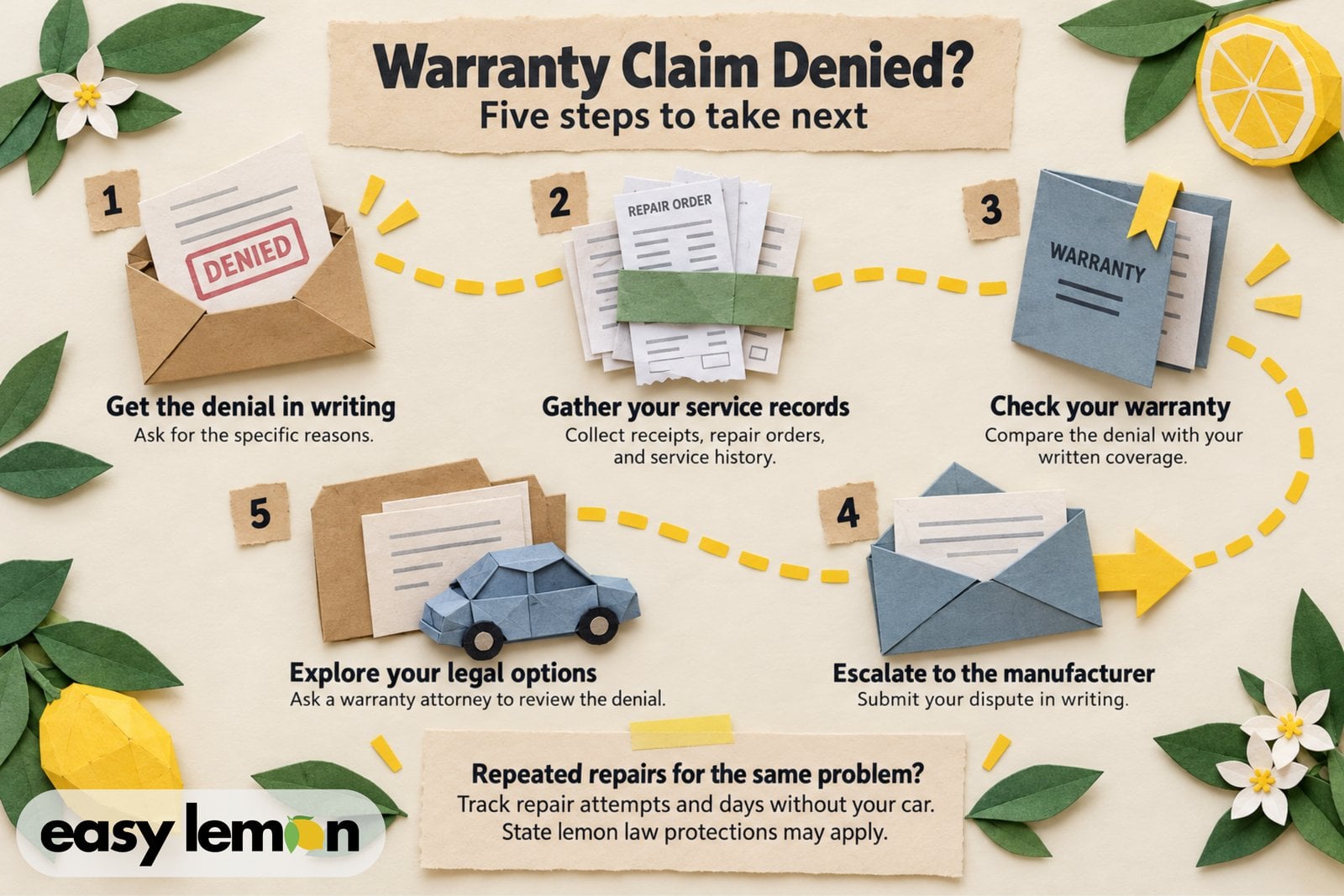
A denied claim is not automatically the final word. First, you should get that denial in writing and request specifics of the reasons why, because vague verbal explanations will be hard to contest later. Second, gather your service records, because having a documented history can help counter any claims that blame a lack of maintenance or the use of aftermarket parts.
Third, verify your written warranty booklet, or the manufacturer's website, against what you were told at the counter, as service writers sometimes misstate what the warranty excludes. Fourth, if the denial still looks wrong, escalate in writing to the manufacturer's regional line rather than stopping at the dealership. Fifth, federal law gives a consumer a direct path to court over a warranty breach, and a prevailing consumer can recover attorney's fees, which is why these cases are usually taken on contingency.
Trying to repeat unsuccessful repair attempts for the same defect can start to feel like crossing into lemon law territory. Most states require a set number of attempts or days out of service before a refund or replacement becomes available, though the threshold varies by state. A Ram warranty breach lawsuit shows how one drawn-out dispute like this actually played out in court.
Ready to Get the Coverage You're Actually Owed?
A car warranty is a legal promise with real boundaries, not a goodwill gesture the manufacturer can redraw after the sale. Knowing what's included in coverage and what a dealer can condition as part of that coverage puts you in a stronger position when you go to talk to someone at the service desk. Often, when someone denies something based on something like aftermarket parts rules that turn out to be myths, looking closely at the actual laws reveals that denial does not stand up.
Our lemon law attorneys have recovered over $50 million for consumers through more than 3,000 cases, including a recent $148,749 settlement for a Mercedes owner. The firm takes these cases on contingency, so clients generally pay no attorney fees unless it recovers money for them. Contact us today to get an attorney to look at your denial of warranty and your repair history.
Past results do not guarantee future outcomes.
Frequently Asked Questions
These are the questions Easy Lemon's attorneys hear most often once a warranty claim goes sideways, answered against the rules covered above.
What Does a Car Warranty Typically Cover?
A bumper-to-bumper warranty covers most of the parts between the front and rear bumpers, whereas a warranty for the powertrain focuses on the engine, transmission, and drive axle.
What Voids a Car Warranty?
Neglect, accidents resulting in damage, and proof of responsibility from the manufacturer that a specific aftermarket part is responsible for a specific failure can also void that claim. A blanket non-dealer-parts policy cannot void the entire warranty.
Is an Extended Warranty the Same Thing as a Manufacturer Warranty?
Legally, an extended warranty is a service contract, a separately purchased product governed by its own terms rather than the federal warranty statute.
Are EV Battery Warranties Required Nationwide by Federal Law?
Not as a single nationwide rule, since the 8-year, 100,000-mile figure comes from California's program, binds California and the states that adopted it, and its enforceability is currently being litigated.
Can I Sue a Manufacturer Directly Over a Denied Warranty Claim?
Yes, generally, since federal law creates a private right of action for warranty breach, separate from any state lemon law, with recoverable attorney's fees for a prevailing consumer.
Is a Vehicle Service Contract Regulated Like a Warranty?
They're not handled in the same way because the terms of service vary and in some states these are regulated more like insurance rather than a warranty.
Legal Disclaimer: This article provides general information only and should not be considered as legal advice. Reading this article or talking with Easy Lemon or RockPoint Law P.C. does not create a lawyer-client relationship. Warranty and lemon laws vary by state, and prior results do not guarantee a similar outcome in any future case.
What Our Clients Say
Read More Relevant Blogs
Ram Warranty Breach Lawsuit Updates 2026
A Ram warranty breach lawsuit helps owners with defective vehicles get compensation if Fiat Chrysler Automobiles fails to...
Read Full Post →
Dodge Warranty Coverage Dispute: What to Do When FCA Denies Your Claim
A Dodge warranty coverage dispute usually starts with a single denied repair order, not a lawsuit. FCA US...
Read Full Post →
The Magnuson-Moss Warranty Act: A Consumer's Guide to Federal Warranty Law
The Magnuson-Moss Warranty Act (15 U.S.C. §§ 2301–2312) is the federal statute that governs written warranties on consumer...
Read Full Post →Resolving Your Lemon Law
Case Has Never Been Easier
Our experienced attorneys handle everything — from paperwork to manufacturer negotiations. You focus on your life, we'll get you results.
