








Georgia Lemon Law for Used Cars
 By Liam Jones

Your used car keeps failing. Here's what Georgia law actually covers.
Georgia lemon laws usually don't apply to new cars that you buy used. A used car buyer still has other routes, including warranty claims under the Magnuson-Moss Warranty Act, the FTC Buyers Guide, and the Fair Business Practices Act, and we can tell you which one fits your car.
What the Georgia Lemon Law Says About Used Cars
The Georgia lemon law covers new cars, not used ones. The statute, O.C.G.A. §§ 10-1-780 through 10-1-798, has been called the "Georgia Lemon Law" since the 2008 rewrite. Its definition of a new motor vehicle in § 10-1-782(15) excludes "any vehicle on which the title and other transfer documents show a used, rather than new, vehicle." Before a claim moves forward, the Georgia lemon law application asks whether you're the original buyer or lessee and whether the title is still in your name.
A car that comes from one of the used cars in town, a neighbor's car, or a certified pre-owned car won't qualify. That's true even if you bought it within the first two years, because the law's definition of "consumer" doesn't extend to later owners. A used car under factory warranty can still have strong claims, but they run through warranty law.
Schedule a free case evaluation
Which Vehicles Are Covered
Georgia applies its lemon law to a "self-propelled vehicle primarily designed for the transportation of persons or property over the public highways" that was purchased, leased, or registered in Georgia. The title must go first to the buyer or lessor, and no one other than a new motor vehicle dealer can have held it before.
Protection lasts for the lemon law rights period: two years after original delivery or the first 24,000 miles of operation after delivery, whichever comes first. The miles shown on the odometer at delivery don't count.
The law exempts any truck that has a Gross Vehicle Weight Rating exceeding 12,000 pounds, as well as motorcycles and golf carts. On a motor home, it covers the vehicle and chassis but does not cover the living quarters. Defects resulting from abuse, neglect, or unauthorized changes do not apply.
There is one very narrow exception. The Attorney General's lemon law guidance says a dealer demonstrator can be a new motor vehicle if it was titled as new and never titled to anyone but the dealer. A car with demo miles may still be "new" under the law.
Lemon Buybacks Resold as Used Cars
Some used vehicles are former lemons. Under § 10-1-790, a manufacturer or dealer can't knowingly resell a reacquired vehicle unless it clearly discloses the buyback and the defect in writing, and the manufacturer warrants that defect for one year or 12,000 miles. Using deception is called a knowing violation, and buyers can sue under the Fair Business Practices Act.
When a Vehicle Qualifies Under Georgia Lemon Law

Here's what the original buyer, or the buyer of a demonstrator titled as new, has to show. Under § 10-1-784, makers of new motor vehicles get a reasonable number of repair attempts during the rights period. That number is reached when a serious safety defect has had one repair and isn't fixed, when the same nonconformity has had three repairs and isn't fixed, or when the car has been out of service for one or more nonconformities for a total of 30 days.
A nonconformity is a defect that substantially impairs the use, value, or safety of the vehicle, or makes it fail to conform to the warranty. A serious safety defect is a life-threatening defect, a malfunction that impedes your control of the car in ordinary use, or one that creates a risk of fire or explosion. Failing brakes can qualify, and the law requires only one repair attempt for these defects, though you still send the final notice.
That notice goes to the manufacturer by certified mail, return receipt requested, or by statutory overnight delivery, at the address in the owner's manual. Within seven days, the manufacturer must name a reasonably accessible repair facility, which Georgia's rules define as one within 60 miles of you or the closest facility if none is that near. You'll deliver the car by Day 14. The manufacturer then has 28 days from receiving your notice to make a final repair attempt. If the car was out of service for 30 days, you can skip this step.
If the manufacturer won't buy back or replace the car, the owner can apply for free state arbitration through the Georgia Department of Law's Consumer Protection Division. The application is due within one year after the rights period ends (§ 10-1-786). Currently, there is no manufacturer that has a state-certified dispute program for dealing with disputes first. Either side can appeal the decision to superior court within 30 days. Used car buyers aren't eligible for this arbitration, so the next section matters more for them.
Options When the Georgia Lemon Law Doesn't Cover Your Used Car
Most used car problems in Georgia fall under federal law, contract law, or state law on deceptive practices, depending on who sold you the car and whether a warranty was still running. The same claims keep coming up in used car lemon law cases across the country.
The Magnuson-Moss Warranty Act
The Magnuson-Moss Warranty Act is often called the federal lemon law. It's a warranty law that covers consumer products sold with a written warranty, used cars included, and it lets later owners enforce a warranty that's still running. If the factory, certified pre-owned, or written dealer warranty covers a defect and the warrantor won't fix it after a reasonable chance, you may be able to sue under 15 U.S.C. § 2310(d). If you win, the court may order the warrantor to pay your attorney's fees. For a used car with a warranty still running, this is usually the first claim to look at.
Implied Warranties, "As Is" Sales, and the FTC Buyers Guide
Under the FTC's Used Car Rule (16 CFR Part 455), a dealer that sold or offered five or more used vehicles in the past 12 months must post a Buyers Guide on each used car it offers. The guide says whether the car is sold "as is" or with a warranty. When you sign a contract to buy a used car from a dealer, the Buyer's Guide overrides any conflicting terms from your side.
When a car dealer sells a car, Georgia law implies a warranty that it's fit for ordinary use. Many used cars in Georgia are sold "as is," which generally removes that implied warranty if the language is conspicuous. But under 15 U.S.C. § 2308, a dealer that gives a written warranty, or sells you a service contract within 90 days of the sale, can't disclaim implied warranties. Ensure that any verbal statements regarding repairs are documented on the Buyer's Guide. Typically, a signed contract takes precedence over any verbal claims.
The Georgia Fair Business Practices Act, Fraud, and Odometer Claims
The Fair Business Practices Act, O.C.G.A. § 10-1-390 et seq., bans deceptive acts in consumer transactions, such as a dealer hiding flood or frame damage or lying about accident history. Under § 10-1-399, you must send a written demand at least 30 days before suing. You can recover damages, three times actual damages for an intentional violation, and attorney's fees. You can also file a complaint with the Consumer Protection Division. Odometer rollbacks are a separate federal violation under 49 U.S.C. § 32710, with damages of three times your loss or $10,000, whichever is greater.
Buying From a Private Seller
A private seller isn't a used car dealer under the FTC rule, so there's no Buyers Guide. Private sales are usually "as is," and the implied warranty of merchantability only arises when the seller is a merchant. Your main routes are usually fraud, which means showing the seller knowingly lied about something important, odometer law, and any factory warranty still on the car.
The table below compares the main protections, so you can see which ones might apply to a defective vehicle you bought used.
Our Simplified 3-Step Process
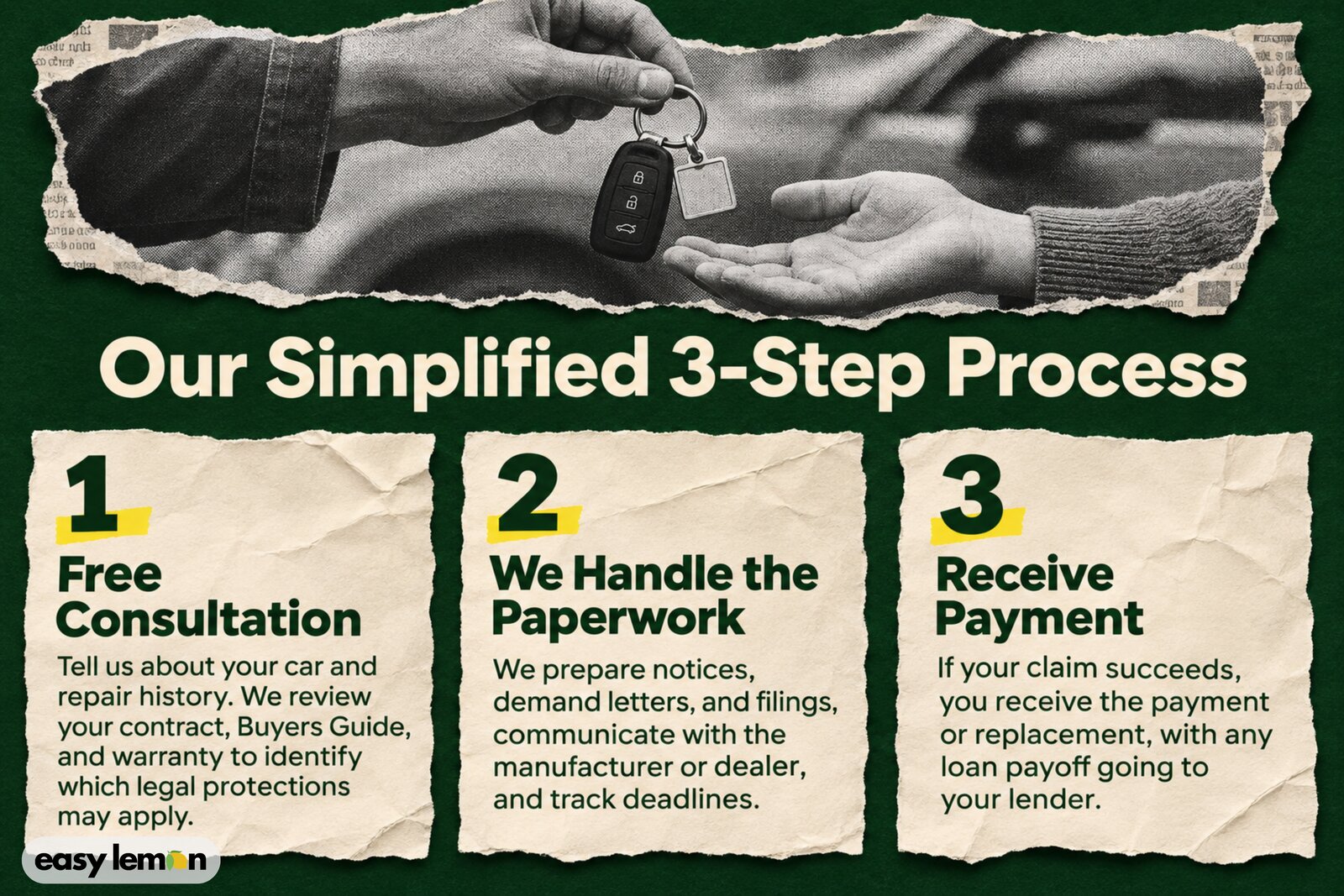
Most used car clients arrive with a stack of repair orders and no idea which law applies. Here's how we sort it out.
1. Free Consultation
Tell us about the car, the problems, and the repair history. Our attorneys review your contract, Buyers Guide, and warranty to see whether your vehicle qualifies under the lemon law or another statute.
2. We Handle the Paperwork
We prepare the notices, demand letters, and filings, and we deal with the manufacturer or dealer for you while we track the deadlines.
3. Receive Payment
If your claim resolves in your favor through a settlement, award, or judgment, the payment or replacement goes to you, and any loan payoff goes to your lender.
Benefits of Hiring a Georgia Lemon Law Attorney
The state's arbitration program is free, but used car claims don't fit it, and the other routes have procedural traps. A Fair Business Practices Act demand letter has to describe the deceptive act and your injury, and rejecting a reasonable settlement offer can cut off later fee recovery. Magnuson-Moss claims turn on the warranty's exact terms.
Our attorneys focus on lemon law and warranty claims, and you pay no attorney's fees unless we recover for you. Where the law allows fee shifting, as under Magnuson-Moss and the Fair Business Practices Act, or in a lemon law arbitration award, we ask that the manufacturer or dealer pay those fees. Many buyers first learn how lemon law for used cars works when a dealer's "as is" sticker turns out to have limits.
Compensation for a Defective Used Car in Georgia
The lemon law has a buyback formula for eligible vehicles. Used car warranty and fraud claims usually end in a settlement or court damages.
Full Refund
When the lemon law applies, a buyback covers the purchase price, collateral charges such as sales tax and finance charges, and incidental costs like towing. The manufacturer subtracts a reasonable offset for use: purchase price times miles driven before the first repair visit, divided by 120,000. If you're still making payments, the money is paid to you and your lender, such as a bank or credit union, according to its lien. A refund for used cars is either done via some kind of settlement or through an order from a court reversing the sale.
Cash and Keep Settlement
Many lemon law cases end with a negotiated payment while you keep the car. It varies depending on what the defect is, how many repairs have been done already, and also considering the total price of the car, including monthly installments and interest rates. It's a negotiated result, not a statutory remedy.
Vehicle Replacement
Under the lemon law, the owner of an eligible vehicle can choose a replacement that's identical or equivalent, and the manufacturer pays the incidental costs and transaction charges. If you lease, the lease terms transfer to the new vehicle. When it comes to used cars, what you're negotiating is replacing something.
Talk to a Georgia Lemon Law Attorney About Your Used Car
Bring over all of the repair orders and the contract, Buyer's Guide, if your car is consistently coming back to the shop for the same issue. During a free evaluation, we review them and explain what Georgia or federal laws might apply. There's no attorney's fee unless we recover for you.
Georgia Lemon Law Used Cars FAQ
Here are some of the questions Georgia drivers regularly ask us about cars that don't get fixed properly. If you bought your car new, a Georgia lemon law attorney can walk you through the state arbitration route.
Does Georgia's lemon law cover used cars?
Generally, no. Whether you bought a new or used car, the law looks at the title, and it only covers vehicles first titled to the buyer. A demonstrator titled as new is the one exception. If your used car has an active warranty, Magnuson-Moss may apply, and the FTC Buyers Guide and the Fair Business Practices Act can also help.
Can I return a used car in Georgia?
There is no cooling-off period for buying cars in Georgia. You can return a car only if the dealership agreed to a return policy in writing, or if a settlement or court unwinds the sale for fraud or breach of warranty.
Is a used car still under the factory warranty covered?
It's not under Georgia lemon law. The manufacturer still has to honor the warranty for later owners, subject to its transfer terms. Repeated failed repairs can support a Magnuson-Moss claim.
What if I bought my used car from a private seller?
The lemon law and the FTC Used Car Rule don't apply, and private sales are usually "as is." If the seller knowingly lied about the car's condition or rolled back the odometer, you may have a fraud or odometer claim.
Does a test drive or an "as is" sale waive my rights?
A test drive waives nothing. An "as is" sale with a proper Buyers Guide generally waives implied warranties. It doesn't cancel a factory warranty that's still running, and it doesn't make a dealer's deceptive statements legal.
Can I sue a dealership for selling me a lemon used car?
Okay, if the facts back that up. Claims against a dealer usually arise from either breaches of warranty, the Fair Business Practices Act, or fraud. The lemon law only reaches dealers for undisclosed buyback resales.
How many repair attempts make a car a lemon in Georgia?
For an eligible new vehicle: three attempts for the same nonconformity, one repair for a serious safety defect, or 30 days out of service, all within the rights period. After that, you send written notice and the manufacturer gets a final repair attempt, unless the 30-day route applies.
How long do I have to file a Georgia lemon law claim?
The arbitration application is due within one year after the rights period ends. Warranty, fraud, and Fair Business Practices Act claims have their own deadlines, and odometer claims must be filed within two years, so don't wait.
How do I know if my used car was a lemon buyback?
Georgia requires a clear written disclosure of the buyback and the defect before resale, plus a one-year or 12,000-mile manufacturer warranty on that defect. Make sure you review your sales paperwork and a vehicle history report.
This page contains lawyer advertising. This document provides general information about Georgia and federal law and does not provide legal advice. Every case depends on its specific facts and results differ. Past results don't predict future outcomes. Reading this page or contacting Easy Lemon will not create an attorney-client relationship.
What Our Clients Say
Read More Relevant Blogs

How to File a Lemon Law Claim in Georgia
A Georgia lemon law claim starts inside the Lemon Law Rights Period, which runs the earlier of two...
Read Full Post →
Georgia Lemon Law Attorney Fees: Who Pays?
In Georgia, whether the manufacturer pays your attorney fees is a decision the arbitrator makes, not an automatic...
Read Full Post →
Does Georgia Have a Lemon Law?
Georgia does have a lemon law, and it lets owners of defective vehicles seek a refund, a replacement...
Read Full Post →Resolving Your Lemon Law
Case Has Never Been Easier
Our experienced attorneys handle everything — from paperwork to manufacturer negotiations. You focus on your life, we'll get you results.
