







Vehicle Recall Laws: What Every Car Owner Needs to Know
 By Liam Jones
Attorney Advertising.
Vehicle recall laws require automakers to notify owners and repair safety defects or emissions failures at no cost. The NHTSA investigates safety defects under the National Traffic and Motor Vehicle Safety Act, while the EPA handles emissions problems under the Clean Air Act. Owners typically get a free repair, replacement, or refund minus depreciation, though that free guarantee has its own age limit.
At Easy Lemon, our lemon law team has recovered more than $50 million for consumers across more than 3,000 cases, helping drivers nationwide. With years of experience handling vehicle recalls, we know how to hold manufacturers accountable and maximize available remedies under state lemon laws. If there's an issue with a recall repair job, get in touch with us today for a free case review.
Past results do not guarantee future outcomes.
This article explains the notification deadlines, the free repair window, the EPA's separate role, and what to do if your vehicle is affected.
The Federal Law Behind Every Vehicle Recall
Vehicle recall laws for vehicles go back to the National Traffic and Motor Vehicle Safety Act, which is a federal law that Congress signed in 1966. Congress wanted to protect drivers from cars with known safety issues. That same goal still motivates every recall to this day. Congress strengthened the statute in 2000 with the TREAD Act after a run of tire failures. Those failures revealed gaps in the way automakers reported defects to the federal government.
Today, the rules are in place in 49 U.S.C. Chapter 301. They handle both motor vehicles and replacement parts and apply if there's any safety defect in a vehicle. They also apply if a vehicle fails to meet standards set by the Federal Motor Vehicle Safety Standard. A defect can appear in a single component or across an entire line of vehicles that share the same design.
For a long time, NHTSA has treated airbags, brakes, steering components, and fuel systems as typical causes of safety issues. Defective parts can appear together in different years of the same model. According to federal law, if there is a problem that meets legal standards and poses a risk to safety, then the manufacturer is to take action.
Who Actually Issues a Recall?
Not all auto recalls happen in the same way. The agency responsible for a recall varies depending on the nature of the problem the vehicle has. A vehicle manufacturer finds most of the defects on its own and notifies the National Highway Traffic Safety Administration directly (NHTSA). The NHTSA can also open an investigation and order a recall if they think a vehicle is unsafe according to them. A separate track exists for emissions problems, and the vehicle recall process looks different once the Environmental Protection Agency gets involved instead of NHTSA.
Why Some Recalls Come From the EPA Instead of NHTSA
Safety defects and emissions defects fall under two different federal laws. Mixing them up is one of the most common mistakes in recall reporting. NHTSA's authority covers brakes, airbags, steering, and fuel system fires, the kind of safety issue most drivers picture when they hear the word recall.
The Environmental Protection Agency derives its authority from a different statute called the Clean Air Act. That statute deals with vehicles that start failing to meet emission standards when they are actually driving on roads. A single car can in theory face both kinds of recalls for two unrelated problems. Different agencies, statutes, and processes that support them do not overlap.
Voluntary Recalls Versus a NHTSA-Ordered Recall
Most recalls of vehicles are done voluntarily. A manufacturer issues the recall after deciding on its own that a defect exists, without NHTSA having to order anything. The NHTSA can also launch its investigation based on reports of a pattern of complaints. Even if the manufacturer disputes that there is a problem, NHTSA can still hold a hearing and order the recall anyway through a process called final decision.
NHTSA also maintains a running recall database that is partly based on consumer complaints. That database is one of the main ways new defect patterns and real safety problems get flagged early. Higher volume manufacturers like General Motors show up more frequently simply because more of their vehicles are on the road.
How You Get Notified, and How Long That's Supposed to Take
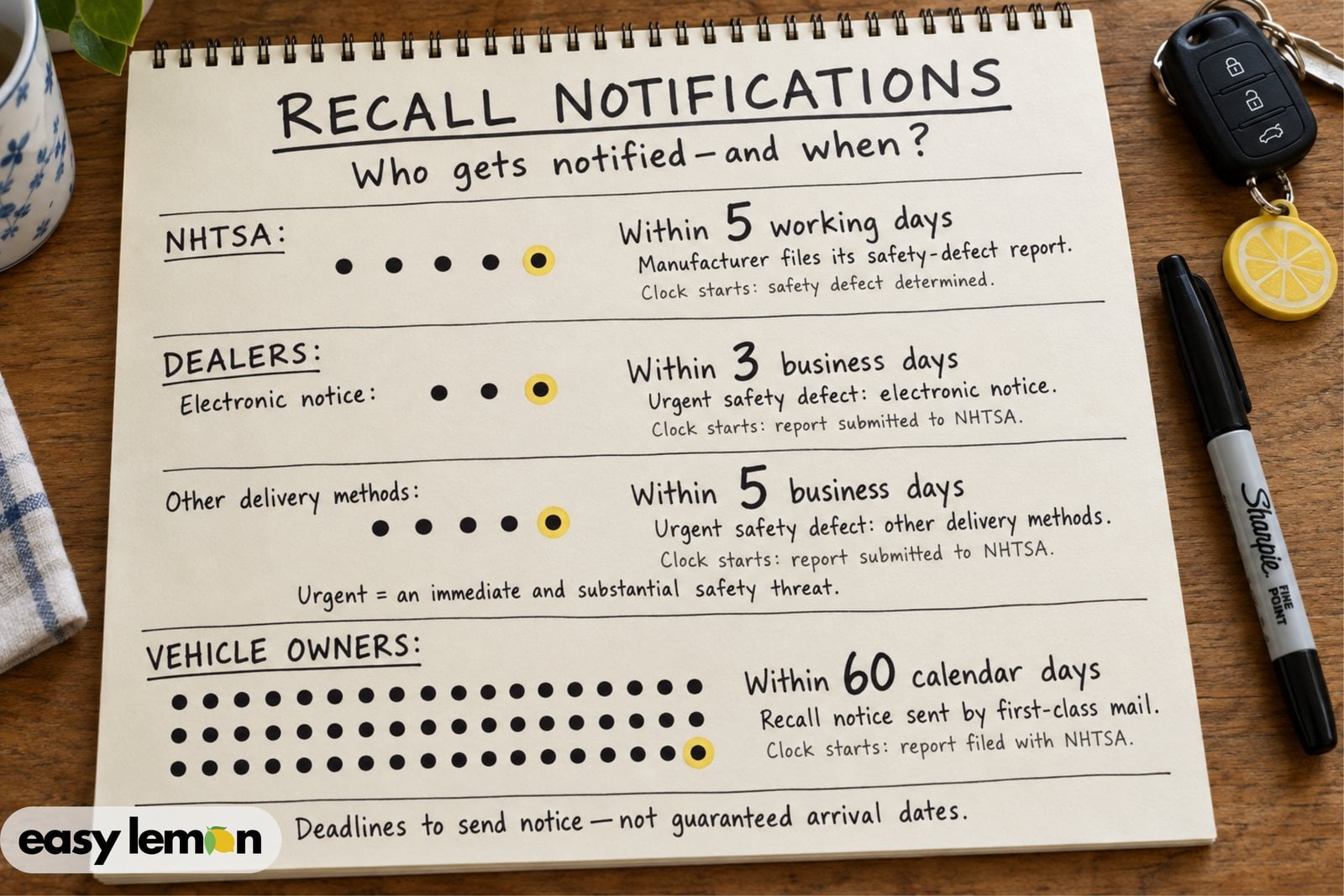
A recall notice has to reach three different audiences, and each one operates on its own deadline. People often compress these into a single "notified within five days" rule. This number does not hold up well for any of those three groups. The table below breaks out who gets notified, how fast, and which regulation sets the clock.
Owners are at the end of that chain, not the beginning. That is why a notice can feel slow even when the manufacturer has already acted quickly. Once you receive a recall notice in the mail, it has to include a clear description of the defect and the risk it poses. That requirement comes from 49 U.S.C. § 30119, which also requires the notice to state the date a free remedy becomes available.
Owners of affected vehicles who don't have contact information listed with state registrations are still getting timely notification as well. Notice usually goes instead to the most recent purchaser on file. Owners who lease their vehicle get their own copy of the same notice too.
What a Free Remedy Actually Covers
Federal law provides manufacturers with three ways to fix recalled vehicles, and ultimately the decision rests with the manufacturer, not the owners. It imposes a deadline by which that fix will then be free. More car owners trip over this limit than any other part of vehicle recall laws.
Repair, Replacement, or Refund Minus Depreciation
Under 49 U.S.C. § 30120(a)(1), a manufacturer must repair the vehicle or replace it with an identical or reasonably equivalent vehicle. A third option is to refund the purchase price, less a reasonable allowance for depreciation. That same idea, the purchase price minus a reasonable allowance for depreciation, applies if a repair attempt fails too. The statute considers the 60-day window as a reasonable repair period unless NHTSA grants an extension. None of these three options will have charges for parts, labor, or any diagnostic fee.
The 15-Year Cutoff on Free Repairs
An open recall never runs out on its own when it comes to safety. The responsibility of manufacturers to eventually fix the defect does not disappear even if a vehicle gets older. The free remedy is no longer available after 15 calendar years have elapsed since the vehicle's first owner made the purchase, as stated in 49 U.S.C. § 30120(g)(1).
For a tire, that window of time lasts 5 calendar years. The clock for sales starts ticking right from the first sale and does not restart even if something is sold again later. A recalled car well past that window can still carry an active recall, just without the free repair guarantee.
Can a Dealership Sell You a Car With an Open Recall?
New vehicle dealers do not get a say in this either. Under 49 U.S.C. § 30120(i), a dealer cannot deliver a new car under a sale, lease, or rental agreement while a known recall sits unrepaired. Once they are notified, large rental fleets face a similar deadline. Dealerships for used cars are a different matter, and this provision is the part of vehicle recall laws that surprises consumers the most. Federal law doesn't prevent sales of used vehicles that still have recalls outstanding; this provision is often referred to as a loophole for used cars.
The Used Car Safety Recall Repair Act Bill would close that gap for dealers who sell lots of vehicles each year if it is passed. Some states regulate used car dealers more stringently compared to federal laws. A dealer's own recordkeeping duties also tend to be narrow, tied to the specific vehicles in its possession rather than a sweeping documentation requirement.
Getting Reimbursed for a Repair You Already Paid For
Many owners end up paying to resolve a problem long before they receive any recall notices. This frequently happens when a dealer diagnosed something during routine service visits. Consumer law under federal law applies there too. Under 49 U.S.C. § 30120(d), a manufacturer's remedy program must include a plan to reimburse vehicle owners who paid for the repair. That plan has to cover owners who paid ahead of the manufacturer's notice.
The statute defines a reasonable timeframe both through regulation and according to each manufacturer's submitted plan of remedy. The number of days varies from one recall campaign to another. Owners should keep repair receipts and read the notice carefully for the exact reimbursement terms related to their vehicle.
How to Check If Your Vehicle Is Under Recall

Once you suspect your car has been recalled, checking it takes only a few minutes, and it costs nothing. Find your Vehicle Identification Number (VIN). It is a string of 17 characters that is stamped near the windshield on the dashboard. Then enter that number into a VIN lookup tool such as the National Highway Traffic Safety Administration NHTSA recall page or Easy Lemon's recall search page. Both draw from the same data that has been recalled in the federal recall database. After you submit the VIN, the tool returns every open recall tied to that specific car. It also shows the description of the defect and whether a remedy is currently available.
If you get results showing that you need a recall, then the final step is contacting an authorized dealer to set up a time to fix the thing. The dealer is the one who resolves the problem at no charge. Before signing anything, buyers should run these same checks on used cars.
What a Technical Service Bulletin Is, and Why It Isn't a Recall
At first glance, a technical service bulletin looks like a recall for cars, but the two are different in law. Service bulletins for cars exist because manufacturers give repair instructions for recurring issues that never rise to the level of a safety defect. The NHTSA stores technical service bulletins in a separate database that is distinct from the database for recall information. A bulletin is sent only to dealers and techs that describes a known repair procedure for a specific vehicle part rather than a mandatory remedy.
Manufacturers do not have to notify owners about a bulletin or provide a free fix. Unless they are still covered under warranty, dealers can charge full price for repairing parts that have bulletins related to them. Although it is uncommon, if a significant issue arises in a bulletin, NHTSA will eventually initiate an investigation that could lead to a full recall. Rules for free repairs kick in at that point. If a dealer mentions a bulletin after you ask about a recall, it is worth asking a follow-up question. Find out if the fix comes as part of an open recall or only by your warranty.
When an Unrepaired Recall Turns Into a Lemon Law Case
A recall and a lemon law claim are not the same thing, but they can overlap. State lemon laws and the federal Magnuson-Moss Warranty Act generally ask whether a vehicle's nonconformity was fixed within a reasonable number of attempts or days. An open recall defect a manufacturer cannot or will not fix is a textbook example of that kind of nonconformity. Pursuing the federal recall remedy does not give up any separate lemon law rights, and the two tracks can run side by side.
A car does not automatically qualify as a lemon based on a specific number of recalls. Every state's statute weighs the facts a little differently. Attorneys who handle vehicle defect cases look at the full repair history rather than a single number.
What Happens When a Manufacturer Doesn't Comply?
Manufacturers that ignore their notification or remedy duties face real financial consequences, not just strong correspondence. Under 49 U.S.C. § 30165 rules, NHTSA can get a civil penalty of up to $27,874 for each violation. For related repeated violations, the limit is $139,356,994, adjusted for inflation and currently in effect for 2026. NHTSA has collected penalties in that range before. Fiat Chrysler paid a $105 million penalty in 2015, and Hyundai and Kia paid a combined $210 million settlement in 2020.
The NHTSA can also instruct manufacturers to move faster if they are proceeding too slowly regarding a remedy program. If there's a high risk of serious injury or death due to this delay, then the penalty will occur. Separately, an injury or property damage already caused by a defective vehicle can sometimes support an independent product liability claim against the manufacturer. This is especially true when defective parts were known, and the fix was delayed.
That kind of case is fact-specific and varies significantly from state to state. It should be looked at carefully on an individual basis rather than relying solely on a recall notice. A consumer in that position may be looking at medical bills and property damage the recall remedy itself was never designed to cover.
Frequently Asked Questions
Car owners regularly ask the Easy Lemon's lawyers the same questions every week when they get a recall notice in the mail. The answers below cover the most frequently asked questions about vehicle recall laws, drawn directly from the federal rules discussed above.
How Do I Know if My Car Has an Open Recall?
Enter your 17-character Vehicle Identification Number into either of the tools: NHTSA recall lookup or Easy Lemon's own recall search page. If there is any open recall for that VIN number, it appears immediately.
Do I Have to Pay for a Recall Repair?
No, that is not true if the remedy is still within its free repair period. Manufacturers must repair, replace, or refund the purchase price after deducting depreciation without charging the owner.
Does a Recall Repair Stay Free Forever, or Does It Expire?
The recall itself never expires, but there is a deadline for free repairs. The free remedy runs out if more than 15 calendar years have elapsed since the vehicle's first retail sale.
Can a Dealership Sell a Car With an Open Recall?
A new vehicle dealer cannot legally deliver a new car with an unrepaired recall. A used car dealer currently faces no such federal ban, a gap often called the used car loophole.
What Is the Difference Between a Recall and a Technical Service Bulletin?
A recall involves a safety or emissions defect, mandatory owner notice, and a free fix. A technical service bulletin is repair guidance that is sent only to dealers, but there is no requirement that this information be provided free of charge.
Who Regulates Vehicle Recalls, NHTSA or the EPA?
Both of these agencies play different roles, but they do so differently. NHTSA regulates safety recalls under Title 49, while the Environmental Protection Agency handles emissions nonconformity under the Clean Air Act.
Can I Get a Refund Instead of a Repair?
The choice of repair, replacement, or refund belongs to the manufacturer, not the owner. One of three options that federal law allows is to receive a refund minus depreciation according to reasonable allowance.
What Is the Difference Between a Voluntary Recall and One Ordered by NHTSA?
Most recalls occur when manufacturers decide on their own that there is a defect and then report this decision. After an investigation by NHTSA, there are fewer things that occur when they disagree with what the manufacturer's actions and subsequently order a recall after going through a hearing process.
Can I Get Reimbursed if I Already Paid to Fix the Defect Myself?
Often yes, since federal law requires every recall remedy program to include a plan for reimbursing owners who already paid for the repair.
Does an Open Recall Affect My Lemon Law Rights?
Opening up a recall process does indeed impact people's rights. An unrepaired recall defect is often treated as evidence of a nonconformity, which is exactly what state lemon laws and the Magnuson-Moss Warranty Act address.
Ready to Find Out if Your Vehicle Has an Open Recall?
Vehicle recall laws for vehicles provide real legal rights, not just polite recommendations from the manufacturer. Those rights only help if you use them, starting with a quick VIN check and a read of any recall notice in your mailbox. If a dealer refuses to help, or a repair does not resolve the problem, you do not have to accept that as final.
Our lemon law attorneys have recovered more than $50 million for consumers across more than 3,000 cases, including a recent $160,264 recovery for a BMW X6 owner. We take these cases on a contingency basis, so clients generally pay no attorney fees unless the firm recovers money for them. Contact us today to have an attorney review both your specific recall notice and your vehicle's full repair history for your car.
Past results do not guarantee future outcomes.
Legal Disclaimer
This article is for general informational purposes only and does not serve as legal advice. Reading this article or speaking with either Easy Lemon or RockPoint Law P.C. does not create an attorney-client relationship. State recall and lemon laws differ, and prior results do not guarantee success in any future cases.
What Our Clients Say
Read More Relevant Blogs

Jeep Cherokee Transmission Problems Lemon Law Overview
Jeep Cherokee transmission problems may qualify for a lemon law buyback or replacement when the same defect survives...
Read Full Post →
Jeep Dealer Refuses Repair? Know Your Warranty & Lemon Law Rights
If a Jeep dealer refuses to fix something you need fixed, write down that denial and keep track...
Read Full Post →
Jeep Wrangler Death Wobble Lemon Law Filing Rights in 2026
Jeep Wrangler owners experiencing death wobble may have Lemon Law rights if the defect substantially impairs safety, value,...
Read Full Post →Resolving Your Lemon Law
Case Has Never Been Easier
Our experienced attorneys handle everything — from paperwork to manufacturer negotiations. You focus on your life, we'll get you results.
