








Florida Lemon Law Used Vehicle: Does It Qualify?
 By Ron Kaniuk
Florida Lemon Law can cover a used vehicle if it is still within the original 24-month Lemon Law rights period from its first delivery to the original owner. The rights transfer with the vehicle, so buying a used car does not automatically eliminate Lemon Law protection. The vehicle must also meet Florida's other eligibility requirements, including having a qualifying defect covered by the manufacturer's warranty. If the vehicle is outside the 24-month period, Florida's Lemon Law generally will not apply, though other warranty remedies may still be available.
At Easy Lemon, our lemon law team has recovered more than $50 million for consumers and handled 3,000+ cases‡ nationwide, helping clients pursue buybacks and cash settlements. Outcomes turn on the statute, the purchase price and the use offset rather than on any typical figure. We know how to hold manufacturers accountable and pursue the remedies available under state lemon laws. If you're stuck with a defective vehicle, contact us today for a free consultation.
In this guide, we cover all of the Florida Lemon Law used vehicle requirements. We also discuss if the Florida Lemon Law covers all used cars and give you tips if you plan to file a claim.
What Is the Florida Lemon Law for Used Vehicles?
Florida Lemon Law applies primarily to new cars. Most claims involve new vehicles, but the law's basic criteria do cover certain used vehicles as well. For something to qualify as a defect, it has to substantially impair the car's use, safety, or value. And the car also needs to still have an original manufacturer warranty in place.
In our experience, the Florida Lemon Law applies for the first 24 months. In addition, drivers must give a reasonably accessible repair facility the chance to fix the issue. Depending on how serious the defect is, the facility might need to try fixing it several times. Florida's Lemon Law does not give used-car buyers a separate 30-day window. A used vehicle can be covered only while it is still inside the original 24-month Lemon Law rights period, counted from delivery to the first owner; outside that period, a remaining manufacturer's or dealer warranty or the Magnuson-Moss Warranty Act may still help.
Most used cars in Florida are sold "as is," which means buyers are responsible for any repairs needed after purchase. Knowing which of three paths applies to your car before you build a file is useful. The table below compares them.
Based on our experience, a warranty offered by a dealer might cover some repairs for a used car purchased from a licensed dealer. A written warranty can open up avenues under the Magnuson-Moss Warranty Act where Chapter 681 has otherwise closed them. Under Magnuson-Moss, consumers have the right to take their vehicles to independent repair shops without voiding warranties. Thus manufacturers cannot require service only through dealers.
What If I Bought a Pre-Owned Vehicle in Florida?
Just because you buy a used car doesn't automatically mean you can use Florida Lemon Law. Even if the car is fairly recent and still under warranty, that doesn't necessarily give you protection through Lemon Law. Florida's Chapter 681 Lemon Law typically applies to new motor vehicles and certain demo vehicles rather than regular used ones. The main issue then is not just the age of the car, but how it was defined and classified at first sale and whether any warranties or other legal rights still apply to the owner.
Suppose you buy an SUV that is two years old from a licensed dealer in Florida and discover a serious transmission problem shortly after the sale. Just because the warranty is still good doesn't automatically make the used car a Chapter 681 Lemon Law vehicle. Instead, you might want to check the warranty from the manufacturer, any dealer warranty as well, read through the Buyers Guide, look at your contract of purchase, and also consider federal warranty protections.
It's important because even if a car has warranty coverage, you still won't be able to get a Florida Lemon Law buyback just because of that. Before assuming that Chapter 681 applies, an owner of a vehicle should review the original purchase documents, warranty terms, title history, and repair records.
If you're not sure if your car qualifies, start by checking if it was originally sold as brand new; find out if it was ever used as a demo unit; determine whether the title has been transferred to a final buyer; and see what kind of written warranty was valid at the time the defect showed up.
The 3-Path Test for a Florida Defective Used Vehicle
When a used car turns out to have a major defect we conduct a three-path test before deciding on the legal recourse to pursue. We have found this method to be very efficient in pursuing claims.
Path 1: Florida Lemon Law. First, decide if the vehicle falls within Chapter 681's definition of a covered motor vehicle. Florida's statute generally deals with new vehicles and specifically targets vehicles that are dealers' demonstrators or certain leased vehicles. The 24-month Lemon Law rights period starts from the date of original delivery so the date of purchase for the buyer is not necessarily the important one.
Path 2: Warranty claim. If the vehicle is purchased used but still has any manufacturer warranty or dealer warranty or service contract, review that written coverage separately too. A warranty can create rights even when Chapter 681 does not apply. The Magnuson-Moss Warranty Act may also provide a federal remedy for certain breaches of written warranties, including potential recovery of attorney fees when the statutory requirements are satisfied.
Path 3: As-is purchase. If the vehicle was sold as-is and no applicable written warranty or other legal protection covers the defect, the buyer may have fewer warranty-based remedies. The FTC recommends reviewing the Used Car Buyers Guide and understanding whether the dealer sold the vehicle with a warranty or as-is.
Through our experience, we have seen that this framework helps avoid a common mistake of just automatically classifying any used car with issues as a case under Florida Lemon Law. The correct legal route depends on several factors, including the original status of the car, warranty paperwork, terms of sale, history of defects, and history of repairs.
A One-Year-Old Pre-Owned Vehicle With a Major Defect
A car owner purchases a pre-owned sedan that is only one year old from a licensed dealer in Florida. Within the first month of ownership, the transmission starts slipping and the car struggles when accelerating. The owner brings the car back to the dealership repeatedly for repairs but the problem continues. In addition to repair costs, the owner also spends money for towing services and other related expenses.
Just having a lot of service visits doesn't mean you have a claim under Florida Lemon Law. The owner needs to first figure out if the car is actually protected by Chapter 681 or if it was sold as a used vehicle outside the statute. Then the owner should review the vehicle history report along with the Buyers Guide, purchase contract, manufacturer warranty, dealer warranty, repair orders and any service-contract documents.
Different legal options can result from the same facts depending on those documents. For an ordinary used car, you might look into warranty claims or a Magnuson-Moss Warranty Act claim instead of a Chapter 681 claim. If the vehicle is legally classified as a new or demonstrator vehicle, then the Florida Lemon Law analysis might be different. That's why the first step isn't just tallying up how many repair attempts there have been. It is figuring out which specific law applies to this vehicle.
How Does the Florida Lemon Law for Used Vehicles Work?

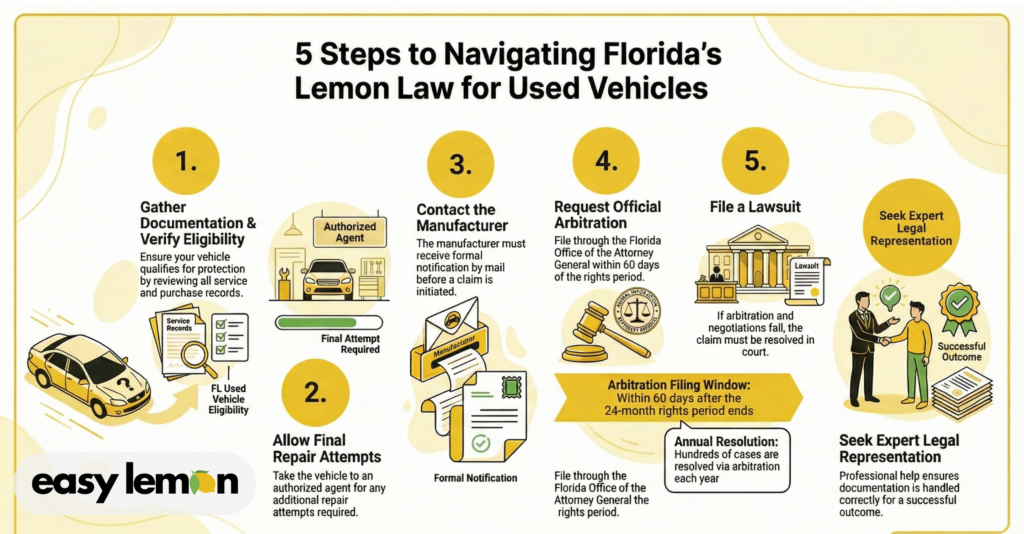
Working with an experienced lawyer really helps if you file a lemon law case in Florida. Most lawyers follow these steps when they begin to file a claim.
Step 1: Confirm the Vehicle is Within the Rights Period.
Find when the vehicle was originally delivered to its first owner, not when you purchased it, because the 24 months start running from that original delivery date. Your contract of sale and the receipt from the manufacturer can establish both those dates for you.
Step 2: Gather Repair Records.
Each time you encounter a problem with the vehicle, take it to an authorized service center. Each time you go there, collect a repair order that includes the date, mileage reading, description of the symptom and what they did. Even if they can't reproduce the fault, visits count and the law looks at recurring nonconformities.
Step 3: Send a Written Notification.
Based on our experience, there are two main triggers that activate this procedure: if the same defect has gone through three repair attempts or if the car has been out of service for 15 days, notify the manufacturer in writing. Use the state's Motor Vehicle Defect Notification form. Send the letter via registered mail or express mail and keep a copy of the receipt. Then, within about 10 days from when they direct you to an accessible repair shop, the manufacturer gets one last chance to fix it.
Step 4: Fulfill the Presumption.
The law presumes a reasonable number of attempts have been made in two situations. Either something is still wrong after four attempts or the vehicle has been out of service for a total of 30 days. Longer periods apply to recreational vehicles and any living spaces inside the RV are not covered.
Step 5: Arbitration.
Someone who qualifies for relief files a case with the Florida New Motor Vehicle Arbitration Board through the Attorney General's office. The deadline is 60 days after the Lemon Law rights period expires. Usually the Board hears cases within about 40 days. If the rights period was interrupted by war, invasion, strike, fire, flood, or another natural disaster, that time does not count against you.
What Are the Key Requirements for a Lemon Law Case?
To be eligible, four things have to be true. At the time the defect appears, the car must still be under the original factory warranty. For something to qualify as a defect, it has to substantially impair the use, value, or safety of the car. That defect has to fit under the terms of that warranty and not fall outside of it.
Before you file any claims, the problem needs to show up within the 24-month Lemon Law rights period starting from when the car was originally delivered and there is no mileage limit either. Also, before filing any claims, the manufacturer or its authorized repair shop must have been given a reasonable number of repair attempts. Coverage is also determined based on how the vehicle is used because this law only applies to those that buy cars for personal or household use rather than commercial purposes.
Carefully document any defects and pay attention to time limits too. We've found that to qualify under Florida lemon law, used vehicles must meet warranty, defect, and repair attempt requirements.
What Are Common Challenges and Solutions?
One of the biggest hurdles in handling defective vehicle cases is figuring out what legal path to take before you focus on the car's repair history. An owner of a car might encounter some major mechanical issues that lead to multiple repairs, but still not have a Chapter 681 claim if they bought the car as a regular used car instead of a covered new or demo vehicle.
In our experience, the strongest initial review starts with the paperwork. Collecting documents such as vehicle history reports, sales agreements, Buyers Guide, warranty booklets, service contracts, repair orders, invoices and letters to dealers, manufacturers, or insurance companies or warranty administrators helps us figure out when the car was bought, how it was sold, whether there was any warranty involved, what problems arose and how long the car stayed at the repair shop.
It's really important to pay special attention to repair orders. Keep careful records of each repair attempt for your claim. Record things like when you made the repair attempt, the mileage, what problems you reported, what the diagnosis found, what parts were changed, and how much those repairs cost. Also note if the car came back because the same issue kept showing up. An order that just says that the customer was concerned can look quite different than one that details a recurring transmission, electrical, braking, or engine defect.
Another common confusion involves mixing up warranty coverage with Lemon Law coverage. A manufacturer may still have to honor a written warranty even when Chapter 681 does not offer a statutory buyback remedy. Conversely, an as-is purchase may leave the vehicle owner with significantly fewer warranty remedies.
Finally, don't ignore small expenses. Under Florida's Lemon Law guidance, there are some reasonable incidental costs that can be included; this includes things like renting a car, towing fees, deductibles under warranties and repair costs. Collateral costs can include related expenses such as title charges. Keep all receipts for those expenses instead of just thinking they are insignificant.
Florida used car owners can improve their chances at getting a successful Lemon Law claim if they anticipate these challenges and take proactive steps. Since an average cost for hiring an attorney in Florida is about $350 per hour according to the Florida Bar, people tend to hesitate to hire a lawyer. Under section 681.112(1) of the Florida Lemon Law, consumers who win recover reasonable attorney fees and other costs from manufacturers.
"The Florida cases we cannot save are almost always the ones where nobody sent the notification form. Owners assume that four trips to the dealer speak for themselves. Under Chapter 681, the manufacturer is entitled to one final attempt after written notice, and if it never received that notice, it has a clean answer to the whole claim."
Steven P. Nassi, Founder and Managing Partner at Easy Lemon
What Are the Benefits of Filing a Lemon Law Claim?

Successful Florida lemon law claims may result in a refund, replacement vehicle, or financial compensation. Whether you are filing for the Florida Jeep Lemon Law or another manufacturer, there are benefits to filing your claim. Here are a few to consider.
Florida offers two statutory remedies, and the consumer can choose a refund rather than a replacement. A refund returns the full purchase price along with the trade-in allowance, finance charges, sales tax, and title and registration fees. Incidental costs such as towing or a rental are included. A reasonable offset applies for the miles driven up to the settlement or the arbitration hearing, whichever comes first.
A replacement will provide a new vehicle that is comparable and has the same offset applied to it. Beyond just the remedy itself, prevailing consumers also recover reasonable attorney fees and other costs from the manufacturer under section 681.112(1). So pursuing the claim does not reduce what you receive.
Having a serious defect doesn't automatically mean that a used car is subject to Florida Lemon Law. Chapter 681 has specific definitions and eligibility requirements. Also, Florida's Attorney General explains that the state's Lemon Law applies to defects in new and demo vehicles and not regular used cars.
It doesn't mean that someone who owns a used vehicle has no legal recourse. There could be different protections available through things like manufacturer warranties, dealer warranties, service contracts, and federal protections too. For example, the Magnuson-Moss Warranty Act can provide relief for some violations of warranties and may allow recovery of reasonable attorney fees and court costs if you win.
There is a trade-off here though; the other options don't offer exactly the same solutions, processes or presumptions as Florida's Lemon Law. So before you decide to go through arbitration or file a lawsuit, make sure you know what kind of warranty you have, the car's original status, the applicable deadlines, and what documentation supports your case.
What Happens at Florida Lemon Law Arbitration?
The Florida New Motor Vehicle Arbitration Board is run through the Attorney General's office. It's not optional if you want to enforce Chapter 681. Under the Lemon Law, a consumer must go through the board before filing suit, which is different from simply being encouraged to try it.
Filing is free for consumers. The Board reviews the request and decides if the dispute is eligible. They schedule a hearing usually within about 40 days. Both sides put forward evidence at this hearing. Most of the work is done by the repair orders. If the decision comes out in favor of the customer, then the manufacturer must give a refund or a replacement within 40 days.
People who want to check eligibility before filing can call the State Lemon Law Hotline at 1-800-321-5366. This hotline deals with procedural questions and verifies if a car falls within the rights period but does not provide legal advice for a specific claim.
Ready to File a Florida Lemon Law Claim for Your Used Vehicle?
Understanding Florida's Lemon Law for used vehicles is really important if you're dealing with problems that don't go away. Understanding what your rights are and how to proceed helps you deal confidently with any concerns. Let Easy Lemon show you the way through this process.
Our team at Easy Lemon is here to help with any questions you might have. You can look us up on Google and read reviews from past clients too. Contact us now to schedule a free consultation.
Frequently Asked Questions
If you own a car with repeated problems, you may have questions about your rights under the Florida Lemon Law used vehicle compensation rules. This FAQ explains how affected owners can seek refunds, replacements, or other remedies. Keeping detailed records of all repair services is key to supporting your claim and making the process smoother.
What Are the Requirements for a Florida Lemon Law Used Vehicle Claim?
To file a Florida Lemon Law used vehicle claim, the car must have a substantial defect that affects safety, value, or use. Problems with electrical systems or other major components must occur while the vehicle is still under warranty, and the dealer or manufacturer must have had a reasonable number of repair attempts. Keeping detailed repair records is essential.
How Long Do I Have to Report a Florida Lemon Law Claim for Used or New Cars?
You must report a Florida Lemon Law claim after your last attempt at repairs for the same defect. The law requires you to notify the dealer or manufacturer in writing, so be sure to document the issue and your repair history carefully before sending that letter. Prompt action is important because it helps you to protect your rights whether you have a used car or a brand new one.
Does the Magnuson Moss Warranty Act Work With Florida Lemon Law?
Yes, the Magnuson-Moss Warranty Act can work alongside the Florida Lemon Law for a new vehicle or a used car still under warranty. Under this act you have the right to seek legal remedies in federal court if the manufacturer fails to honor the warranty; this is even if you've already gotten a decision through arbitration based on state law.
Do I Need an Attorney When Florida Lemon Law Covers My Defective Vehicle?
Having an attorney is not always necessary but they can be very useful when dealing with complicated legal matters. Many owners begin by calling the lemon law hotline for guidance. If the matter moves forward into arbitration or if negotiations with the manufacturer get tough, then having an attorney on board can really help out.
Are There Exemptions to the Florida Lemon Law for Used Cars?
Yes, there are exceptions. Generally speaking, Florida Lemon Law does not apply to off-road vehicles and problems that result from failure to do regular maintenance as specified in the owner's manual.
Legal Disclaimer: This article is provided for general informational purposes only and is not legal advice. Reading it or contacting Easy Lemon does not create an attorney-client relationship. Eligibility, deadlines, and remedies under Florida's Lemon Law, Chapter 681 of the Florida Statutes, depend on the specific facts of each vehicle, including the defect, the repair history, and the date of original delivery to the first owner. Used vehicles are covered only while inside the original 24-month Lemon Law rights period. Statutes and procedures change over time. Past results do not guarantee future outcomes. For advice about your own vehicle, consult a licensed attorney in Florida.
What Our Clients Say
Read More Relevant Blogs

Washington Lemon Law Attorney Fees: Who Pays?
In Washington, manufacturers pay legal fees for consumers under two circumstances, and these fees don't involve any fraction...
Read Full Post →
Colorado Lemon Law Attorney Fees: Who Pays?
Colorado has some unique rules when it comes to costs and fees compared to other states. Under Colorado...
Read Full Post →
Georgia Lemon Law Attorney Fees: Who Pays?
In Georgia, whether the manufacturer pays your attorney fees is a decision the arbitrator makes, not an automatic...
Read Full Post →Resolving Your Lemon Law
Case Has Never Been Easier
Our experienced attorneys handle everything — from paperwork to manufacturer negotiations. You focus on your life, we'll get you results.