








How Lemon Law Arbitration Works

Attorney Advertising
Lemon law arbitration is an informal dispute resolution process between consumers and manufacturers that takes place outside of court. An independent arbitrator reviews the evidence, decides whether the vehicle is a lemon, and sets the remedy the manufacturer owes. Programs are run by either the manufacturer or the state, and eligibility and procedures vary by state.
Easy Lemon has seven attorneys with 25+ years of combined experience and more than $50 million recovered in over 3,000 cases. We pursue lemon law claims against manufacturers under state lemon laws and Magnuson-Moss. You owe no attorney's fees unless we recover, since the manufacturer pays them when you win, so book a free, confidential consultation.
Past results do not guarantee future outcomes.
This article explains how lemon law arbitration works under federal rules and in New York, Florida, and Texas.
Key Takeaways
-
Lemon law arbitration lets an independent arbitrator decide your claim outside court, usually faster and at lower cost than a lawsuit.
-
New York's state program binds both sides, Florida requires its Board before most lemon law suits, and Texas uses an administrative hearing.
-
Programs run by federally regulated manufacturers and the Florida Board charge a filing fee of $0, while Texas and New York charge $35 and $250, respectively.
-
Deadlines are short, including 60 days after Florida's rights period ends and six months in Texas, so start early.
What Is Lemon Law Arbitration

Lemon laws provide protection for buyers of vehicles that have significant defects. If you cannot repair your car after a reasonable number of attempts, these laws may offer you recourse. Arbitration is a process that allows you to assert your lemon law rights without the complications and lengthy delays often associated with the court system. Typically, this process involves filing a claim, submitting relevant evidence, participating in a hearing, and ultimately receiving a written decision regarding your case.
The remedies available under lemon laws can vary by state and may include a refund or buyback of your vehicle, a comparable replacement vehicle, or monetary damages. In arbitration, the rules regarding evidence are generally less strict than in court, meaning that your testimony and supporting documents, such as repair orders, can significantly influence the outcome of your case.
State Programs vs a Manufacturer's Certified Arbitration Program
Many automakers send warranty disputes to the manufacturer’s certified warranty arbitration program, and BBB AUTO LINE is a common one. These programs may not charge consumers any fee, as per Federal Trade Commission rules in 16 CFR Part 703. Within 40 days of notification of a dispute, the program will decide, which will not be binding on you.
The Magnuson-Moss Warranty Act adds a wrinkle, because a written warranty can require you to try the program before suing. As a result, Magnuson-Moss indirectly impacts arbitration requirements in some states.
State programs run on a separate track. In states like New York and Florida, the attorney general's office first reviews each request. In California, it is the state agencies that certify manufacturers’ warranty arbitration programs.
Who Is Eligible for Lemon Law Arbitration?
There are a few commonalities between lemon laws in different states. To qualify under most lemon laws, your vehicle must have a significant defect. You must also demonstrate that you’ve attempted to have the problem fixed a reasonable number of times. Keep in mind, too, that defects must be covered by the written warranty to qualify for arbitration. So, before filing for arbitration, review your warranty booklet to determine how long your warranty lasts.
In New York, the vehicle may qualify if it can’t be repaired after at least four tries or after being in the shop for 30 days or more. The car must be less than 18,000 miles old or two years from original delivery (whichever comes first).
In some states, manufacturers can argue that your vehicle does not qualify as a lemon because the defect at issue doesn’t significantly impact your vehicle’s value. In other states (like Connecticut), a lemon is defined as any car that isn’t performing as promised under the manufacturer’s warranty. If you’re unsure whether your car qualifies as a lemon, consider having a lawyer review your situation under your state’s lemon law.
Lemon Law Arbitration Rules in New York, Florida, and Texas
However, each state’s lemon law arbitration program differs. Depending on where you live, your rights to participate in arbitration or back out of the process vary, as do costs and timetables. Here’s how New York, Florida, and Texas’ state lemon law arbitration programs measure up against the federal program offered by manufacturers.
New York Attorney General's Lemon Law Arbitration Program
Under General Business Law 198-a, manufacturers must agree to arbitration if a New York consumer so requests. The New York Attorney General screens and accepts each request before it moves forward. The New York State Dispute Resolution Association then runs the hearings under contract, a partnership that splits screening from hearings.
The state program's filing fee is $250 for a new car. If you win, you get your money back. Hearings are scheduled within 35 days of filing, and the decision binds both parties subject to CPLR Article 75 review. You have two years of coverage, but four years from delivery in which to bring suit under the Act. If you plan to file a lemon law claim in New York, map out both dates before you choose a forum.
Florida New Motor Vehicle Arbitration Board
Under Florida’s lemon law, Chapter 681 of the Florida Statutes, the Lemon Law rights period is 24 months from delivery. After three attempts to repair the vehicle, plus a fourth attempt to repair the vehicle, or 30 days out of service, whichever occurs first, there is a presumption that the vehicle is a lemon. If a manufacturer has a state-certified warranty process and provides information on how to initiate the claims process, you must initiate that process before filing with the Board.
Florida requires you to arbitrate before you can file a civil suit. This process is referred to as filing with “the Board.” The Board hears the case within 40 days and makes a decision within 60 days after the request is approved. The Board does not award attorney’s fees, and arbitration is provided at no cost.
The Florida Attorney General's 2020 Lemon Law report found that consumers prevailed in 67 of 130 Board hearings, or 51.5%. The same report says consumers have recovered more than $509 million since 1989. The 60-day filing window is the first date on the calendar when you file a lemon law claim in Florida.
Texas Lemon Law Hearings Through TxDMV
Texas Arbitration Hearings – Chapter 2301 of the Texas Occupations Code provides for an administrative hearing that is similar to, but different from, arbitration in the commonly used sense of the word. Submit your complaint to the Texas Department of Motor Vehicles and pay the $35 fee. Notify the manufacturer in writing of the problem and provide a reasonable time for the manufacturer to correct the problem. Department staff will review your complaint and attempt to mediate a resolution. If you cannot resolve it, your case will be assigned to a hearing examiner.
For serious safety hazards, the test applies after two repair attempts. The 30-day and four-repair tests use a 24-month or 24,000-mile window. You must file within six months after the earliest of your new vehicle limited warranty expiring or 24 months or 24,000 miles. Within 60 days after the hearing concludes, the hearing examiner will issue a written decision. Either party may request a rehearing and then appeal the decision to a district court in Travis County. That six-month limit is why you need to move quickly once you decide to file a lemon law claim in Texas.
How to File a Lemon Law Arbitration Request
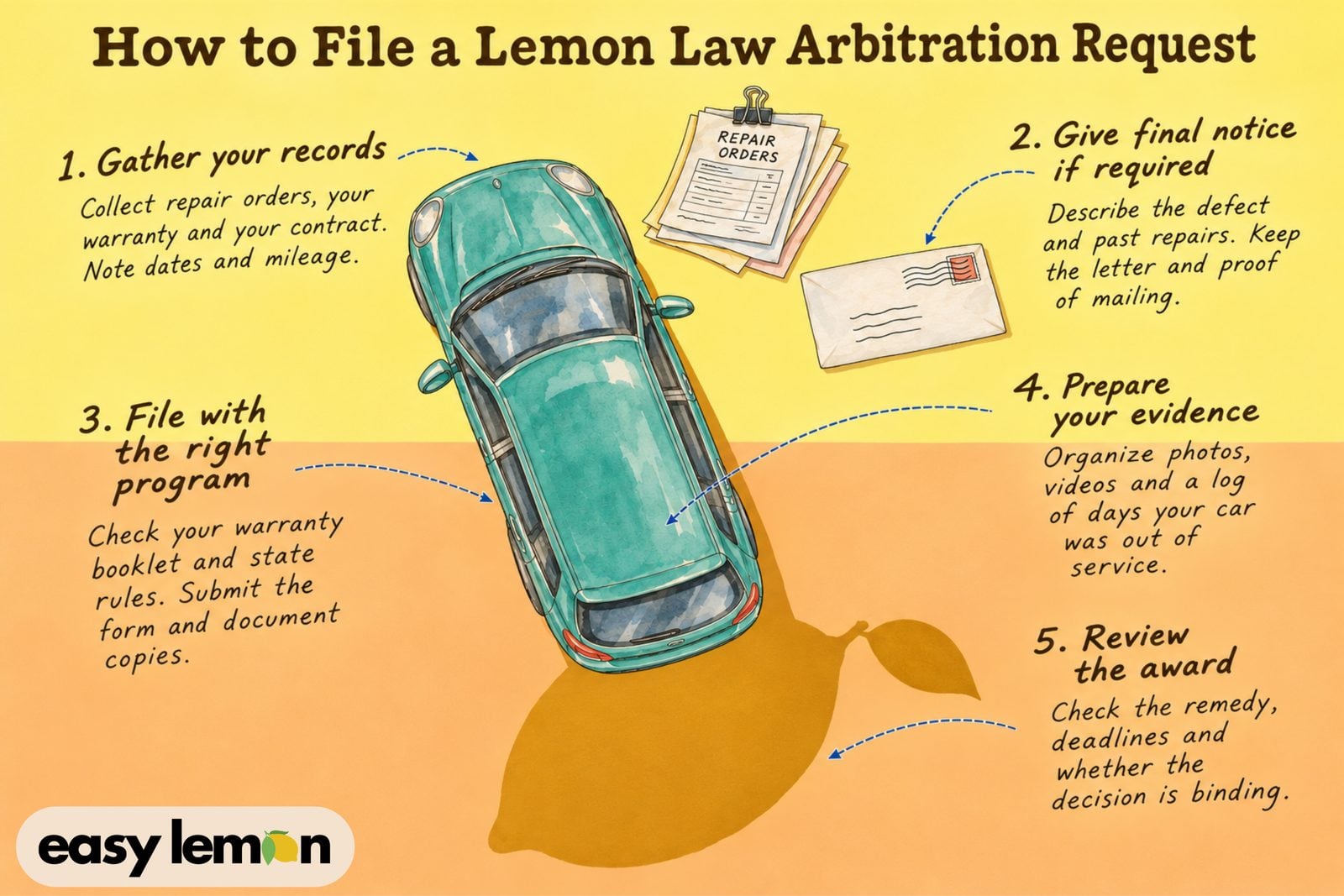
Lemon law arbitration requests must be filed in a particular order to make sure that your rights are protected. Most states’ lemon law programs follow these basic steps from start to finish:
Gather Your Repair Orders and Warranty Documents
First, collect every repair order, since each one proves a repair attempt along with the date and mileage. Pull your purchase or lease contract, the warranty booklet, and any letters from the manufacturer or dealer. Then write down each problem with dates, so your account stays consistent through the hearing.
Send a Final Repair Opportunity Letter
Next, send the manufacturer a written notice, because Florida and Texas both require it before a refund or replacement. Florida requires registered or express mail, and the manufacturer then has 10 days to respond and 10 more to repair the car. A clear lemon law demand letter names the defect, lists the repair history, and states the remedy you want. Keep the mail receipt in case the manufacturer later says it was never notified.
File With the Right Program
Third, determine whether the manufacturer’s arbitration program or the state program comes first (the manufacturer’s program is often referred to by name in your warranty booklet), and if the manufacturer’s arbitration program is state-certified, Florida law requires you to go through that process first. To initiate arbitration, you’ll have to fill out a request for arbitration form, send in copies of your documents, and pay any program-related filing fees.
Prepare Your Evidence for the Hearing
Gather documentation to support your case as soon as the program accepts your request. Some cases are decided based only on the written information, so it’s important to submit strong evidence to support your case. You can bring documentation with you to the hearing or submit it ahead of time, depending on the type of hearing you’ve been scheduled for.
-
Repair orders showing each attempt, its date, and the mileage
-
Your written warranty and the purchase or lease contract
-
A copy of your final repair letter and the mail receipt
-
Photos, videos, or a log of the defect and the days out of service
Review the Award and Decide Whether to Accept It
Carefully review the decision, including such issues as the amount of any refund, mileage allowance, and compliance dates, before you accept or reject it. Remember that a decision issued under a federally regulated manufacturer program may be rejected and you may still bring a lawsuit, but a New York state decision will be binding once issued.
What Happens at an Arbitration Hearing
Many arbitration programs allow hearings to take place remotely, by phone, or via document submissions, as well as in person. New York hearings are usually in person, though document-only hearings are allowed when both sides agree. Each side gets to present its evidence, answer the arbitrator's questions, and respond to the other side.
Arbitration limits discovery compared to court, so you will not see months of document requests or depositions. If the award is a refund, please anticipate a use offset or mileage allowance for the miles you drove. New York applies it only above 12,000 miles, and the attorney general's own example puts it at $600 on a $20,000 car driven 15,000 miles.
Is a Lemon Law Arbitration Decision Binding
The answer depends on which program decided the case and which state you are in. Decisions made under 16 CFR 703 programs are not legally binding on anyone (although manufacturers must act in good faith). Some decisions bind the manufacturer once you accept them according to the rules of the program. If you reject the program's decision, you can still take legal action against the manufacturer.
A decision made under New York's state program is binding upon the parties and may be attacked only as provided in CPLR Article 75 within 90 days. In Florida, decisions of the Board are final unless a party petitions a circuit court for relief within 30 days. If a manufacturer appeals in bad faith, the amount awarded to the consumer doubles, and the court can triple that amount. In Texas, either party can seek a rehearing from the TxDMV and then appeal to the state district court. Before you participate in a manufacturer program, know that the program's decision can be used as evidence if you later take legal action against the manufacturer.
Lemon Law Arbitration vs Filing in Court
Filing for arbitration can be done without a lawyer and can be quicker than the court process. There is little to no filing fees (federally regulated lemon law programs offered by manufacturers do not charge a filing fee).
Some arbitrators may favor manufacturers, and the concern comes from manufacturers setting up the programs they use. Also, arbitration awards may not be as generous as court awards, and the Florida Board can’t award attorney’s fees, while a court can under state lemon laws and Magnuson-Moss.
The 2024 audit of BBB AUTO LINE filed with the FTC shows how much screening happens before any hearing. BBB AUTO LINE rejected 5,564 of 12,906 submitted claims, or 43.1%, as ineligible in 2024. Only 26.3% of arbitrated cases were closed within the 40-day period that federal rules set.
Filing Fees, Costs, and Attorney Fees
Costs for arbitration are usually lower than court, and filing fees at most programs fall somewhere between $0 and $50. Federally regulated manufacturer programs and the Florida Board charge nothing, and Texas charges $35. New York ($250 for a new vehicle, refunded if you win) is the exception when it comes to filing fees.
Court carries its own costs, but under New York law, Florida law, and the federal Magnuson-Moss Warranty Act, courts can order defendants to pay the legal fees of prevailing consumers. That fee-shifting rule explains how lemon law attorneys get paid without billing the client by the hour. Speaking with an attorney before filing a case may be wise, since where you file affects who pays the legal bill.
How Long Arbitration Takes
While arbitration is supposed to be an expedient process with cases typically being resolved in a matter of weeks, actual cases can drag on, as shown by BBB AUTO LINE’s arbitration audit program. The target set by federal rules is 40 days. The target set by the state of New York is to schedule a hearing within 35 days. In Florida, the target for a decision by the Board is 60 days. A realistic lemon law case timeline helps in deciding whether to take a quick award or file a lawsuit in which attorneys’ fees may be shifted.
Mistakes That Can Weaken Your Claim
In Florida, a claim with a certified manufacturer program is due no later than 60 days after the rights period expires. In Texas, for example, the time is six months from the earliest triggering event, and in New York, four years after delivery of the car.
Make sure you file before the deadline, because a missed deadline can end a valid claim. Use the manufacturer’s dispute resolution program when it is required. In Florida and under some express warranties, this is a precondition to a valid claim. Don’t hastily accept a low settlement, especially one that overstates the mileage allowance.
Buying from a dealer: Some dealer sales contracts include arbitration clauses. This is separate from any arbitration program offered by the manufacturer under the state lemon law. In some states, courts have held that the manufacturer cannot force you to arbitrate using the clause in the dealer sales contract. Consult with an attorney to determine whether an arbitration clause applies to your situation, depending on the state and the exact wording of the clause. These lemon law mistakes can ruin an otherwise meritorious lemon law claim.
Ready to Take On the Manufacturer?
Lemon law arbitration can give you a quick, low-cost decision, but the right program depends on your state and deadlines. New York binds both sides, Florida requires its Board before most suits, and Texas sends you to a TxDMV hearing. If your car keeps going back to the shop, talk to a lemon law lawyer before you file anything.
Easy Lemon's seven attorneys have 25+ years of combined experience and have recovered more than $ 50 million in over 3,000 cases. Our lemon law attorneys handle both arbitration and court cases. You owe no attorney's fees unless we recover, since the manufacturer pays them when you win, and consultations are free and confidential. Contact us today to schedule a free consultation.
Past results do not guarantee future outcomes.
Frequently Asked Questions
Arbitration-related issues frequently arise in the over 3,000 cases handled by Easy Lemon’s lawyers. The short answers reflect the federal rules, as well as those of the state programs we discuss in this article.
Do I Have to Go to Arbitration Before Suing Under Lemon Law?
In Florida, consumers must typically go through the Board before bringing a lemon law action. Before bringing a Magnuson-Moss Act claim, consumers may need to go through the manufacturer’s remedy program if their written warranty requires it. In New York, consumers are not typically required to go through the state’s program. However, for some potential remedies, consumers may first need to exhaust the manufacturer’s remedy program.
How Much Does Lemon Law Arbitration Cost?
These resources are available at no cost from the Florida Board and federally regulated manufacturer programs. In Texas, it costs $35, and New York charges $250 for a new car. This fee is refunded if you win.
Can I Have a Lawyer at My Arbitration Hearing?
If you choose to have an attorney represent you, it’s helpful to have someone sort through the documents, verify that your refund is calculated correctly, and discuss options with you about whether to accept the award amount. You don’t have to have an attorney to file a claim; each program has different rules about legal representation.
What Happens If the Manufacturer Does Not Comply With the Award?
If you accept, the manufacturer will have 30 days to comply in New York. If it doesn’t comply with the decision, it’ll owe between $25 and $500 for each day it’s late. In Florida, if the manufacturer doesn’t comply or appeal, the attorney general can seek fines of up to $1,000 per day.
Does Arbitration Work for Used or Leased Vehicles?
For New York, vehicles that are leased or purchased during the program’s coverage period are covered, and there’s a different fee of $120 for used cars. Other states’ regulations regarding leased or used vehicles may be different. Refer to your state’s statute for additional information.
Can I Reject an Arbitration Decision?
Decisions under manufacturer programs regulated at the federal level may be rejected and taken to court. Decisions under state programs are final and binding upon the parties in New York. In Florida and Texas, the decisions may be appealed to the courts, but action must be taken within a prescribed time.
Legal Disclaimer
This website and its contents serve only general information purposes and do not constitute legal advice. Receiving or reading this website or any of its contents does not create an attorney-client relationship between you and RockPoint Law P.C. For specific legal advice, please schedule a consultation with one of our attorneys. “No attorney’s fees” or similar phrases refer to attorneys’ fees only. Depending on the case, you may be responsible for certain costs and expenses associated with the lawsuit, which may be deducted from any amount you recover. Easy Lemon and RockPoint Law P.C. are not endorsed by, affiliated with, or sponsored by any vehicle manufacturer.
What Our Clients Say
Read More Relevant Blogs
Jeep Cherokee Transmission Problems Lemon Law Overview
Jeep Cherokee transmission problems may qualify for a lemon law buyback or replacement when the same defect survives...
Read Full Post →
Should I Buy A Lemon Law Buyback Car?
A lemon-law buyback car is a vehicle the manufacturer repurchased from its original owner under a state lemon...
Read Full Post →
Jeep Wrangler Death Wobble Lemon Law Filing Rights in 2026
Jeep Wrangler owners experiencing death wobble may have Lemon Law rights if the defect substantially impairs safety, value,...
Read Full Post →Resolving Your Lemon Law
Case Has Never Been Easier
Our experienced attorneys handle everything — from paperwork to manufacturer negotiations. You focus on your life, we'll get you results.
