








How to Write a Lemon Law Demand Letter (+ Free Template)


Short Answer
A lemon law letter — usually called a lemon law demand letter — is a formal written notice to a vehicle manufacturer stating that your vehicle has a persistent, documented defect and demanding a buyback, replacement, or final repair attempt under your state’s lemon law.
An effective letter includes your contact information, the vehicle’s year, make, model, and VIN, a description of the defect and how it substantially impairs the vehicle’s use, value, or safety, a dated repair history, a specific demand, and a response deadline. In most states, send it to the manufacturer’s corporate address — not the dealership — by certified mail with return receipt. A free sample template is included below.
At Easy Lemon, our experienced lemon law attorneys have guided clients through the process of filing and pursuing lemon law claims. Our team has recovered millions of dollars for consumers, and we can help you protect your legal rights and understand the car lemon law better. Contact us today for a free consultation.
Most people writing this letter have already had the dealer conversation that goes nowhere, and are trying to reach someone at the manufacturer who can actually authorize a remedy.
That is what the letter does, and it is why the record behind it matters more than the wording of it. Gather your repair orders, the purchase or lease agreement, and the warranty booklet before you draft.
The sections below cover the structure, a template you can adapt, the mistakes that weaken a letter, and what happens after you send it.

What Is a Lemon Law Letter?
A lemon law letter, or demand letter, is a formal written notice sent to a vehicle manufacturer informing it that a vehicle has a persistent, documented defect — a lemon — and demanding a refund, replacement, or final repair attempt under your state’s lemon law or federal warranty law.
In many states it serves as the manufacturer's required final opportunity to repair the defect before a claim moves forward.
Its purpose is to clearly document the problem and give the manufacturer a last chance to fix the issue or offer a remedy before legal action is taken.
At this point it helps to understand how to file a lemon law claim, or to hire a lemon law attorney to guide you through the process. The letter creates an official record of your complaint and is often a required step in the legal process.
It is also worth knowing how many repair attempts your state requires — and, separately, how many recalls before lemon law protection becomes relevant.
The letter should include key details such as a clear description of the vehicle’s defect, a timeline of repair attempts with dates and outcomes, and relevant warranty information showing the issue is covered.
Including this information helps demonstrate that the defect substantially affects the vehicle’s use, value, or safety, and that reasonable efforts have been made to repair it. A well-documented letter strengthens your claim and improves the odds of a quick resolution.
How Do You Structure a Lemon Law Letter?
A clear lemon law letter should follow a structured business format so it reads as professional and serious. Begin with your contact information, the date, and the manufacturer’s contact details at the top, followed by a formal greeting.
Open with a brief statement that you are writing to report a defect and assert your rights under your state’s lemon law.
Next, organize the body into distinct sections. Start with the vehicle information — year, make, model, and vehicle identification number (VIN) — then provide a detailed description of the defect and how it affects the vehicle’s use, value, or safety.
Follow this with a repair history section that lists every repair attempt, including dates, locations, mileage, and outcomes, showing that reasonable efforts have been made to fix the issue.
You can find the manufacturer’s corporate address in the customer-assistance section of your warranty booklet or owner’s manual, or on the manufacturer’s website.
Conclude with a clear and firm demand for resolution — a buyback, replacement, or final repair attempt — and set a reasonable deadline for response.
End with a professional closing, your signature, and a note listing the attached supporting documents such as repair invoices and warranty records. This organized format makes your claim easy to evaluate and harder to dismiss.

Free Lemon Law Demand Letter Template (Sample)
Below is a sample lemon law demand letter you can copy and adapt — this lemon law letter template works in any state once you tailor it.
Replace everything in brackets with your own details, keep the tone factual, and attach copies — never originals — of your supporting documents.
Because notice requirements differ by state, check your state’s lemon law (or have an attorney check it) before sending; some states require specific language, a specific recipient, or a statutory form.
[Your Full Name]
[Street Address]
[City, State ZIP]
[Phone] · [Email]
[Date]
[Manufacturer Name]
Attn: Customer Relations / Legal Department
[Manufacturer’s Corporate Address]
RE: Lemon Law Demand — [Year Make Model], VIN [Vehicle Identification Number]
To Whom It May Concern:
I [purchased/leased] the above vehicle on [purchase date] from [dealership name] in [city, state]. Since [date the problem first appeared], the vehicle has exhibited [plain description of the defect — e.g., repeated stalling at highway speed], a condition that substantially impairs its use, value, or safety.
The vehicle has been presented for repair of this condition [number] times while under warranty:
• [Date] — [Dealership] — [Mileage] — [Complaint / repair order #] — [Outcome, days out of service]
• [Date] — [Dealership] — [Mileage] — [Complaint / repair order #] — [Outcome, days out of service]
• [Add a line for every repair visit]
Despite these attempts, the defect persists. Under [your state]’s lemon law and the federal Magnuson-Moss Warranty Act, I hereby demand [a repurchase of the vehicle / a replacement vehicle / a final repair attempt].
Please respond in writing within [30] days of receipt of this letter. If I do not receive a satisfactory response, I intend to pursue all remedies available to me under law.
Enclosed are copies of my purchase agreement, warranty, and all repair orders referenced above.
Sincerely,
[Signature]
[Printed Name]
Sent via certified mail, return receipt requested. Enclosures: [list of documents].
Keep the letter to one or two pages. The repair-history list does the persuading — a manufacturer’s representative should be able to see the pattern of failed repairs at a glance without reading a single emotional sentence.
What Are the Steps to Write a Lemon Law Letter?
The process runs from researching your state’s requirements to mailing the finished letter, and each step builds the record your claim will rest on. Send the final letter via certified mail, return receipt requested, to establish a legal record of receipt.
The table below outlines the steps to write a lemon law letter:
What Challenges Might Arise?
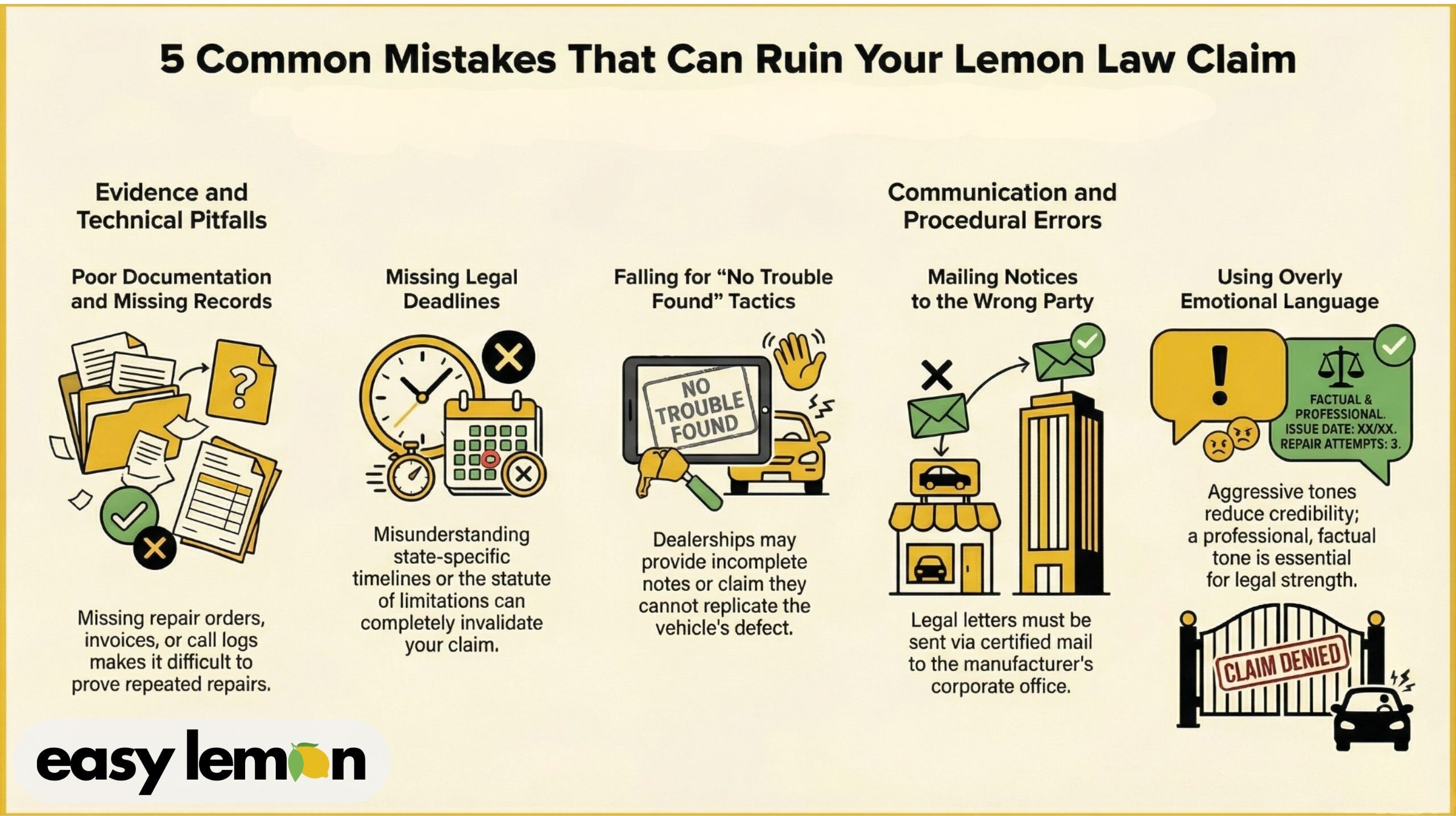
Writing a lemon law letter is a critical step in a lemon law claim, and the challenges typically come from the need to satisfy specific legal criteria, provide complete evidence, and counter manufacturer resistance. Common challenges include:
1. Poor Documentation and Missing Records
A major challenge is failing to keep complete records such as repair orders, invoices, and receipts, which makes it difficult to prove repeated repair attempts.
Missing correspondence like emails or call logs can weaken your claim and create disputes over what was communicated. Additionally, not tracking how long the vehicle was out of service can hurt your ability to meet legal requirements.
2. Legal and Technical Complexities
Many consumers struggle to prove that a defect substantially affects the vehicle’s use, value, or safety rather than being a minor issue.
Lemon laws vary by state, so misunderstanding specific requirements like repair attempts or timelines can lead to denial. Missing the statute of limitations is another critical mistake that can completely invalidate a claim.
3. Manufacturer/Dealership Resistance and Tactics
Dealerships may claim they cannot replicate the issue, resulting in “no trouble found” reports that weaken your case.
Manufacturers might also blame the problem on misuse, neglect, or unauthorized modifications to avoid responsibility. In some cases, repair notes are incomplete or misleading, failing to properly document the actual complaint.
4. Procedural Mistakes
One common issue is failing to send the lemon law letter to the correct party — the manufacturer’s corporate office rather than just the dealership. Not using certified mail with a return receipt can make it hard to prove the letter was received.
An unclear or vague demand for resolution can also reduce the effectiveness of the claim. We regularly see claims stall for exactly this reason: letters mailed to the selling dealership sit unanswered because the manufacturer — the party actually responsible under the warranty — never received them. You can see how properly directed claims tend to resolve on our recent settlements page.
5. Emotional Decision-Making
Using overly emotional or aggressive language in the letter can weaken your position and make the claim seem less credible. A professional, factual, and concise tone is essential to maintain legal strength. Staying objective helps ensure the focus remains on evidence and legal rights rather than frustration.
To overcome these challenges, we advise keeping detailed records of every repair visit, sending all notices via certified mail, and describing the symptoms accurately rather than trying to diagnose the cause.
What Are the Benefits of a Well-Written Letter?
A well-written lemon law letter clearly presents your case in a professional and organized manner, which significantly increases the likelihood of a successful claim.
By outlining the defect, repair history, and your legal rights in a concise way, it makes it easier for the manufacturer to understand the seriousness of the issue. This clarity often encourages quicker acknowledgment and action.
Another key benefit is focused handling. When your letter includes complete documentation and a clear demand, it reduces delays caused by back-and-forth communication or requests for additional information. As a result, manufacturers are more likely to respond promptly with a buyback, replacement, or final repair attempt.
An effective letter also strengthens your legal position if the matter escalates. It serves as formal evidence that you followed proper procedures and gave the manufacturer an opportunity to resolve the issue — which can carry real weight in arbitration or litigation and improves your chances of a fair outcome without unnecessary complications.
How Can You Ensure Success?
Ensuring success with a lemon law letter requires building a thorough paper trail before sending it, stating your legal demands clearly, and sending the letter via certified mail.
A successful letter is backed by documented, repeated attempts to fix a substantial defect. It also helps to have some sense of how long a lemon law case takes in your state.
To strengthen a lemon law letter, focus on using precise language and factual details to describe your particular circumstances.
Avoid vague statements and instead include specific details such as dates of repairs, descriptions of the defect, and how the issue affects the vehicle’s use, value, or safety. A well-structured, fact-based letter makes your claim more credible and harder for the manufacturer to dispute.
Another effective strategy is to support your letter with strong documentation and a clear demand for resolution.
Attach copies of repair invoices, warranty records, communication history, and other relevant documents to reinforce your claims, and state plainly whether you are requesting a buyback, replacement, or final repair attempt. Keeping the tone professional and concise also improves the overall impact of the letter.
Finally, seeking legal advice can significantly improve your chances of success, especially in complex cases. An experienced attorney can make sure your letter meets all legal requirements and aligns with your state’s lemon law standards.
Consulting a licensed lemon law attorney not only strengthens your position but also helps you avoid costly mistakes during the process.
What Are the Next Steps After Writing?
After writing and sending a lemon law demand letter, usually via certified mail, the next steps involve initiating the formal claim process, allowing the manufacturer a final opportunity to repair the vehicle, and preparing for potential arbitration or litigation if the issue is not resolved.
The first step is to closely monitor for a response from the manufacturer or dealer. Keep track of every communication — emails, phone calls, and written replies — and note the timeline of the response against the deadline you set in the letter. Staying organized at this stage helps you respond promptly and maintain a strong position.
If the manufacturer fails to respond or denies your claim, begin preparing for possible legal proceedings. This includes organizing all your documentation, keeping your copy of the letter and the certified-mail delivery proof together, and seeking professional legal assistance to evaluate your options. Taking these steps ensures you are ready to escalate the matter effectively if a resolution is not reached.
What Does the Statute Require Your Letter to Say?
Alaska spells this out most precisely. Under AS 45.45.310 the written notice has to state four things: that the vehicle has a nonconformity, a reasonable description of it, that a reasonable number of repair attempts have already been made, and a demand that a refund or replacement be delivered on the 60th day after the notice is mailed.
Timing is part of the same requirement: the notice must go out before 60 days have elapsed after the warranty expires or the one-year period ends, whichever terminates first. Alabama is stricter about repair history.
Ala. Code 8-20A-1(7) requires the notice to describe the vehicle, the nonconforming condition, and all previous repair attempts, naming who made each and when. A letter that says “the car has been in three times” does not satisfy that; the statute wants the entries itemized.
How Does the Letter Have to Be Sent?
Delivery method is a statutory element in some states and unspecified in others, so check before you mail. Alabama requires certified United States mail to the manufacturer (Ala. Code 8-20A-3(a)).
Alaska requires certified mail to the manufacturer and to its dealer or repairing agent, both (AS 45.45.310). New York routes it through the dealer instead: the consumer reports the defect to the dealer, who then has 7 days to forward written notice to the manufacturer by certified mail (GBL 198-a(b)(1)).
Idaho has a similar relay, and specifies return receipt requested when a dealer forwards the notice on (Idaho Code 48-903(5)). Arizona asks for prior written notice and an opportunity to repair (A.R.S. 44-1264(C)). Texas requires written notice but prescribes no mail method at all (Tex. Occ. Code 2301.606(c)).
What Clock Does the Letter Start?
A properly sent letter puts the manufacturer on a deadline. In Alabama the manufacturer has 7 calendar days to name a reasonably accessible repair facility, then no more than 14 calendar days after delivery to fix the vehicle (8-20A-3(a)).
In Alaska it gets 30 days after receipt for one final repair attempt (AS 45.45.310). Washington runs on the written request itself: the manufacturer has 40 calendar days from that request to replace or repurchase, and the choice between the two belongs to the consumer (RCW 19.118.041(1)).
Louisiana penalizes delay: under R.S. 51:1943(A)(2) a manufacturer that fails to respond or repair in time waives its right to a final cure attempt, and R.S. 51:1945 gives it 30 days to deliver once the consumer tenders title.
Want Help Writing a Lemon Law Letter?

Crafting an effective lemon law letter is your first step toward resolving issues with a defective vehicle. With the components, template, and legal nuances covered here, you are equipped to assert your rights with confidence. Remember: persistence and accuracy in documentation are the keys to a successful claim.
Do you need professional guidance with your lemon law letter, or do you want to file a lemon law claim? At Easy Lemon, our experienced lemon law attorneys can help you draft the letter, direct it to the right party, and pursue the claim through to resolution. Schedule a free consultation and let us make sure your rights are protected.
Legal Disclaimer: This content is provided for informational purposes only on how to write a lemon law letter and does not constitute legal advice. Lemon law eligibility and outcomes vary based on individual circumstances, vehicle history, and applicable laws.
Reading this article does not create an attorney-client relationship. For legal advice regarding your specific circumstances, consult a qualified lemon law attorney licensed in your state.
Frequently Asked Questions
Here are answers to common questions about writing a lemon law letter.
What Should I Include In A Lemon Law Letter?
A lemon law letter (or demand letter) must formally notify the manufacturer of the vehicle’s defects and demand a buyback, replacement, or final repair attempt.
It should include your name and address, the vehicle information (VIN, year, make, model), the purchase date, a dated history of repair attempts, copies of supporting documents, a specific request for a remedy, and a response deadline, and it should be sent via certified mail with return receipt requested.
How Do I Format A Lemon Law Letter?
Format a lemon law letter as a formal business letter: your contact information and the date at the top, the manufacturer’s corporate address, a subject line identifying the vehicle and stating that it is a lemon law demand, short factual body sections covering the defect and repair history, a clear demand, and your signature. Send it via certified mail, return receipt requested, so you can document that the manufacturer received it.
Where Can I Find Templates For Lemon Law Letters?
This page includes a free lemon law demand letter template you can copy and adapt. Many state attorney general and consumer-protection websites also publish sample letters, and some state motor vehicle agencies provide complaint forms of their own.
Whichever starting point you use, tailor it to your state’s lemon law and your vehicle’s specific repair history.
Do Lemon Law Letters Need To Be Notarized?
No. Lemon law letters, often called demand letters or final repair attempt notices, generally do not need to be notarized. What matters legally is proof that the manufacturer received the letter, which is why it should be sent by certified mail with return receipt requested.
Can I Send A Lemon Law Letter Via Email?
Yes, you can send a lemon law letter via email to put the manufacturer on notice quickly, but you should also send it via certified mail, return receipt requested.
Email creates a fast, time-stamped record, while certified mail provides legally solid proof of delivery, and some state lemon laws specifically require written notice by mail.
How Long Should I Give The Manufacturer To Respond?
A response deadline of about 30 days from receipt is common in lemon law demand letters. Some state lemon laws set their own response or final-repair windows, so check your state’s statute or ask a lemon law attorney before you pick a date.
Whatever deadline you set, state it plainly in the letter and keep a record of when the certified-mail receipt shows the letter was delivered.
What Our Clients Say
Read More Relevant Blogs

Washington Lemon Law Attorney Fees: Who Pays?
In Washington, manufacturers pay legal fees for consumers under two circumstances, and these fees don't involve any fraction...
Read Full Post →
Colorado Lemon Law Attorney Fees: Who Pays?
Colorado has some unique rules when it comes to costs and fees compared to other states. Under Colorado...
Read Full Post →
Georgia Lemon Law Attorney Fees: Who Pays?
In Georgia, whether the manufacturer pays your attorney fees is a decision the arbitrator makes, not an automatic...
Read Full Post →Resolving Your Lemon Law
Case Has Never Been Easier
Our experienced attorneys handle everything — from paperwork to manufacturer negotiations. You focus on your life, we'll get you results.