





Washington Lemon Law Attorney Fees: Who Pays?

In Washington, manufacturers pay legal fees for consumers under two circumstances, and these fees don’t involve any fraction or percentage of what they recover. The first situation happens when consumers win an arbitration hearing at the state level, and the manufacturer hires their own lawyer. In the second scenario, too, there is a win for the consumer, this time on an appeal from that initial arbitration. Washington’s lemon law uses a free arbitration panel that is overseen by the Office of the Attorney General, and the fee rules for this are quite similar to those used in the other cases as well.
Easy Lemon has recovered than $30 million for consumers and has helped thousands of drivers across the country obtain buybacks and cash settlements. We recently helped a BMW X6 owner recover $160,264; a Mercedes owner recover $148,749; and a Porsche owner recover about $144,550. Our experience in defective-vehicle cases helps us pursue manufacturers and make the most of state lemon laws. Contact us for a consultation today.
This guide explains what attorney fees are under Washington Lemon Law and covers who has to pay legal costs for consumers as well as how this law affects potential claims that consumers might have.
Who Pays Attorney Fees in a Washington Lemon Law Case?
In our experience, the manufacturer pays when the consumer wins in the correct forum. Washington’s Motor Vehicle Warranties Act, chapter 19.118 of the Revised Code of Washington, includes two fee provisions relevant to a vehicle owner. The arbitration rule is found in RCW 19.118.090(6)(b).
If the board determines that repairs are adequate, they will also approve costs and legal fees. This means handling things like issuing refunds or replacements for purchases, negotiating settlement issues, drafting statements from manufacturers, and attending arbitrations.
Section RCW 19.118.100(3) contains rules about how to proceed with this matter. Either party may request a trial in Superior Court regarding the arbitration decision. If the customer wins in Superior Court, they will receive back the money that was awarded, along with legal fees and other costs. This section also specifies that there is $25 cash compensation per day if an arbitrator orders a refund or replacement, but the manufacturer doesn’t honor that order or provide the car.
Chapter 19.118 does not include a clause allowing a manufacturer to recover attorney fees from a consumer who loses the case. In contrast, Colorado’s statute awards fees to the prevailing party in either direction. Our Arizona and Florida attorney-fees guides explain the state-level differences. The table below outlines which fee rule is applicable at each stage of a Washington claim.
What Does a Washington Lemon Law Fee Dispute Look Like in Practice?
A car owner from Washington has had the same serious safety defect that has been fixed twice but still persists. Now the owner is seeking to replace their car altogether. When the manufacturer fails to resolve this issue, the owner turns to arbitration by the state. If an arbitrator rules in favor of the owner and the manufacturer hired legal help, then according to RCW 19.118.090 (6)(b), the arbitrator can award reasonable legal fees and other costs to the customer.
Results can vary depending on whether the company handles disputes through its customer service instead of hiring lawyers. Consumers can still get lemon laws relief, but there may not be provisions for reimbursement of fees. Therefore, recording exactly what the manufacturer says, as well as your current phase of the proceeding, is really important before thinking you’ll get reimbursed for legal costs.
Why Does It Matter Whether the Manufacturer Hired a Lawyer?
In our experience, it matters because it can improve the manufacturer’s legal protection and compliance. The board can only award fees under certain conditions, according to the Attorney General’s guidance on submitting a request for arbitration. Fee awards require the manufacturer to be represented by counsel.
Major manufacturers usually don’t show up personally at hearings. Hearings are one of four required stages. An attorney who communicates with you or negotiates with a manufacturer before the hearing is still able to invoke the billing rule. There is also an additional procedural step added under Attorney General rules.
According to WAC 44-10-200, the arbitrator must base the fee award on an affidavit of costs and fees. The consumer’s attorney must prepare and submit this document at the conclusion of the arbitration hearing. In Washington, a manufacturer that handles a claim through customer relations staff does not trigger the board’s fee rule. Your fee agreement should clearly state what happens in such cases. The Washington lemon law has a broader scope on this.
What Happens to Fees if the Manufacturer Appeals and Loses?
If the manufacturer loses an appeal and is unsuccessful, then the consumer will pay court costs. When the customer accepts a decision from a board, there are 40 calendar days for the manufacturer to comply with that decision; otherwise, they have 30 calendar days to ask an appellate court to review their case.
According to RCW 19.118.100(2) if an appealing manufacturer loses the appeal they can be ordered to put up some kind of security to cover the losses that consumers incur as a result of this appeal. If the appeal isn’t really justified or is brought in bad faith, the judge might also increase the total amount of damages to at least three times and at least double what was originally decided.
This rule affects both those who appeal and those who contest board decisions. People must get advice before filing any appeals, and they have 120 days to get that advice in. If manufacturers fail to file an appeal or complaint within 40 days, then the Attorney General can fine them up to $1000 per day under RCW 19.118.095(2). Maximum fines cannot exceed $100,000.
Is the Washington Lemon Law Arbitration Program Free?
The Attorney General’s office has confirmed that consumers do not have to pay any direct fees related to arbitration. Instead, a very small fee of just $3 is collected with each transaction if something is bought or leased.
The program handles a significant caseload. The Attorney General’s 2025 Annual Report shows the office handled more than 314 arbitration requests and returned over $18 million to consumers. This figure includes both comparable replacement vehicles and refunds. The office also fined manufacturers over $500,000 for noncompliance in 2025.
The Attorney General stresses that people in Washington need to look closely at this information before sending money to anyone. There’s a dispute resolution program where consumers resolve most claims themselves without having to use lawyers. One has to know that understanding fees well means some people can handle straightforward claims alone, and reputable firms will clearly explain this as well.
Do You Have to Go Through Arbitration Before Suing?
RCW 19.118.080(3) requires consumers to use either the new arbitration board process or any informal procedures set out by manufacturers prior to filing suit in superior court. The manufacturer’s option matters because it can affect fee eligibility. Section 19.118.150 lets a consumer choose a manufacturer program that follows 16 CFR part 703. We found no fee clause in chapter 19.118 for that path, so fee recovery would have to come from another statute.
There are two candidates. RCW 19.118.120 states that violating the chapter is considered an unfair or deceptive act under the Consumer Protection Act. RCW 19.86.090 permits a victorious private plaintiff to recover the costs of the case, including a reasonable attorney’s fee. Alternatively, the federal Magnuson-Moss Warranty Act is applicable.
Pursuant to 15 U.S.C. 2310(d)(2), a consumer who wins the case may be entitled to costs and expenses, including attorneys’ fees based on actual time worked. RCW 19.118.140 states that the chapter does not limit a consumer from seeking rights under any other law.
Which Vehicles Does the Washington Lemon Law Cover?
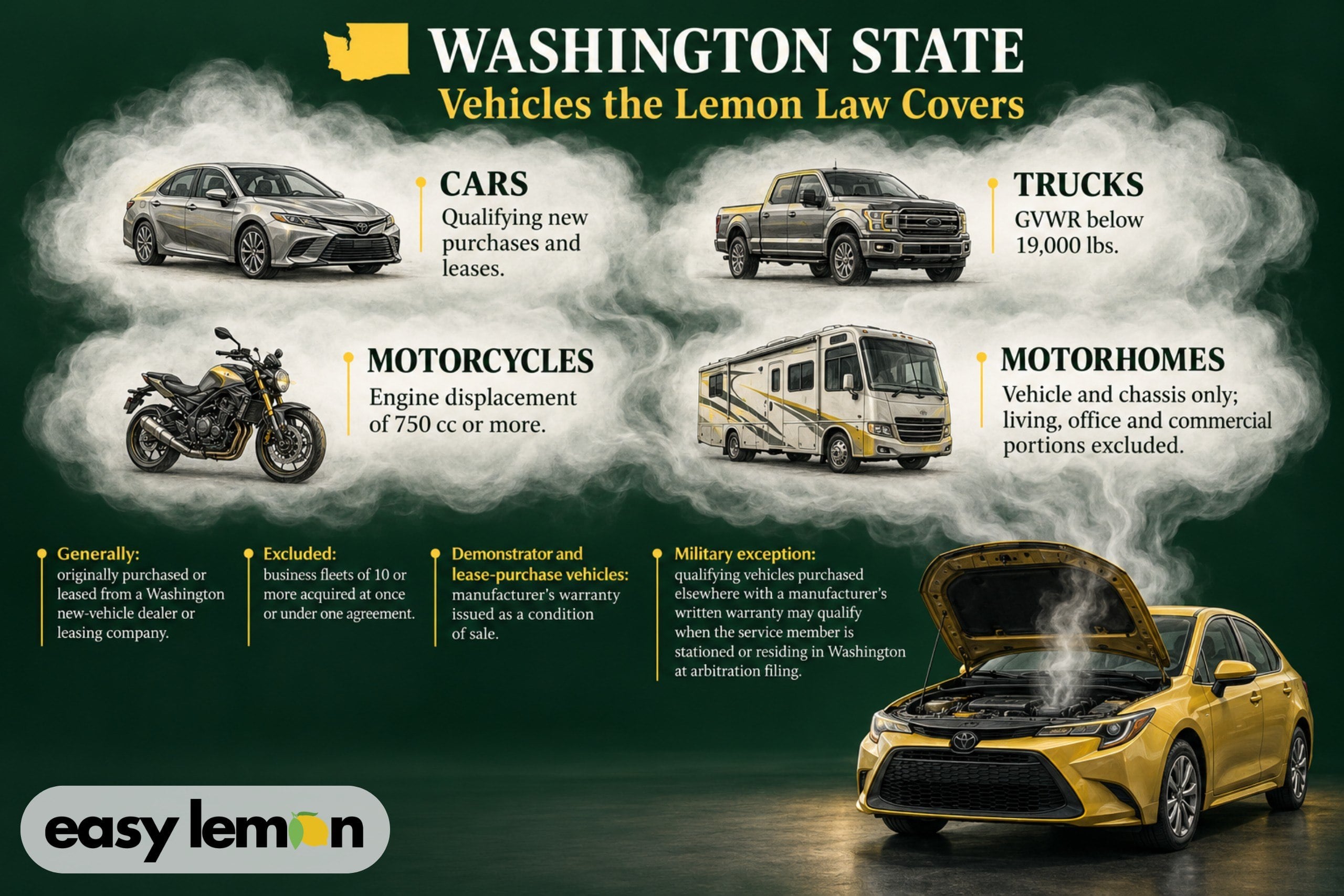
Section RCW 19.118.021(12) defines new vehicles as those purchased or leased directly from motor vehicle dealers or leasing firms located in the state of Washington. Primarily, these are designed to carry people or goods on public roads; they include cars and trucks along with some motorcycles.
In our experience, motorcycles qualify if they have at least 750 cc displacement. Trucks with a gross vehicle weight rating of 19,000 pounds or more are not included. Additionally, vehicles purchased or leased as part of a fleet of 10 or more, or obtained under a single agreement, are excluded.
Essentially, motorhomes are like mobile homes that roll around. They’re vehicles that blend together RV characteristics such as chassis and wheels but do not include essential equipment used for living, work or business purposes. Repair limits are usually elsewhere.
If a car comes with a factory warranty at the time of sale, then both leased cars and demo cars should be covered under that warranty. However, there is an exception: if someone who works for the military gets involved with arbitration about a vehicle that carries the applicable manufacturer’s written warranty, they too would get warranty coverage.
Does the Washington Lemon Law Cover Used Cars?
Most used cars aren’t covered under lemon laws. They only protect people who buy a car when there is still a warranty period and who get the manufacturer’s warranty. The car has to be brand new at the time that it is sold originally.
RCW 19.118.130 ensures that the chapter’s rights apply to subsequent transferees. A second owner who receives the refund is based on their own purchase price, not the original buyer’s. For more details on used vehicle purchases, see our page on the Washington used car lemon law.
What Counts as a Defect Under the Washington Lemon Law?
Under the statute, a defect is something that doesn’t meet RCW 19.118.021(14). That means a defect is something wrong with a new car that impacts its use, value, worth, or safety. The statute also does not include things that happen because of misuse, lack of proper care, or modifications that aren’t authorized.
A vehicle is considered substantially impaired if it becomes unreliable and unsafe to drive regularly and its resale value falls below that of similar vehicles. Repetitive problems with the engine, transmission, or electrical systems would be enough to qualify. Minor issues that just affect appearance usually won’t count towards impairment, but there can be some effect on resale value if they’re significant.
According to RCW 19.118.021(19), a serious safety defect is one that results in a life-threatening malfunction or nonconformity. This defect prevents the consumer from safely controlling or operating the new motor vehicle for everyday use or other intended purposes, or it increases the risk of fire or explosion.
How Many Repair Attempts Does Washington Require?
Washington counts any one of four pathways as a reasonable number of attempts. One common pathway ends two years after delivery or when the vehicle reaches 24,000 miles, whichever comes first. The table below outlines the four routes for cars, trucks, and motorcycles, along with the warranty condition for each.
The statute considers the written warranty to last at least one year or 12,000 miles, whichever comes first. Calendar days are used, not business days. A visit is counted only if the owner permits the facility to attempt or complete the recommended repair. See our guide for details on how long the lemon law lasts in Washington.
According to RCW 19.118.041(3), motor homes have to pass one test for major safety defects and three tests for other deficiencies. For each test, there has to be a final repair following either written notice from the inspector or within sixty days of use. Cars, trucks, and motorcycles don’t get this chance for final repairs.
How Should You Screen Washington Lemon Law Fee Risk?
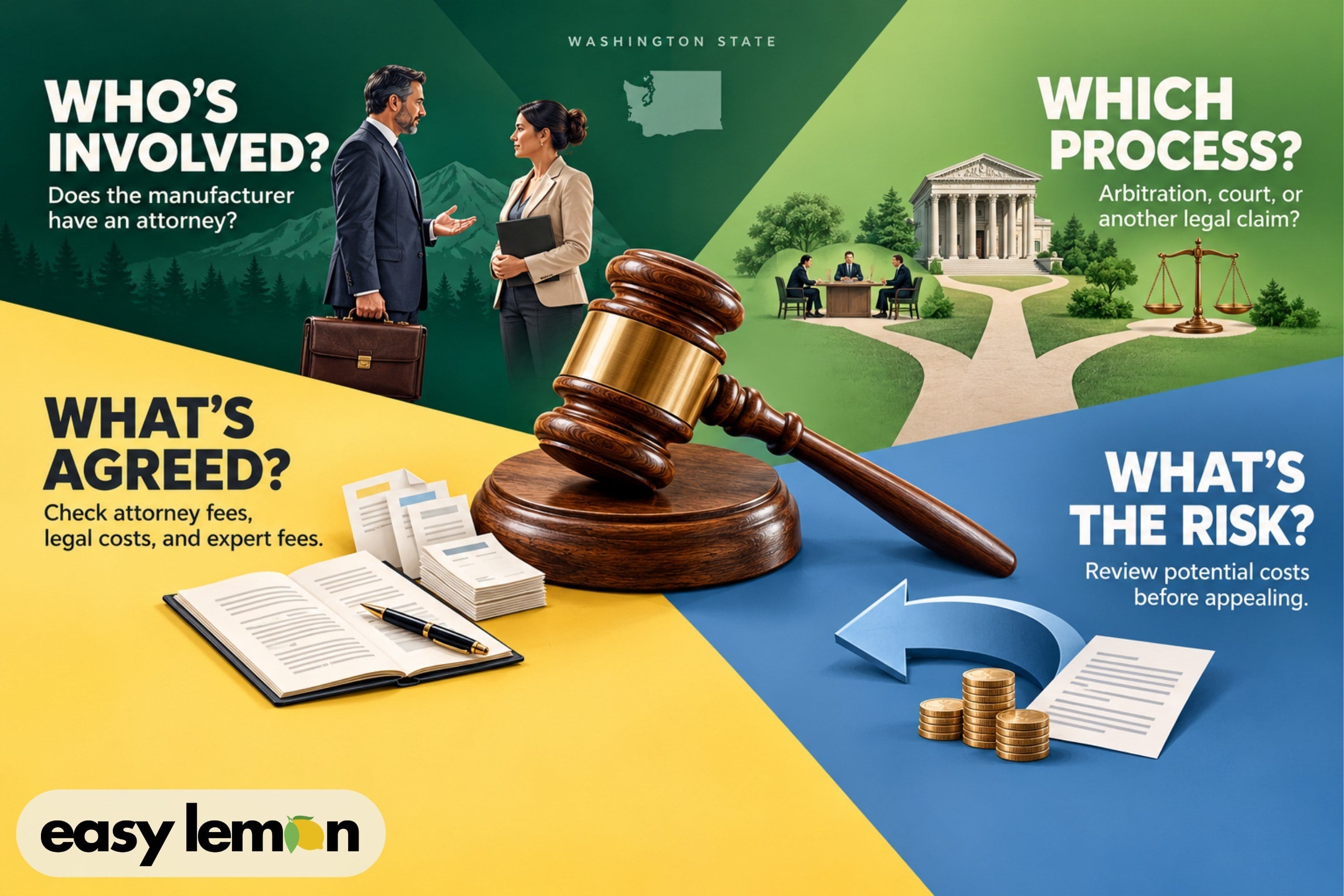
Recovering fees isn’t just about winning a case in Washington State lemon law. We use a framework of four parts to determine when we can recover fees and also when consumers will have to pay certain costs. When relevant to RCW 19.118.090(6)(b) was in effect, did the manufacturer hire an attorney? This is significant because this could determine if the arbitral panel can be awarded legal fees.
Identify whether this case proceeds through arbitration under the Attorney General’s program, a trial in superior court de novo, or some other theory like the Consumer Protection Act or Magnuson Moss Warranty Act. Fee rules might differ depending on which stage of proceedings this case is at.
Before you automatically think that everything will be covered by the company, make sure to read carefully the written agreement that was given to you. Different things can happen regarding attorney fees, costs for legal actions, expert fees, and other associated costs too.
Be aware of the potential repercussions if you appeal a decision from arbitration. If someone appeals for no good reason or just to cause trouble, they might have to pay bigger penalties under RCW 19.118.100(3).
This framework focuses on asking and addressing four main related questions simultaneously: Who are the people who are directly involved in this case currently? Where is this case currently being processed? What clear details about fees are spelled out? And what financial risks are still outstanding as well?
How Do You File a Washington Lemon Law Claim?
The sequence below follows the statute. Each step builds the record, which the next step and any fee award depend on.
Step 1: Report Every Defect to the Dealer or Manufacturer During the Eligibility Period.
Section RCW 19.118.031(5) lets you receive detailed repair orders after each visit. This document needs to detail the problem that was reported as well as what was done during that visit. Dates and mileage information should also be included.
Step 2: Track Your Repair Attempts and Days Out of Service
Make sure to document everything carefully. Clearly record any issues that have been fixed, the time when this work was done, and how long the car was out for repairs. Keep track of things such as repair orders and receipts, and also note down when the car arrives at the shop and when it goes back.
Step 3: Send a Written Request for a Repurchase or Replacement to the Manufacturer.
According to RCW 19.118.041 (1) use the contact information of the manufacturer’s corporate, dispute resolution, zone or regional office as specified. They have 40 days to respond. While the statute doesn’t specify using certified mail, the Attorney General recommends using certified mail and asking for a receipt that proves when they received your communication.
Step 4: Submit a Request for Arbitration to the Attorney General.
The Attorney General will handle any requests received during the forty-day window if this deadline is not close, according to RCW 19.118.090(3). Delivery of products must occur within thirty months of the original retail delivery date.
Step 5: Attend the Hearing.
The board needs 45 days to hear a case and 60 days to make a decision. Gather everything relevant to work on repairs and warranties, as well as any other evidence supporting your claims. Prepare yourself to clearly and consistently explain what has happened previously, the repairs you’ve had performed, and what compensation you’re asking for.
Step 6: Respond in Writing
Do this within sixty days to accept or reject the decision. Silence counts as rejection. Our guide on how to file a lemon law claim in Washington State provides a closer look at the necessary paperwork.
What Does a Washington Lemon Law Refund Include?
Based on our experience, consumers decide what they want: a replacement or a refund. Under RCW 19.118.041(1), manufacturers have to follow the choice of the consumer regarding either replacement or repurchase. A repurchase means refunding the amount paid for the item along with any collateral charges such as sales tax and use tax and fees that haven’t been used yet, like registration fees and title fees. Collateral charges in Washington are defined very broadly.
This policy covers both finance charges and service contracts. The manufacturer will pay reasonable expenses like towing fees and other transportation costs. Costs that are not covered specifically under Colorado law mean that owners in Washington get a wider range of things reimbursed. Under leasing agreements, the manufacturer will refund any money paid, including trade-in value, down payment, and security deposits.
The offset is calculated according to RCW 19.118.041(1)(c). Multiply the miles driven before the first repair attempt on the defect by the purchase price, then divide by 120,000. For a motor home, use 90,000 as the divisor, and for a motorcycle, use 25,000. Miles driven after the first attempt do not count. Reporting a defect early keeps the deduction small. A consumer who gets a replacement vehicle pays the offset to the manufacturer.
How Do Washington Lemon Law Attorneys Get Paid?
We notice that contingency rates for personal injury cases vary quite a lot. Under the Lemon Law, there are also associated costs that fluctuate; these fees depend on the actual work done by lawyers, and they come from manufacturers.
Easy Lemon has stated in its fee terms that typically manufacturers pay the legal fees and costs when dealing with lemon law cases, according to applicable statutes for shifting fees or through negotiation. Costs can also be charged to clients, and those costs will be deducted from any recovery. Details of these terms are found in each client’s written agreement. We also have a guide on how much lemon law attorneys cost, which gives a practical explanation for this.
When charges go to the side that loses a case, the difference between hourly fees and flat fees doesn’t matter much because clients really don’t pay directly from their own pockets anyway. What’s important is how much time you spend working on the case and your hourly rate. Courts or arbitrators will just set reasonable fees based on this.
Repair orders that are comprehensive speed things up. Appeals made by manufacturers regarding large losses could slow things down. Expert fees count as costs and not just legal fees; they need to be clearly delineated in writing. Location isn’t really important because if there is an appeal, it goes to a higher court within the same county where the customer resides.
Before you sign anything, there are three things you would want to know: Who pays for legal fees if I don’t hire a lawyer and the board doesn’t step in? How much of my settlement will be deducted for expenses? And what happens if the company decides to appeal this decision?
Do You Need a Lawyer for a Washington Lemon Law Claim?
Not always, and Washington is the state where that answer is most often no. The arbitration program is free, and the Attorney General’s Office says a consumer does not need to have an attorney for most claims. A lawyer adds the most value when the manufacturer hires counsel, disputes substantial impairment, or appeals. The same is true when federal or Consumer Protection Act claims are in play. Our discussion of whether you need a lemon law attorney covers the general case.
Need Help With a Washington Lemon Law Claim?
The rules for winning in Washington cases are not simple to understand just by looking at whether consumers win. Results can also vary depending on venue, whether manufacturers hired lawyers, terms of consumer contracts, and if either side takes an appeal against arbitration decisions. This guide points out places where representation by manufacturers, appeals to higher courts or filing claims based on different federal or state laws can affect the cost analysis.
Easy Lemon is a firm with experienced Lemon Law attorneys who can evaluate your case, review your lease agreement, and file a legal claim where necessary. Visit any of our offices or contact us directly to begin your journey toward getting the relief you deserve.
Frequently Asked Questions
These are the questions Washington vehicle owners most often ask about the costs of a lemon law claim.
Do Washington Lemon Law Attorneys Take a Percentage of the Settlement?
Generally speaking, lemon laws don’t follow this specific structure very closely. Under Washington State law, if a customer wins a dispute over an allegedly defective car or product, the manufacturer pays reasonable legal costs and attorney fees. The fees aren’t based on a percentage of refunds; they are based on work performed. Look carefully at any written agreement for specifics about handling costs.
Are There Upfront Costs to File in Washington?
According to the Attorney General’s office, there are no upfront fees that consumers need to pay when starting arbitration at the state level. Of course, lawyers charge different amounts upfront based on the terms of your contract with them, so it’s very important to find out about this before you commit.
Can I Recover Attorney Fees if I Win?
According to the law, at arbitration the board awards reasonable costs and legal fees if remedies are awarded. And if the manufacturer hires lawyers then they should be reimbursed for those fees too. If a consumer wins a trial in a higher court though, they can recover from their winnings both any legal costs and fees associated with the trial.
Can a Consumer Be Ordered to Pay the Manufacturer’s Fees?
We did not find any provision in chapter 19.118 that transfers a manufacturer’s attorney fees to a consumer. The statute allows a court to double or triple the total award if the appealing party acted without good cause or merely to harass. Before appealing a board decision, seek advice.
How Long Do I Have to Request Arbitration?
Now that your motorhome has been with you for thirty months, including all extra time that the manufacturer spent finishing up any necessary repairs at the end, that time has now expired too.
Legal Disclaimer: This article provides general information and is not legal advice, and reading it does not create an attorney-client relationship. The firm is Easy Lemon by RockPoint Law P.C., with attorneys admitted in New York, New Jersey, Pennsylvania, Florida, Texas, Missouri, and Kansas. No attorney at the firm is currently admitted to practice in Washington. No local practice offer is made, and nothing suggests local admission. Statutory references are to chapter 19.118 RCW, as published by the Washington State Legislature and reviewed in September 2026. Fee provisions in the chapter have not changed since 2009, and a 2026 bill to increase the program’s funding fee did not pass. The Legislature can amend the chapter at any time. Vehicle qualification depends on specific facts, applicable warranties, and current statutes and rules. Fee awards under RCW 19.118.090(6)(b) depend on whether the manufacturer was directly represented by counsel. The thirty-month deadline to request arbitration under RCW 19.118.090(3) is short. Consumers should consult a licensed attorney about their own circumstances before acting on any information in this article.
ATTORNEY ADVERTISING. Easy Lemon by Rockpoint Law P.C. Easy Lemon attorneys are admitted to practice in New York, Pennsylvania, New Jersey, Florida, and Texas. An office or mailing address does not by itself mean we are admitted in that state. Prior results do not guarantee a similar outcome. Every case turns on its own facts and on the applicable statute.
Reviewed by: Steven P. Nassi, Esquire, Managing Attorney of Easy Lemon. Admitted to practice law in New York (Bar No. 4263489), Pennsylvania, and New Jersey. Service and mailing of process: 10880 Wilshire Boulevard, Suite 1290, Los Angeles, CA 90024. Phone: (855) 435-3666.
What Our Clients Say
Read More Relevant Blogs
Washington Lemon Law Attorney Fees: Who Pays?
In Washington, manufacturers pay legal fees for consumers under two circumstances, and these fees don’t involve any fraction...
Read Full Post →
Colorado Lemon Law Attorney Fees: Who Pays?
Colorado has some unique rules when it comes to costs and fees compared to other states. Under Colorado...
Read Full Post →
Georgia Lemon Law Attorney Fees: Who Pays?
In Georgia, whether the manufacturer pays your attorney fees is a decision the arbitrator makes, not an automatic...
Read Full Post →Resolving Your Lemon Law
Case Has Never Been Easier
Our experienced attorneys handle everything — from paperwork to manufacturer negotiations. You focus on your life, we'll get you results.