







Illinois Lemon Law Attorney Fees: How Much Will You Pay?


Most Illinois consumers pay nothing out of pocket for an Illinois lemon law attorney because the manufacturer generally pays reasonable attorney fees when a claim succeeds. However, you must first use the manufacturer’s informal dispute resolution process if one is available and required under the applicable law. Your attorney’s fees are separate from your settlement or vehicle repurchase amount, so hiring a lawyer does not normally reduce your recovery. Fee arrangements can vary by case, so review the attorney’s agreement before proceeding.
At Easy Lemon, our lemon law team has recovered more than $50 million for consumers and handled 3,000+ cases, helping clients pursue buybacks and cash settlements. Our recent results include a $148,749 settlement for a Mercedes SL43R owner and a $144,550 recovery for a Porsche Macan owner. From handling defective vehicle claims, we know how to hold manufacturers accountable and pursue the remedies available under state lemon laws. If you’re stuck with a defective vehicle, contact us today for a free consultation.
This guide explains where the fees actually come from, what you could still owe, and how to read a retainer agreement before you sign it.
What Is the Illinois Lemon Law?
The Illinois Lemon Law is the New Vehicle Buyer Protection Act, 815 ILCS 380. Illinois law requires car manufacturers to replace vehicles they cannot conform to any applicable express warranty, or to buy them back. The Act runs only eight sections. Reading all of them takes about fifteen minutes, and it is worth doing before you talk to anyone.
The core test sits in Section 3 and two triggers set it off. The same nonconformity has been subject to at least four repair attempts, or the vehicle has been out of service for repair services for 30 or more business days. Either one creates a presumption that a reasonable number of attempts has been made to fix a defect that substantially impairs the vehicle. Thirty business days is roughly six calendar weeks, so the two triggers are closer together than they look.
That presumption is rebuttable, not automatic. It also carries a prerequisite that catches people out. Under Section 3(h), the presumption does not apply unless the manufacturer received prior direct written notification and an opportunity to correct the alleged defect. Dealership repair orders do not satisfy this. The manufacturer itself must be told, in writing, before you rely on the four-attempt rule.
What Vehicles Does the Illinois Lemon Law Cover?
The Act covers new cars, Second Division motor vehicles weighing under 8,000 pounds, and recreational vehicles other than camping trailers and travel trailers. In practice, that means new passenger cars and light trucks. You must buy or lease the vehicle primarily for personal, household, or family purposes.
Two points here run against common assumptions. Leased vehicles are covered, as long as the lease runs at least one year. Recreational vehicles are covered too, so a motor home or a truck camper qualifies even though a travel trailer does not. The weight ceiling applies only to Second Division vehicles such as trucks and vans, not to passenger cars. The statutory warranty period is one year or 12,000 miles, whichever occurs first. That is a two-part window, not a mileage cap, and the defect must arise within it.
The Illinois Attorney General states that the law does not cover used cars, altered or modified vehicles, motorcycles, or boats. The Act was written to protect consumers buying new, so used vehicles fall outside it. Buyers of used cars still have options, though. Illinois gives used vehicle purchasers a 15-day or 500-mile powertrain warranty under 815 ILCS 505/2L. A used car still inside the original factory-written warranty can also support a federal claim. Our Illinois used car guide covers that route in full.
What Rights Do Illinois Consumers Have Under the Act?
In our experience, Illinois consumers can require the vehicle manufacturer to supply a comparable replacement vehicle or to refund the vehicle purchase. The refund covers the full purchase price or lease cost, including all collateral charges, less a reasonable allowance for use. Read that sentence carefully, because the choice is not yours.
Section 3(a) says the manufacturer shall either replace or refund. On the plain text of the statute, the manufacturer elects, and we have found no Illinois appellate decision squarely deciding otherwise. Anyone promising you a buyback outright is describing a negotiation, not one of your Illinois lemon law rights. The reasonable allowance is calculated more favorably in Illinois than in many states.
It measures wear and tear from use before the first report of a nonconformity, plus periods when the vehicle was not out of service for repair. Time your car spent sitting at the dealership does not count against you. Illinois publishes no mileage formula, so do not import California's calculation. One quirk to plan around: sales tax is expressly excluded from collateral charges, so taxes paid come back through a retailer tax credit rather than through your refund.
How Does Illinois Compare With Lemon Laws in Other States?
Illinois sits in the weaker half of state lemon laws, mainly because it lacks a fee provision and a state-run arbitration board. Florida and Texas both run state programs. Illinois relies entirely on manufacturer-established dispute programs that conform to federal regulation 16 CFR Part 703. If a dispute board rules against you, you can still bring a civil action. The manufacturer may not dispute the board's decision. The process only binds one direction.
Two more Illinois deadlines matter. A civil action must be commenced within eighteen months following the date of original delivery, and that period is extended by the days your matter sat in informal dispute resolution. Separately, the Attorney General warns that consumers lose the remedy if they wait more than twelve months from purchase to start the process. Treat eighteen months as the outer limit and twelve as the working one.
How Do Illinois Lemon Law Attorney Fees Actually Work?
Under federal law, the court may order the manufacturer to pay Illinois lemon law attorney fees when the consumer prevails, which is why the arrangement costs most clients nothing out of pocket. Knowing which statute applies matters because it changes how you plead your claim.
Why Does the Illinois Lemon Law Contain No Attorney Fee Provision?
This is simply because the legislature never put one in. The words attorney, fees, costs, and expenses appear nowhere across the eight sections of 815 ILCS 380. Section 3(a), the remedial provision, ends at replacement, refund, collateral charges, and the usage allowance. This is not a drafting accident that courts have quietly fixed.
In 2019, the General Assembly considered a full rewrite that would have added fee-recovery language, but it did not become law. The Act as codified still stops where it always did. The practical consequence is sharp. A consumer who pleads only the Illinois lemon law and wins gets a refund and no fees. That single fact is the strongest argument in this article for having a lawyer draft the complaint, and we cover it further in our Illinois filing guide.
How Attorney Fees Could Affect Your Recovery
Suppose an Illinois consumer has a qualifying vehicle defect and agrees to a $35,000 buyback settlement. If the consumer’s attorney successfully pursues attorney fees from the manufacturer under the Magnuson-Moss Warranty Act, those fees are generally sought separately from the consumer’s $35,000 recovery.
Related case result: 2025 Rivian R1T buyback in Illinois ($89,073)
For example, if the attorney reasonably spent $6,000 worth of billable time on the case, the manufacturer could be responsible for that amount in addition to the consumer’s recovery. The important point is that the $6,000 attorney-fee figure is not automatically deducted from the consumer’s $35,000 recovery. The actual result depends on the fee agreement, the claims asserted, how the case resolves, and whether the applicable law permits recovery of the fees and costs.
How Does the Magnuson-Moss Warranty Act Pay Your Attorney?
The Magnuson-Moss Warranty Act is the federal law that carries the fee. Under 15 U.S.C. 2310(d)(2), a consumer who finally prevails may be allowed to recover costs and expenses, including attorney's fees based on actual time expended, as part of the judgment. Three features of that language decide everything about your costs.
Fees are awarded on top of the judgment, not carved out of it, so a fee award does not shrink your buyback. Fees are calculated on actual time expended, which is a lodestar measure rather than a percentage. The award is discretionary because the statute says fees may be allowed and lets a court decline where an award would be inappropriate.
A prevailing consumer may recover reasonable attorney's fees from the manufacturer, but a manufacturer that wins cannot recover its fees from you under this federal law. Illinois practitioners therefore plead Magnuson-Moss alongside the state count as routine. Our federal lemon law explainer walks through how the two fit together.
A second fee route exists under the Illinois Consumer Fraud Act at 815 ILCS 505/10a(c), which lets a court award the prevailing party reasonable attorney's fees and costs. Note the difference. The prevailing party runs both directions, so Illinois consumer protection laws are not as risk-free as the federal route is. Claims against the vehicle manufacturer rather than the dealer avoid several additional traps in that statute.
What Fee Arrangements Do Illinois Lemon Law Lawyers Use?
Illinois lemon law attorneys generally use a fee structure that allows consumers to pursue claims without paying attorney fees upfront. Under federal lemon law protections, attorneys may assist consumers with claims involving new or used cars and lemon vehicles when the vehicles covered meet applicable requirements. The table below explains the main fee arrangements and how commonly each is used in Illinois lemon law cases.
|
Fee arrangement |
How you pay |
How common in Illinois lemon law |
|
Fee-shifting |
The manufacturer pays your reasonable attorney’s fees separately from your recovery when the law permits. |
Standard. Commonly used in consumer lemon law claims. |
|
Contingency percentage |
The attorney takes an agreed percentage of your settlement or award. |
Rare. Ask why a percentage is being charged when fee-shifting may apply. |
|
Hourly rates |
You pay the attorney for each hour worked, regardless of whether you win. |
Very rare for consumer lemon law claims; more common in commercial disputes. |
|
Flat fee |
You pay one agreed amount for a specific service, such as reviewing a claim or sending a demand letter. |
Uncommon. Sometimes used for limited, defined work. |
Standard attorney fee structures in this field combine the first two ideas, which is where confusion starts. Most retainer agreements provide that the firm looks first to the manufacturer for its fee, and takes a percentage only if a settlement is structured as a single undivided sum. Ask which applies to you and get the answer in writing.
Be skeptical of any Illinois lemon law lawyer quoting a flat 33% to 40% of your recovery as the standard arrangement. That is the personal injury model. It is not how fee-shifting cases are ordinarily priced, and on a buyback, it would cost you thousands that federal law was designed to make the manufacturer pay.
Are There Hidden Costs in an Illinois Lemon Law Claim?
Costs and fees are different, and that distinction is where unpleasant surprises live. Attorney's fees are the price of your lawyer's time. Costs are the out-of-pocket expenses a case generates: court filing fees, service of process, deposition transcripts, expert witnesses on a contested engineering defect, records requests, and travel.
Fee-shifting statutes generally cover both, and a well-drafted agreement says so. Even so, read the cost paragraph of your retainer closely. Easy Lemon's own disclosure is explicit on this. Clients may be responsible for certain litigation costs and expenses, which may be deducted from any recovery, and each written fee agreement sets out the fee terms. Any firm that will not put that in writing is telling you something.
Two Illinois-specific costs deserve a mention. Participating in a manufacturer's informal dispute settlement procedure is free, which is part of why it comes first. And under 815 ILCS 380/5, persons who elect to proceed and settle under the Act are barred from a separate cause of action under the Uniform Commercial Code, which governs sales of goods and personal property such as a vehicle. Accepting a board award can close a door. That trade-off is worth an hour of legal advice before you sign anything.
How Much Do Illinois Lemon Law Attorney Fees Typically Cost?
For the consumer, the typical figure is zero. For the manufacturer, a fee award is whatever a court decides was reasonably incurred, and that number scales with how hard the manufacturer fought.
What Factors Influence the Cost of Your Case?
Four things influence the cost. These are the complexity of the defect, the stage at which the case resolves, the experience of the lawyer, and where in Illinois the case is filed. Fee arrangements can vary based on a lemon law case's complexity. A transmission that fails intermittently costs more to prove than a defect that throws a code every time.
In our experience, the resolution stage matters most. A claim settled on a demand letter generates a fraction of the time of one tried to judgment. Geography matters least, though Cook County rates generally run above downstate rates. An experienced lemon law attorney commands a higher hourly rate than a general practitioner, while usually needing fewer hours to get there.
What Does a Reasonable Fee Award Look Like in Illinois?
A reasonable fee award is the hours actually worked multiplied by a rate the court accepts, which is why the federal statute uses the phrase actual time expended. Courts review the hours claimed and cut what they consider excessive.
One consequence deserves stating plainly, because it is counterintuitive. A fee award can exceed the value of the vehicle recovery, particularly on a lower-value claim that the manufacturer contested hard. That is the design working as intended. Without it, no lawyer could economically take a $9,000 claim, and manufacturers would have little reason to settle small cases.
We do not publish specimen fee figures from past matters. Every case turns on its own facts, and a number from someone else's file tells you nothing reliable about yours.
Is Hiring an Illinois Lemon Law Attorney Worth It?

For a vehicle that has genuinely failed repeated repair attempts, yes, because the fee structure removes the usual reason to hesitate. You are not weighing a recovery against a legal bill. You are weighing a recovery against no recovery.
The repair histories involved are rarely marginal. The 2024 Audit of BBB AUTO LINE was filed with the Federal Trade Commission under 16 CFR 703.7. It found that manufacturers had attempted to repair 86.5% of the vehicles in question at least once. It also found that 48.2% of those cases involved vehicles put through four or more repair attempts.
This reflects 405 surveyed consumers, carries a margin of error of plus or minus 4.8%, and excludes attorney-represented cases from the survey frame. It describes consumers who went through that program, not all lemon law claims.
Four attempts is also the exact threshold Illinois uses. If your repair history looks like the profile above, the statute was written for your situation. You can check the qualifying criteria against our lemon law qualifications guide or estimate a figure with our buyback calculator.
Hiring an Illinois lemon law attorney is not the only way to pursue a vehicle dispute. If your manufacturer has already offered a fair resolution or you are comfortable handling the manufacturer’s informal dispute process, you may decide to proceed without counsel. The trade-off is that you remain responsible for identifying the correct legal claims, meeting notice and deadline requirements, evaluating the offer, and understanding what rights you may give up by accepting a settlement or dispute-resolution decision.
An attorney can be particularly valuable when the manufacturer disputes the defect, challenges whether you have satisfied Illinois’s repair requirements, makes an inadequate settlement offer, or raises questions about warranty coverage. The key is not simply whether you can handle the process yourself, but whether the potential benefit of professional representation outweighs the time, complexity, and legal risk.
How Do You File a Lemon Law Claim in Illinois?
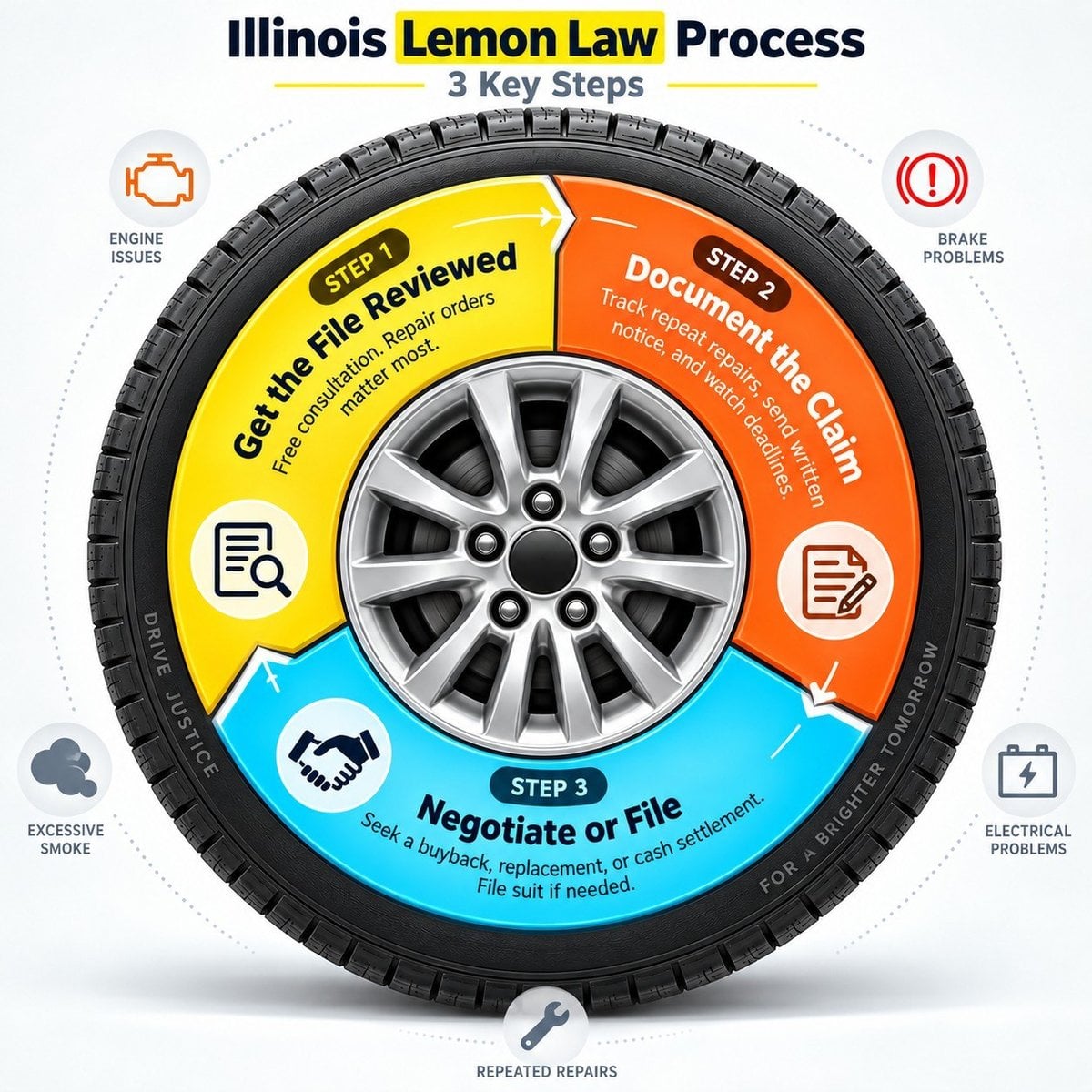
Filing an Illinois lemon law claim takes four moves. Gather the repair history, send written notice to the vehicle manufacturer, complete any qualifying dispute program, then file a civil action pleading both state and federal counts.
Step 1 - Get the File Reviewed.
The initial legal consultation is a screening conversation, and at Easy Lemon it is free and carries no obligation. A lawyer reads your repair history against the statutory triggers and tells you whether the claim clears them. Repairs performed by authorized dealers are what the record turns on.
Every repair order, the purchase or lease agreement, the vehicle's warranty booklet, any written correspondence with the manufacturer, and the dates the vehicle was out of service. Repair orders matter more than anything else you can bring. In our experience, the claims that stall are rarely weak on the defect; they are weak on documentation of the attempts.
Step 2 - Document the Claim and Put the Manufacturer on Written Notice.
Your claim needs a repair history establishing the same defect across attempts, and proof the manufacturer received direct written notice. The second item is the one consumers overlook, and Section 3(h) makes it a prerequisite to the presumption.
Watch the timeline while you gather. The defect must arise within the statutory warranty period of one year or 12,000 miles. You must file a civil action within eighteen months of delivery. Days spent in informal dispute resolution extend that deadline. Our Illinois filing guide covers the sequence in detail, and how long a case takes sets expectations on timing.
Step 3 - Negotiate, Then File if the Response Is Inadequate.
Your attorney sends a demand letter, negotiates with the manufacturer's counsel, and files suit if the response is inadequate. Most Illinois matters resolve before trial.
Three outcomes are realistic. A negotiated buyback or replacement vehicle, a cash settlement where you keep the car and take compensation for its diminished value, or a judgment after litigation. Which one fits depends on whether you want the car gone. A cash settlement reflecting the lost market value is often the faster path for a defect you can live with, and settlement tax treatment is worth understanding before you accept one.
How Do You Choose a Lemon Law Attorney in Illinois?
Choose based on focus, transparency, and responsiveness, in that order. Lemon law is a narrow field, and general consumer law experience is not a substitute for it.
What Does the Easy Lemon 3C Framework Measure?
Our 3C framework evaluates any lemon law attorney on three factors: Competence, Cost, and Communication. Competence means a practice focused on lemon law and warranty litigation rather than general consumer work, including familiarity with how Illinois pairs a state count with a federal one.
Cost means the lawyer states plainly whether you could ever owe fees or costs, and puts it in the retainer. Communication means prompt responses, plain language, and updates you did not have to chase. For an Illinois claim, add a fourth question: ask how they intend to plead the fee count, because the answer reveals immediately whether they know the state statute carries none.
What Questions Should You Ask Before You Sign?
We have found these five to be quite useful. Under which statute will you seek attorney's fees in my case? Could I ever owe you a percentage of my recovery, and under what circumstances? What costs might be deducted from my settlement? Who will handle my file day-to-day? What is your assessment of my repair history against the four-attempt and 30-business-day triggers? Ask for the answers in writing. A firm that answers all five clearly is showing you how it will communicate.
What Red Flags Should Warn You Off?
Three warning signs matter: vagueness about fees, unwillingness to explain the fee statute, and pressure to sign at the first meeting. Any of them is reason enough to keep looking.
Know what each one is testing. A lawyer who cannot say whether your fees would come from the manufacturer or from your recovery has not thought about your case. A lawyer who describes the Illinois lemon law as containing its own fee-shifting provision is repeating something they read on a competitor's website. And any promise about what your case is worth before they've reviewed your repair history is a promise nobody can keep.
Do You Need a Lemon Law Attorney?
We focus on lemon law and defective-vehicle claims, with an approach built around each consumer’s repair history, applicable state and federal laws, and potential fee recovery. We also explain fees and costs upfront so you know what you could owe before signing an agreement.
Easy Lemon is a law firm with experienced Lemon Law attorneys who can help evaluate your case, review your lease agreement, and even file a legal claim where necessary. You can contact us directly to begin your journey toward getting the relief you deserve.
Frequently Asked Questions
The Illinois lemon law questions below cover the fee questions vehicle owners ask us most often.
What Factors Can Affect the Cost of Hiring an Illinois Lemon Law Attorney?
Case complexity, how far the claim goes before it resolves, and the attorney's experience all affect the total fee. None of those factors normally changes what you pay, because the manufacturer covers fees on a successful federal claim.
Are Illinois Lemon Law Attorney Fees Recoverable?
Yes, but not under the Illinois lemon law, which contains no fee provision. Instead, you recover legal fees under state or federal law through the Magnuson-Moss Warranty Act or the Illinois Consumer Fraud Act, and in both cases the award is at the court's discretion.
How Do Illinois Lemon Law Attorneys Charge for Their Services?
Most work on a fee-shifting basis, meaning they seek payment from the vehicle manufacturer if you win. You are not billed hourly, and you do not pay a retainer up front.
Do Illinois Lemon Law Attorneys Take a Percentage of Your Settlement?
Reputable lemon law firms generally do not, because federal law lets them recover fees from the manufacturer instead. Treat a quoted 33% to 40% cut of your recovery as a reason to ask hard questions.
Are There Upfront Costs to Hire an Illinois Lemon Law Attorney?
No, consumers incur no upfront attorney fees, and the initial consultation is free. Certain litigation costs may still be deducted from a recovery, so read that paragraph of your retainer agreement.
Can You Negotiate Attorney Fees With an Illinois Lemon Law Lawyer?
The terms of your agreement are negotiable, though there is usually less to negotiate than people expect. When the manufacturer pays the fee, the number that matters to you is what comes out of your recovery, which should be nothing or close to it.
What Happens If You Lose Your Illinois Lemon Law Case?
You owe your attorney nothing for their time under a standard fee-shifting arrangement, and the federal fee statute runs only in the consumer's favor. Ask about case costs and about any Consumer Fraud Act count, since that statute allows fees to the prevailing party either way.
Legal Disclaimer: This article is for general informational purposes only and does not constitute legal advice. Reading it or contacting Easy Lemon does not create an attorney-client relationship. Lemon law outcomes, eligibility, attorney fees, and costs vary based on the specific facts of each case, the vehicle, and the manufacturer involved. The figures and ranges discussed here are general illustrations, not quotes or predictions. Statutory references reflect Illinois and federal law as of the date of publication and may change. Past results do not guarantee future outcomes. For advice about your specific situation, consult a licensed Illinois attorney.
ATTORNEY ADVERTISING. Easy Lemon by RockPoint Law P.C.
Reviewed by: Steven P. Nassi, Esq., Managing Attorney, Easy Lemon. Admitted in New York (NY Bar No. 4263489), Pennsylvania, and New Jersey. (855) 435-3666.
What Our Clients Say
Read More Relevant Blogs

How to File a Lemon Law Claim in Illinois
Illinois lemon law coverage runs just one year or 12,000 miles, one of the shortest windows in the...
Read Full Post →
Illinois Lemon Law: New & Used Car Rights Explained
Illinois's state lemon law (the New Vehicle Buyer Protection Act, 815 ILCS 380) only protects buyers of NEW...
Read Full Post →
How to Write a Lemon Law Demand Letter (+ Free Template)
A lemon law letter — usually called a lemon law demand letter — is a formal written notice...
Read Full Post →Resolving Your Lemon Law
Case Has Never Been Easier
Our experienced attorneys handle everything — from paperwork to manufacturer negotiations. You focus on your life, we'll get you results.
