








Colorado Lemon Law Attorney Fees: Who Pays?


Colorado has some unique rules when it comes to costs and fees compared to other states. Under Colorado law, which is found at C.R.S. 42-10-103(3), prevailing parties get reasonable attorney fees in contests; they do not just get them if they win outright. Colorado also recently updated its law for lemon cars in 2024. Different new thresholds apply to cars sold or leased starting August 7, 2024. Cars that are older than that have different standards that apply.
Easy Lemon has recovered than $30 million for consumers and has helped thousands of drivers across the country obtain buybacks and cash settlements. We recently helped a BMW X6 owner recover $160,264; a Mercedes owner recover $148,749; and a Porsche owner recover about $144,550. Our experience in defective-vehicle cases helps us pursue manufacturers and make the most of state lemon laws. Contact us for a consultation today.
This blog piece looks at who is responsible for paying legal fees related to Colorado Lemon Law. We also discuss changes this will bring for 2024. Different rules apply when you buy versus if you lease the car.
Who Pays Attorney Fees in a Colorado Lemon Law Case?
The statute says the losing side does. C.R.S. 42-10-103(3) states that the court shall award reasonable attorney fees to the prevailing side in any action brought to enforce the provisions of the article. That text appears in the General Assembly’s published Colorado Revised Statutes, Title 42, and Senate Bill 24-192 left it untouched when it rewrote the rest of the article.
The word shall makes the award mandatory rather than discretionary, which favors a consumer with a strong claim. The prevailing side is symmetrical, and that is the part almost every page on Colorado lemon law attorney fees leaves out. Most state lemon laws shift fees one way. They award fees to a consumer who wins and say nothing about a consumer who loses. Colorado did not write it that way.
Legal jargon can carry significant risk: when people lose suits as consumers, they often have to pay reasonable legal fees to the manufacturers. Comparing how different states handle this matter is very clear and quick. Here are examples from four different states that we’ve profiled.
Our guides to Arizona lemon law attorney fees and New York lemon law attorney fees walk through those rules. Colorado sits alone in the first row.
What Does the Prevailing-Side Rule Mean for You?
It means the decision to file suit in Colorado carries a cost that filing in most states does not. A weak claim is not simply a claim that fails. It is a claim where the fee provision can point the other way. Nobody should read that as a reason to stay quiet about a defective vehicle. Read it as a reason to build the case properly before anyone files. The questions a firm asks you at intake are the questions a court will ask later.
Federal law gives you a second route, and that one is not symmetrical. Under the Magnuson-Moss Warranty Act, a consumer who prevails may recover costs and expenses, including attorney fees based on actual time expended.
The federal provision runs one way only. C.R.S. 42-10-105 confirms that the state article does not limit rights available under any other state law or any federal law, so many warranty claims are brought under both. Our overview of the Magnuson-Moss Warranty Act explains how the federal claim fits alongside a state one.
What Could the Fee Risk Look Like in a Real Colorado Case?
Suppose someone bought a brand new car recently in Colorado; they bought the car after August 7, 2024. Recently, that new car has developed a major steering problem. The owner has had the car repaired twice, but the issue still persists. Now the manufacturer has sent a certified letter to the owner. Under certain conditions, this owner might have recourse because of safety defects according to lemon law.
Now change one fact: suppose the consumer files a lawsuit but ultimately does not prevail because the manufacturer proves that the condition does not substantially impair the vehicle’s safety, use, or market value. Under C.R.S. § 42-10-103(3), the consumer is not simply left without a lemon law recovery. Because the statute awards reasonable attorney fees to the prevailing side, the manufacturer may have a statutory basis to seek its reasonable fees.
This shows just how important Colorado law regarding fees is when you’re starting a lawsuit. Generally speaking, there’s a rule that reasonable expenses should go to the winner, and this means that manufacturers might end up paying for costs if they come out as the winner. This is just an example of how such rules work in reality and isn’t based on any specific case reports from Colorado.
What Changed in the Colorado Lemon Law on August 7, 2024?
Senate Bill 24-192 significantly revises Article 10 and Section 11(2). Now this new section applies to cars sold or leased starting on an effective date. The effective date is specified as August 7th, 2024. So now there are two different thresholds side by side in Colorado.
The delivery date on your paperwork decides which column applies to you. The table below shows the difference, drawn from the text of Senate Bill 24-192 as signed, which shows the old language alongside the new.
Many other pages just keep using old figures without pointing out when they use them. If you’re reading a guide on lemon laws for Colorado that says four repair attempts and no mileage is important, those numbers refer to laws applicable to cars that were delivered before August 2024.
What Does the Colorado Lemon Law Cover?
This warranty applies to new cars that you personally purchased here in Colorado. Vehicles within this warranty include pickup trucks and vans and are primarily designed for driving on public roads. They are limited to carrying no more than ten passengers at most.
Three categories are excluded by name. Motor homes are out. So are vehicles designed to travel on three or fewer wheels in contact with the ground. Senate Bill 24-192 added a third exclusion for a motor vehicle modified for commercial use. The consumer definition also now covers the purchaser, other than for purposes of resale, of a motor vehicle that is used for personal, family, or household purposes. Vehicles bought for personal purposes are in. Fleet purchases by small businesses generally are not.
New rules apply to used cars too. C.R.S. 42-10-110 says that this article doesn’t apply to used motor vehicles and to dealers who have licenses under article 20 of title 44. But two parts of this exemption still stand. Section 42-10-108 says if a dealer sells a car that’s subject to the lemon law they must give customers a chance for independent inspection or offer a free look period for seven days. The dealer also has to write this information out clearly beforehand.
Section 42-10-109 says that if you return a used car, you must affix a decal from the Lemon Law Buyback to the B pillar, which is near the driver’s side door, and also show an official title with branding on it. Car owners should look at our page on used car lemon law and ask about any federal warranty claims too.
Under the law, if something goes wrong with your vehicle, there are options for the manufacturer as well. They could simply give you another essentially identical car, or they must return the old one and give you a full refund of what you paid. If you receive that refund, it covers things like sales taxes and registration fees. Also, though, they would subtract a fair amount for use of the car.
We do not include rental car fees and finance charges here either. Things in Colorado are simpler; they simply list government fees. Other charges like those that come up on bills from prior repairs can be dealt with separately or using federal claims rather than using direct state remedies. We also have another page that has more detail about Colorado lemon law.
When Is a Vehicle Presumed to Be a Lemon in Colorado?
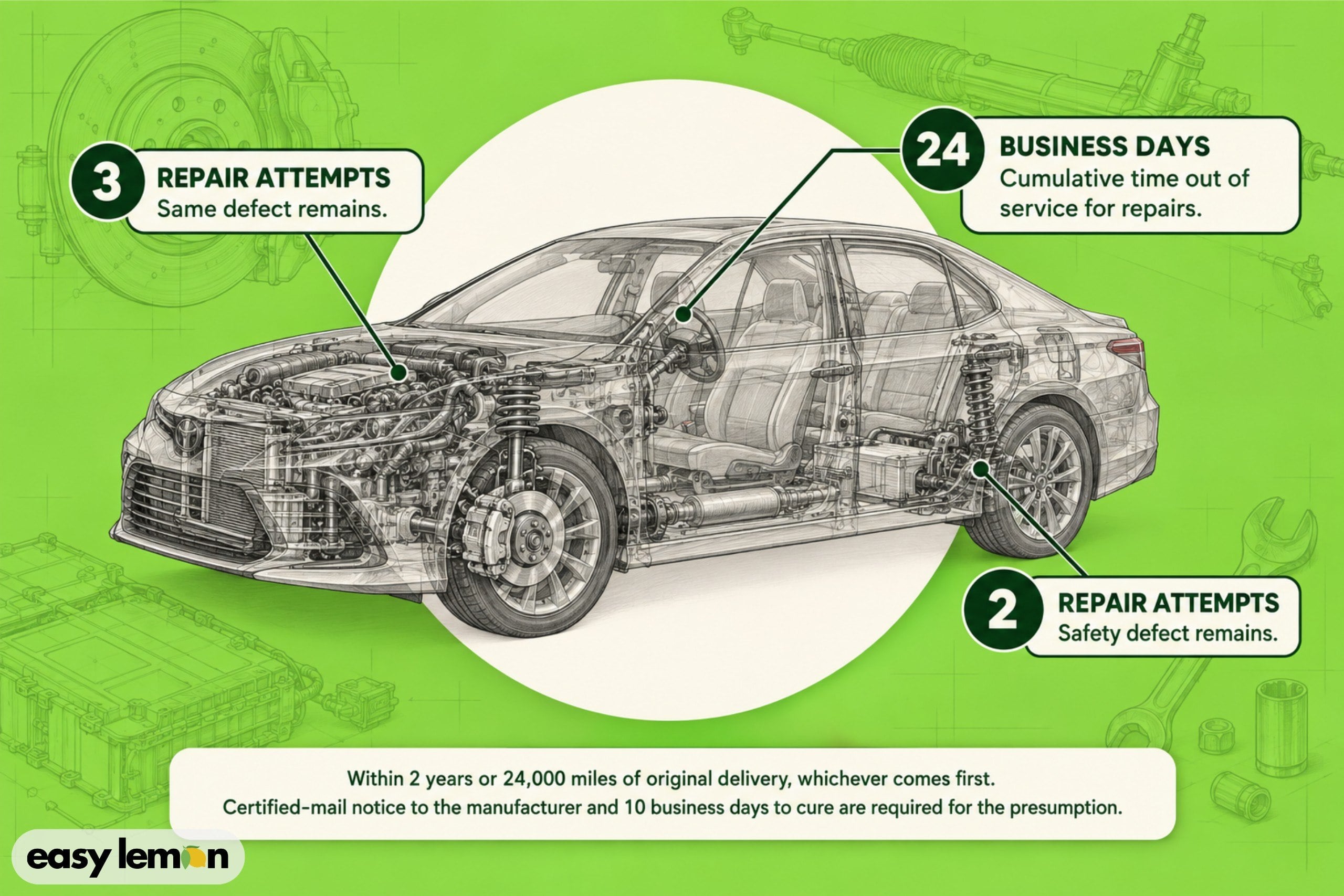
We have seen that there are actually three different ways to demonstrate that you really worked very hard. One way or another will show that you put in sufficient effort. For the first approach, you need to fix the same problem three times, but then the problem should still be there. For the second method, your vehicle must be out of commission due to repairs for at least 24 working days. Workdays exclude weekends and public holidays, so this roughly amounts to about five weeks.
The third route is new and is the most useful addition in the 2024 rewrite. A safety-based nonconformity subject to two or more repair attempts, which still exists, is enough on its own. C.R.S. 42-10-101(2.5) defines a safety-based nonconformity in two ways. It is one that results in a condition likely to cause death or serious bodily injury if the vehicle is driven. It is also one that creates a risk of fire or explosion.
Two attempts rather than three is a meaningful difference when the defect is a brake, a steering component, or a battery pack. All three routes must be satisfied within the first 24,000 miles of operation or within two years following original delivery, whichever occurs earlier. Those periods are extended by any time repair services are unavailable because of war, invasion, strike, fire, flood, or other natural disaster.
One condition sits above all three and ends more Colorado claims than anything else. The presumption does not apply against a manufacturer unless two things have happened first. The manufacturer must have received prior written notification by certified mail, stating that one or more attempts to repair the same nonconformity have been made and that the nonconformity remains.
Manufacturers need to resolve issues within ten working days. For formal notices, certified mail is necessary. Calls to service managers do not count as proper notification, and neither does sending email. Each incident of a problem counts as one nonconformity; if there are two or three such incidents, this number goes up accordingly. Also, in Colorado, dealers distributing manuals must attach a notice form. This form should be clear and conspicuous that certified mailing is required.
The manufacturer has defenses as well. C.R.S. 42-10-104 gives it two. One is that the alleged nonconformity does not substantially impair the vehicle’s safety, use, or market value. The other is that the problem results from abuse, neglect, or unauthorized modifications or alterations by the consumer. In a prevailing-side state, an affirmative defense that succeeds is not just a loss.
How Is the Use Allowance Calculated in Colorado?
Before the new rules starting in 2024, the statute used words to define what a reasonable allowance should be but left some flexibility and discussion open regarding how to calculate it. Under the new Colorado Revised Statute 42-10-103(4), there is now specific wording defining this allowance.
The allowance amount is determined by multiplying the total contract price or lease cost by a fraction. This fraction uses 100,000 as its denominator. The numerator of this fraction is the number of miles driven before the car was first brought in for repairs due to a defect. Then add the miles that have been driven during any period when the car has not been out of service because of maintenance or repairs.
Two consequences follow. Miles driven while the vehicle sits at the dealer do not count against you. And because the numerator starts at the first presentation for repair, reporting a defect early directly reduces the deduction from your refund.
Do You Have to Use the Manufacturer’s Arbitration Program First?
In our experience, yes, because Colorado has no state-run lemon law arbitration board. Instead, C.R.S. 42-10-106 looks to the manufacturer’s own program. Some manufacturers run an informal dispute settlement procedure that substantially complies with part 703 of title 16 of the Code of Federal Regulations. Where one does, the refund and replacement provisions of 42-10-103(1) do not apply to a consumer who has not first resorted to it.
Note the limit of that rule. It is not a blanket bar on going to court. It specifically conditions the statutory buyback and replacement remedy. Check your owner’s manual for the program name, because BBB AUTO LINE is the most common one, and the thirty-month clock keeps running while you work out what applies.
Consumers do not always stay in those programs. The 2024 audit of BBB AUTO LINE surveyed twenty-four consumers nationally who had withdrawn their complaints. Ten said they withdrew because they had hired an attorney or were otherwise pursuing their case outside the program. That was the most common reason, ahead of settlement or repair.
People surveyed included ten individuals who had claims processed by BBB AUTO LINE and who didn’t have legal representation of their own. At first, they did not seek legal advice but later did seek it. Also audited were 274 people who said they got both claim forms and summary reports. Among this larger group, 44.2% found those documents extremely useful while 19% rated them as very useless.
How Long Do You Have to File a Colorado Lemon Law Claim?
Based on what we know, if you buy or lease a car that was delivered on or after August 7, 2024, you have 30 months from that delivery date to file any lawsuit related to that vehicle. As per Colorado Revised Statutes § 42-10-107, lawsuits need to be filed no later than 30 months after delivery of the car to the consumer. So there is only this one time limit and nothing about comparing against an earlier date.
While the consumer is already going through arbitration under C.R.S. 42-10-106 and the vehicle is unavailable due to repairs, there’s another reason that can be quite important and relevant in cases where there are long stays at a repair shop. This second reason for tolling matters greatly.
The three-year deadline that circulates widely on lemon law content is wrong for Colorado in every version of the statute. For a vehicle delivered before August 7, 2024, the deadline is shorter still. It runs six months after the warranty term expires, or one year after original delivery, whichever comes earlier.
How Should You Evaluate Colorado Lemon Law Fee Risk Before Filing?
Before you sue for lemon status in Colorado, we look at four key things that impact both how strong your claim is and how risky it will be. These include the date when you received the car, the nature of any defects with the vehicle, the evidence that you have available, and what would result if the manufacturer won. Together, these four elements, date, defect, documents, and downsides, can help you assess whether your claim makes sense before you actually file suit.
Check first whether the car has been sold or leased after August 7, 2024. After finding that information out, you can then decide different rules for repair work, how many miles have gone on the odometer, when it is not in use, and when you need to do some paperwork.
In order to clearly identify specific deviations and determine which legal process applies, there must be at least three repairs for the same deviation. If the deviation relates to safety issues, there need to be only two such repairs. In addition, there should be more than 24 workdays where the equipment is not operational.
Before you file anything important, build up your chain of evidence. Things like repair orders, dates, mileage logs, communications with manufacturers, and certified mail, along with documentation proving the manufacturer was given a chance to fix any issues, all help show that legal requirements are met.
Let’s also consider the rule of shifting costs. Section C.R.S. § 42-10-103(3) concerns the winning party, so we cannot simply decide who gets legal fees. We have to think about what would happen if the company that manufactured the product won instead.
This four-part screen does not determine whether a claim will succeed. It identifies the statutory issues that should be resolved before litigation begins.
How Do You File a Lemon Law Claim in Colorado?
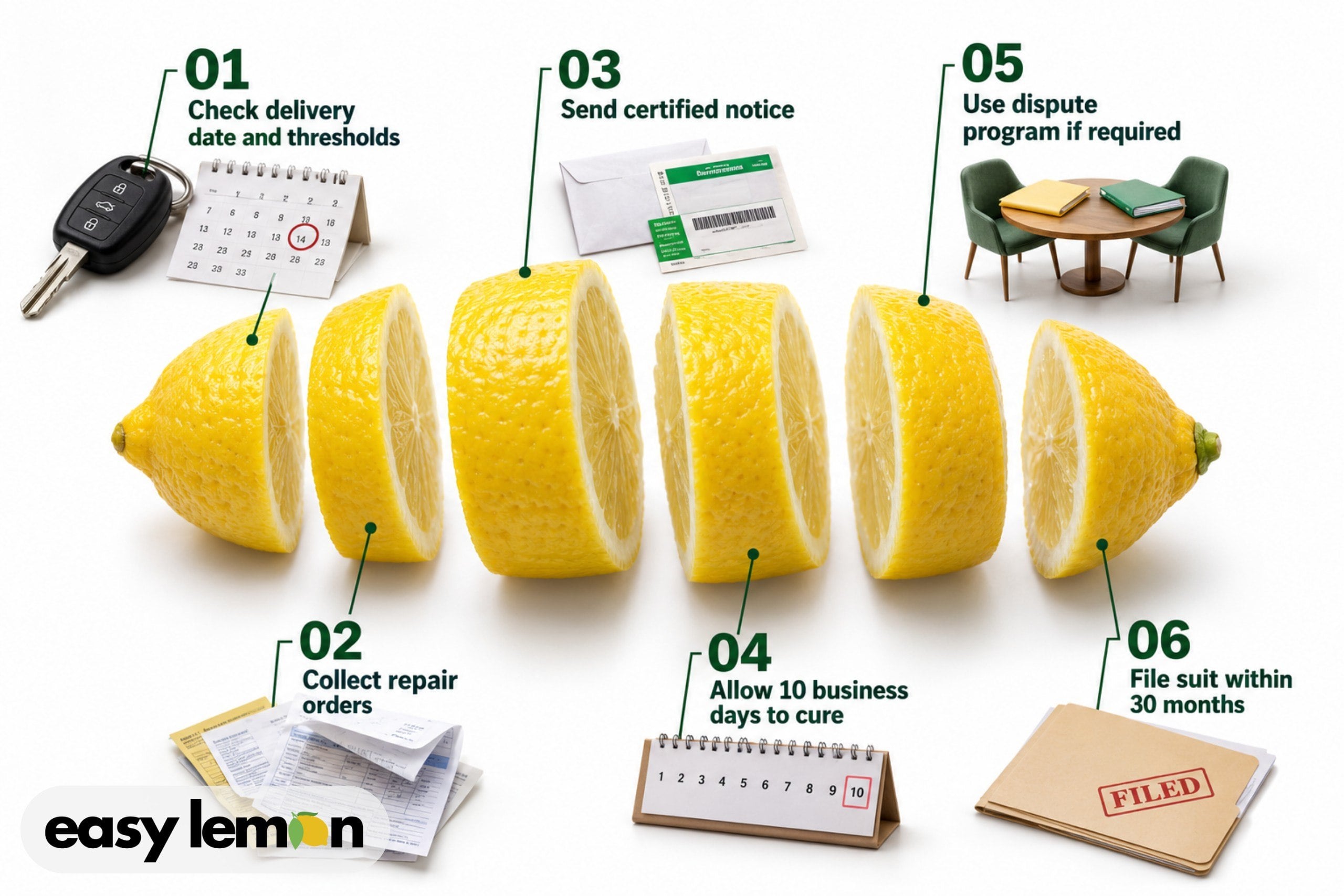
Here’s an important point: skipping steps could lead to things going wrong. So go through this step by step.
Step 1 – Set a delivery date and then check what threshold levels apply to your car. Everything depends on getting that step right.
Step 2 – Collect all repair orders. This means collecting the start date and end date for each repair. Also record the symptoms that customers report. Record exactly what was done as part of the repair work. From this information, we learn how often repairs have failed and how many days of business we missed.
Step 3 – Send written notification to the manufacturer by certified mail. It must state that you have made one or more repair attempts for the same nonconformity and that the defect remains. Use the form the dealer supplied with the owner’s manual if you still have it, and keep the receipt.
Step 4 – Allow ten business days to cure after the manufacturer receives the notice. That visit counts as one nonconformity subject to repair.
Step 5 – Follow the informal dispute resolution process set up by the manufacturer if they have one. That is because the limitation period is paused while that arbitration is pending.
Step 6 – File suit within the thirty-month period set by C.R.S. 42-10-107, counting any tolling. This is when the prevailing-side fee provision applies. Our walkthrough of the lemon law process covers what each stage looks like for the client.
What Do Colorado Lemon Law Attorneys Charge?
Approximately one third of what is recovered goes directly to you. This is unlike situations involving personal injury cases where lemon laws have different financial treatment. Often people have heard that somewhere between 33 and 40 percent will be paid out. That is wrong, though, because that is confusing things. In fact, lawyers get paid only for the work they have done fairly for manufacturers or sellers, and they don’t receive any money directly that customers get back.
Our published fee terms say the manufacturer generally pays attorneys’ fees and costs in lemon law matters under applicable fee-shifting statutes or negotiations. They also say clients may be responsible for certain costs and expenses incurred during litigation. Our guide to what lemon law attorneys cost sets out how that works in practice.
Colorado adds an important question: agreements should be clear about what happens if there’s no win and the manufacturer is entitled to fees under 42-10-103(3). Also, who is responsible for that risk? If you don’t clearly respond to these questions from the side that wins, this isn’t the right firm for work in Colorado.
Several things move the cost of running the case. A complete set of repair orders shortens the work. A manufacturer that disputes whether the defect substantially impairs safety, use, or market value generates more work than one that negotiates a cash settlement or a replacement vehicle. Cases needing expert testimony cost more, and expert witness fees are a cost rather than an attorney fee, which is why a written fee agreement should address them separately.
Do You Need a Lawyer for a Colorado Lemon Law Claim?
Not as a formal requirement, but the pressure points here are unusually unforgiving. The certified mail notice, the ten-business-day cure period, the August 2024 split, the business-day count, and the prevailing-side fee rule all punish a self-represented owner who gets one detail wrong. Our discussion of whether you need a lemon law attorney covers the general case, and Colorado strengthens it.
While most explanations of Colorado lemon laws concentrate only on eligibility criteria, this document focuses on the really important elements that actually influence results. Key dates are August 7, 2024, along with important current repair schedules due to safety considerations. Rules also require repairs within ten workdays. There are rules about statutory compensation as well as processes for resolving disputes with manufacturers. There is also a limitation of thirty months for filing lawsuits. This document also takes a look at who gets legal fees awarded.
This new law is different from those that apply to cars purchased or leased prior to August 7th, 2024. Rules differ regarding repair services, mileage limits, downtime regulations and also there are specific claims handling procedures. We don’t just say Colorado has lemon laws; we really aim to provide clear legal information because you need to know which sections of this new law affect you and how much you could be liable if you choose to file a claim.
Need Help With a Colorado Lemon Law Claim?
Ask four questions. Ask which version of Article 10 governs your vehicle and why. Ask how the firm reads C.R.S. 42-10-103(3) and what its plan is for the downside. Ask whether it brings claims under the Magnuson-Moss Warranty Act as well, because the federal route does not shift fees against you. And ask which attorney is admitted where, because lemon law firms often work across state lines, and that answer belongs on the record before you sign.
Easy Lemon is a firm with experienced Lemon Law attorneys who can evaluate your case, review your lease agreement, and file a legal claim where necessary. Visit any of our offices or contact us directly to begin your journey toward getting the relief you deserve.
Frequently Asked Questions
These are the questions Colorado vehicle owners ask most often about what a lemon law claim costs.
Do Colorado Lemon Law Attorneys Take 33 to 40 Percent?
This number is for cases related to personal injuries and is not about lemon law. Under C.R.S. 42-10-103(3), courts should award reasonable attorney fees to the winner. Fees are determined based on the amount of work performed and go to the manufacturer rather than being a percentage of any refund that you get.
Can a Colorado Consumer Be Ordered to Pay the Manufacturer’s Fees?
This statute puts manufacturers at risk because it provides that awarding reasonable attorney fees goes to the winning party. If a manufacturer wins, they are also on the winning side. Through our research, we have not found any Colorado appeals court decisions that have interpreted this phrase in this specific context. This means there is uncertainty about what might happen, and why these kinds of claims should be carefully screened before they are filed.
How Long Do I Have to File a Colorado Lemon Law Claim?
For a car that you buy or lease starting from August 7, 2024, there is a grace period of thirty months after delivery. This grace period is also waived during arbitration as per C.R.S. 42-10-106 or if the car is not available because of repairs. There is no three-year limit either way under Colorado law.
How Many Repair Attempts Does Colorado Require?
There are three chances for the same defect; if the defect is safety-related, you get only two chances. Cars sold or leased starting from August 7, 2024 have a grace period of 24 working days because of that. Older cars get only four chances total and a maximum of 30 working days.
Is There a Mileage Limit in Colorado?
Under current laws, yes. Both the repair attempts and time that the vehicle was out of service have to happen within the first 24,000 miles driven or within two years after the vehicle was originally delivered, which comes down to whichever happens sooner. Older legislation didn’t include any mileage requirement; hence most of the guidance that’s been published still says Colorado does not have such a limit.
What Does the Refund Include?
We calculate the total cost including sales tax, license fees, registration fees, and other government charges. We apply a reasonable discount based on C.R.S. 42-10-103(4) formula. Costs for renting cars and towing are not regulated by Colorado statutes; therefore, we handle those separately, and they are not part of a fixed component of the remedy.
Legal Notice: The information in this article is for general use only and does not constitute legal advice. Reading this article does not create a lawyer-client relationship. Easy Lemon is run by Rock Point Law PC, but none of its lawyers are yet admitted to practice law in Colorado. There’s nothing here suggesting that Rock Point Law PC provides service in Colorado or makes any claim about admission to practice there. Colorado recently changed Article 10 of Title 42 through Senate Bill 24-192. Some new criteria for determining what qualifies as a vehicle take effect on August 7, 2024. Determining qualification depends on specifics like warranties and current laws, which can change over time. Colorado Revised Statute 42-10-103(3) awards reasonable attorney fees to winning parties. Roughly speaking, this means if someone loses a lawsuit, they might end up having to pay reasonable attorney fees to the manufacturer. We haven’t found any appellate court cases from Colorado that interpret this phrase. Deadlines specified in Colorado Revised Statutes 42-10-107 are very strict. Consumers should get advice from licensed attorneys who can carefully study their own individual situations before relying on information in this article.
We say that we handle legal matters for attorneys. Attorneys at Easy Lemon have licenses to practice law in New York, Pennsylvania, New Jersey, Florida, and Texas. We do not necessarily have physical addresses in certain states to show our license there. Results of previous cases generally don’t forecast future results very well. Every case is different, and success depends on specifics and applicable laws.
Reviewed by: Steven P Nassi Esq., managing attorney at Easy Lemon. Admitted to practice in New York (Bar Number 4263489), Pennsylvania, and New Jersey. Mail service and process service: 10880 Wilshire Boulevard, Suite 1290, Los Angeles, CA 90024. Phone number: (855) 435-3666
What Our Clients Say
Read More Relevant Blogs

Colorado Lemon Law Attorney Fees: Who Pays?
Colorado has some unique rules when it comes to costs and fees compared to other states. Under Colorado...
Read Full Post →
Georgia Lemon Law Attorney Fees: Who Pays?
In Georgia, whether the manufacturer pays your attorney fees is a decision the arbitrator makes, not an automatic...
Read Full Post →
Texas Lemon Law Attorney Fees: Who Pays?
Texas lemon law attorney fees depend on the legal route you use. The Texas Lemon Law administrative process...
Read Full Post →Resolving Your Lemon Law
Case Has Never Been Easier
Our experienced attorneys handle everything — from paperwork to manufacturer negotiations. You focus on your life, we'll get you results.