
The purpose of Washington State’s used car lemon law is to safeguard car owners who inadvertently buy a flawed vehicle that doesn’t adhere to fundamental safety or performance requirements. Certain used cars in Washington are covered by the lemon law if they satisfy stringent requirements related to the manufacturer’s warranty coverage, mileage restrictions, and the original retail delivery date. Consumers in Washington can make wise decisions and pursue a compelling consumer claim by being aware of the law’s application, what constitutes a lemon, and how the arbitration procedure operates.
At Easy Lemon, we leverage expertise gained from years of experience handling lemon law claims to guide our clients through complex legal procedures under the car lemon law with confidence. With an amazing track record of high success rates, our lemon law attorneys have helped many customers resolve their vehicle issues promptly with a satisfactory outcome. Contact us today for a free consultation.
This post explains Washington’s Lemon Law, including eligibility requirements, the step-by-step claims process, best practices, and benefits.
What Is Washington State Used Car Lemon Law?
The purpose of Washington State’s used car lemon law is to safeguard car owners who buy or rent a used car with significant flaws that are covered by the written warranty provided by the manufacturer. When a car meets certain requirements, such as being covered by the original manufacturer’s warranty at the time of purchase and having one or more flaws that significantly reduce its value, safety, or ability to be driven normally, the lemon law is applicable.

If a used car is still covered by the original manufacturer’s warranty at the time of purchase, it may be eligible under Washington’s lemon law. Only defects that arise during the term of the original manufacturer’s warranty are potentially covered under Washington’s lemon law, and extended warranties or third-party warranties do not qualify under lemon law protections in Washington.
According to the National Highway Traffic Safety Administration (NHTSA), over 55 million vehicles were recalled in 2023 alone due to safety-related defects. This highlights how common serious mechanical and safety problems are in both new and used vehicles. Unlike some consumer protection rules, Washington State’s lemon law does not include a cooling-off period for used car purchases. This makes the lemon law, implied warranty, and federal law, such as the Magnuson-Moss Warranty Act, critical tools to protect consumers who purchased a defective vehicle.
What Are the Key Components of the Washington State Used Car Lemon Law?
The core components of Washington State’s used car lemon law include coverage for used cars, warranty requirements, and consumer protection mechanisms. The law covers certain vehicles purchased or leased within two years of delivery to the original retail consumer and within the first 24,000 miles of operation, provided they remain under manufacturer’s warranty coverage.
A vehicle may be considered a lemon if it has one or more significant defects that have been subject to a reasonable number of attempts to repair under the manufacturer’s warranty. A reasonable number of repair attempts is defined as at least two repairs for a safety defect and at least four repairs for a non-safety defect. If a used car has been out of service for at least 30 cumulative days due to repairs, it may also qualify for lemon law protections.
Additionally, most used cars sold by licensed dealers in Washington are covered by an implied warranty, which requires the car to be fit for ordinary driving purposes. Even if the lemon law does not apply, vehicle owners may still have rights under implied warranty, federal lemon law, or other federal law protections.
Lemon Law vs Other Legal Remedies in Washington State
Lemon Law vs. Other Consumer Protection Options
While Washington’s Lemon Law provides strong remedies, it is not the only legal option available to consumers. In some cases, buyers may also rely on implied warranty claims, fraud laws, or federal protections under the Magnuson-Moss Warranty Act. However, lemon law claims often offer faster dispute resolution through arbitration and clearer remedies, making them a preferred option when statutory requirements are met.
How Does Washington State’s Used Car Lemon Law Work?
Washington’s lemon law works by giving consumers a structured legal process to resolve disputes with manufacturers who failed to fix substantial defects. The process typically involves warranty repairs, documentation of defects, and the opportunity to request arbitration through the lemon law administration overseen by the Attorney General’s Office. The lemon law applies to used cars purchased within the eligibility period and tendered for repair at least once during the factory warranty period.
Consumers must provide the manufacturer with a reasonable number of attempts to repair the vehicle before pursuing a lemon law claim, and the manufacturer must be given a fair opportunity to fix the defect that occurred. If the manufacturer failed to repair the vehicle after repeated attempts, consumers may request arbitration and seek remedies such as a refund or a replacement vehicle at the same price, including adjustments for lease payments, sales tax, and purchase price.
The 4-Part Lemon Law Qualification Framework
To determine whether a used vehicle qualifies under Washington’s Lemon Law, consumers can evaluate their situation using four key factors:
- Warranty Coverage – The defect must occur while the vehicle is covered by the original manufacturer’s written warranty.
- Defect Severity – The issue must substantially impair the vehicle’s use, safety, or value.
- Repair History – The manufacturer must have had a reasonable number of attempts to repair the defect.
- Timing Requirements – The claim must fall within statutory deadlines tied to the original retail delivery date.
If all four elements are present, the vehicle is more likely to meet lemon law eligibility standards.
What Is the Step-By-Step Process for Filing a Lemon Law Claim?
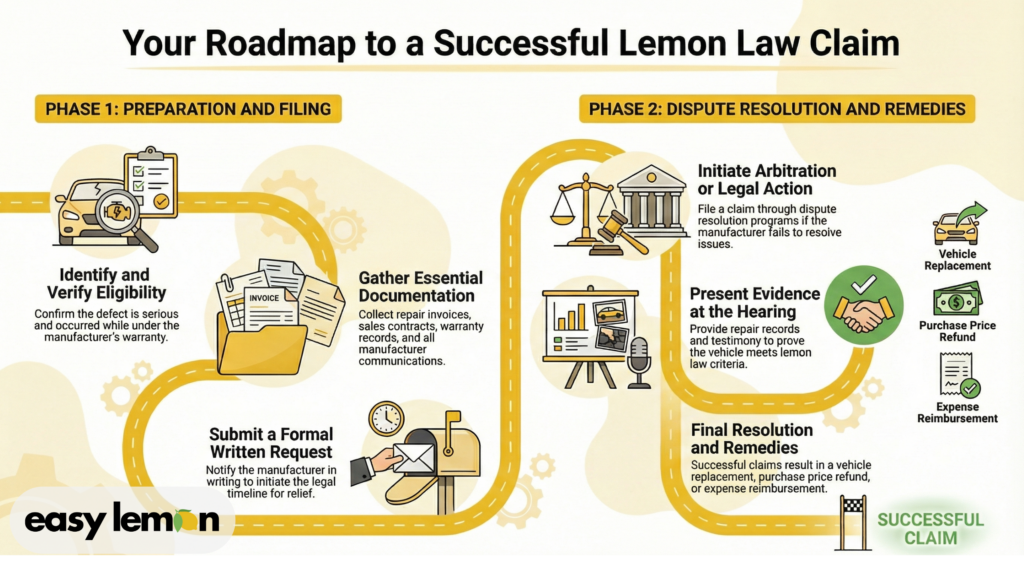
It can be difficult to file a lemon law claim, particularly if a new or used car has significant flaws that compromise its value, safety, or dependability. Lemon law covers certain motor vehicles when defects substantially impair their use, safety, or resale value, but consumers must follow specific steps to ensure their claim is valid. Knowing how to document defects, submit a written request, and navigate arbitration or court proceedings can significantly increase the likelihood of a successful outcome.
Step 1: Identify the Defect and Its Impact
Begin by determining whether your motor vehicle has a serious safety defect, major defects, or one or more defects that substantially impair its use, safety, or resale value. This can include a life-threatening malfunction, a condition that makes the vehicle unreliable, or issues that limit the driver’s ability to operate the vehicle safely. The defect must have occurred while the vehicle was covered by the manufacturer’s written warranty or a service contract, whether it involves a new vehicle, used vehicle, or certified pre-owned vehicle.
Step 2: Confirm Eligibility Under Lemon Law
Review whether the lemon law covers your situation by checking key factors such as the original delivery date, original retail sale, and whether the vehicle was originally purchased for personal use. Both new vehicle owners and some used vehicle buyers may qualify if the vehicle meets statutory requirements, including gross weight rating limits and warranty coverage. If the vehicle has undergone at least one attempt at repair by authorized dealers for defects covered under warranty, it may indicate that the vehicle qualifies for a claim.
Step 3: Gather Documentation
Collect all relevant documents to support your case, including the sales contract, repair invoices, warranty records, the owner’s manual, and any evidence of repeated repairs or failed fixes. Documentation should also show when the defect occurred, details of the test drive, and any communications with the manufacturer or dealer. Strong documentation is essential to proving that the consumer’s claim meets legal requirements.
Step 4: Submit a Written Request to the Manufacturer
Prepare a formal written request to the manufacturer describing the defect, repair history, and the relief sought. This step initiates the legal timeline and allows the manufacturer to respond. In some states, including Washington, this step is critical for Washington consumers before moving forward with arbitration or court action.
Step 5: File a Complaint or Initiate Arbitration
If the manufacturer fails to resolve the issue, proceed with filing a claim through the manufacturer’s dispute resolution program or the state’s arbitration process. The arbitration process provides a structured legal forum where evidence is reviewed and arguments are presented without immediately going to court. This stage is often required before pursuing a lawsuit.
Step 6: Participate in the Arbitration Hearing
During the arbitration hearing, both the consumer and the manufacturer present documentation, repair records, and testimony. The arbitrator evaluates whether the vehicle meets lemon law criteria, whether defects substantially impair its value or safety, and whether the manufacturer made reasonable repair attempts. The arbitrator then issues a decision, which may include a refund, replacement, or other remedies.
Step 7: Escalate to Court if Necessary
If arbitration does not resolve the dispute or the decision is unfavorable, you may pursue the matter through the formal legal process, including filing a lawsuit in the superior court. At this stage, the court determines whether the vehicle qualifies as a lemon and what compensation or remedies the consumer is entitled to receive.
Step 8: Resolution and Remedies
If successful, remedies may include a vehicle replacement, refund of the purchase price, or reimbursement for related expenses. These outcomes depend on whether the vehicle meets statutory thresholds and whether the consumer’s claim meets the legal standards established under state lemon laws.
A successful lemon law claim depends on careful documentation, timely communication with the manufacturer, and adherence to the required legal process. By following the proper steps, consumers can determine whether their vehicle qualifies for protection under the law. Whether the claim involves a new vehicle, a used vehicle, or a certified pre-owned model, understanding each stage of the process empowers consumers to pursue fair compensation and hold manufacturers accountable for unresolved defects.
Case Study: Repeated Transmission Failures in a Certified Pre-Owned SUV
A Washington consumer purchased a certified pre-owned SUV that experienced repeated transmission failures within 6 months of purchase. Despite four repair attempts by authorized dealers, the defect persisted, causing unsafe driving conditions. After filing a lemon law claim through arbitration, the consumer received a full refund, including sales tax, registration fees, and out-of-pocket repair costs. “In our experience, many consumers hesitate to pursue claims because they assume used cars aren’t covered, but timely documentation and persistence often lead to full remedies,” says Natalie Nassi, an experienced lemon law attorney with Easy Lemon.
What Are the Requirements for a Claim?
Filing a lemon law claim can be complex, especially when a new vehicle, used vehicle, or certified pre-owned car develops major defects, serious safety defects, or life-threatening malfunctions that substantially impair its use, safety, or resale value. Washington State’s Lemon Law protects new vehicle owners and some used car buyers whose vehicles are under the manufacturer’s written warranty, though extended or third-party warranties do not qualify.
To be eligible, defects must occur within 30 months of the original retail delivery date, and the vehicle must have undergone at least one repair attempt during the warranty period. Issues caused by owner abuse, negligence, or unauthorized modifications are excluded, making careful documentation of the defect, repair history, and supporting records essential. The implied warranty of merchantability also ensures that used cars must be reasonably safe and operable for ordinary driving purposes.
Once eligibility is confirmed, consumers should submit a written request to the manufacturer describing the defect and repair attempts. If the issue remains unresolved, the next step is filing a claim through the arbitration process, which is free and must be scheduled within 45 days of acceptance.
During the arbitration hearing, both parties present evidence, and the manufacturer may request a vehicle inspection. A successful claim allows Washington consumers to recover a refund, replacement vehicle, or other remedies, giving the best chance to resolve disputes over vehicles that are unreliable or substantially impaired. Following these steps carefully ensures the consumer’s claim meets all legal requirements and maximizes protection under the lemon law.
What Are the Benefits of Washington’s Lemon Law?
Washington’s Lemon Law lets consumers recover a refund, replacement vehicle, or related costs if their claim succeeds. It covers vehicles with major or safety defects under the manufacturer’s written warranty within 30 months of the original retail delivery date, excluding issues caused by owner abuse, negligence, or unauthorized modifications. A reasonable number of repair attempts is required to qualify.
The arbitration process is free, handled by the Attorney General’s Office, and must be held within 45 days of acceptance. Consumers can request arbitration even if they are not the original owner, provided they submit the purchase or lease agreement and title/registration documents. They are entitled to copies of any inspection, diagnosis, or test-drive reports. By combining state lemon law, the implied warranty, and federal protections under the Magnuson-Moss Warranty Act, Washington consumers gain strong legal recourse against vehicles that are unreliable, unsafe, or reduce resale value.
While Washington’s Lemon Law offers strong protections, not every defective vehicle qualifies for relief. Some cases fail because defects are minor, repair attempts are insufficient, or deadlines are missed. Understanding these limitations helps consumers set realistic expectations and choose the most effective legal strategy.
How Can Challenges Be Overcome in the Lemon Law Process?
Consumers pursuing a lemon law claim often face obstacles when manufacturers dispute coverage, argue that defects are caused by misuse or normal wear, or question whether the vehicle meets eligibility requirements. These disputes can complicate the arbitration process or delay resolution, making it important for consumers to understand their rights and the dispute resolution options available.
Evidence gathering is another common challenge, as proving substantial defects, warranty repairs, and defect duration requires thorough documentation. Service records, repair invoices, inspection reports, written requests, and test-drive notes all serve as critical evidence to demonstrate that the vehicle meets lemon law standards.
Arbitration hurdles may also arise if manufacturers delay responses or contest defect severity, but the structured arbitration process, with oversight from the Attorney General’s Office in Washington, ensures fairness. Similarly, in states like Illinois, consumers can rely on arbitration or court proceedings under the state’s lemon law to resolve disputes, emphasizing the importance of following procedural rules and maintaining complete records to strengthen claims.
What Are Best Practices for Filing a Lemon Law Claim?
A successful lemon law claim begins with thorough documentation. Keep detailed records of all warranty repairs, service contracts, and communications with authorized dealers, and track the number of repair attempts, defect duration, and any safety issues affecting ordinary driving. Complete and organized documentation is critical to proving that the vehicle meets lemon law requirements.
Seek legal support early to understand whether your vehicle qualifies and to ensure that your consumer’s claim meets all legal standards. Experienced guidance can help navigate disputes with manufacturers, prepare arbitration requests, and avoid common procedural errors.
Timely submission is equally important. Washington’s lemon law has strict deadlines tied to the original delivery date and warranty period, and delays can jeopardize your claim. By acting promptly, keeping accurate records, and understanding the law, consumers can maximize their chances of obtaining a refund, replacement vehicle, or other remedies for a defective vehicle.
In our experience handling Washington lemon law cases, manufacturers are most likely to challenge claims when documentation is incomplete or repair attempts are poorly recorded. We have found that consumers who keep detailed service records and act within statutory deadlines significantly increase their chances of securing refunds or replacement vehicles.
What Are the Next Steps After a Successful Claim?
After a lemon law claim is resolved, the vehicle return process begins. Consumers typically return the defective vehicle to the manufacturer or authorized dealer, following instructions provided in the settlement or arbitration decision.
The refund process varies depending on whether a full or partial refund is awarded. It usually includes the original purchase price, taxes, fees, and any documented out-of-pocket expenses related to the defect or repairs. Consumers should confirm payment timelines and ensure all paperwork is completed accurately to finalize the refund.
If a replacement vehicle is part of the resolution, the manufacturer will provide a comparable model, often with a new warranty. Consumers should carefully review the replacement’s terms and inspect the vehicle before taking delivery to ensure it meets expectations. Following these steps ensures a smooth transition and full benefit from the lemon law resolution.
Need a Lemon Lawyer for Your Used Car in Washington State?
Unlike many law firms that treat lemon law cases as routine disputes, Easy Lemon applies a strategic, evidence-driven approach to every claim. By combining deep knowledge of Washington statutes, arbitration procedures, and manufacturer tactics, we help clients pursue faster resolutions and stronger outcomes than generic legal strategies typically achieve.
With several years of experience, our lemon law attorneys at Easy Lemon have helped many clients resolve their lemon law cases. Take action today to resolve your lemon law issues and secure the refund or replacement you deserve. Walk into our office or contact us for a free consultation and let our experienced attorneys fight for you.
Frequently Asked Questions
Below are some frequently asked questions in our experience, concerning the Washington used car lemon law. These answers would help enlighten you about the things they cover.
What Are the Requirements to Qualify for the Washington State Used Car Lemon Law?
A used car may qualify if it is covered by the original manufacturer’s written warranty and has defects that substantially impair its use, safety, or value within the warranty period. The consumer must also show a reasonable number of repair attempts, typically at least two for safety defects or four for non-safety defects.
How Long Do I Have to Report a Lemon Under the Washington State Used Car Lemon Law?
Consumers generally must request arbitration within 30 months of the vehicle’s original retail delivery date. Defects must occur while the vehicle is still covered by the manufacturer’s warranty to qualify.
Are Private Sales Covered Under the Washington State Used Car Lemon Law?
Private sales are usually not covered because the law primarily applies to vehicles sold or leased through dealers and covered by the manufacturer’s warranty. However, other legal protections, such as implied warranty or fraud laws, may still apply depending on the circumstances.
Where Can I Find the Official Washington State Used Car Lemon Law Statute?
The official statute is found in the Revised Code of Washington (RCW) 19.118, which governs the Motor Vehicle Warranties Act. You can also find authoritative information through the Washington State Attorney General’s Office website.
What Remedies Are Available if My Used Car Is a Lemon in Washington State?
If successful, consumers may receive a refund of the purchase price and related costs or a comparable replacement vehicle. Additional remedies may include reimbursement for repair expenses and other costs tied to the defect, depending on the case.
Legal Disclaimer: This content is provided for informational purposes only and does not constitute legal advice. Lemon Law eligibility and outcomes vary based on individual circumstances, vehicle history, and applicable laws. Reading this article does not create an attorney-client relationship. For legal advice regarding your specific situation, consult a qualified Arizona Lemon Law attorney.

About The Author
Steven Nassi
Steven P. Nassi is the Founder and Managing Partner of Easy Lemon. A seasoned attorney with nearly 25 years of experience, he has handled some of the most high-profile and complex cases in the country. Steven has litigated in state and federal courts in various fields, including consumer protection, construction, insurance, engineering, finance, cyber and more. His reputation is built on skillfully navigating the legal landscape and achieving favorable outcomes for clients.