

The Arizona Lemon Law protects car buyers when a motor vehicle has serious defects that the manufacturer or dealer cannot fix within a reasonable number of repair attempts. The law applies to both new and specific used vehicles, granting consumers legal rights to refunds, replacements, or compensation. Whether you bought a new or used vehicle, the law provides a legal remedy when a motor vehicle fails to function as promised despite repeated repair services. If your motor vehicle significantly limits safety, value, or ordinary purpose, Arizona’s Lemon Law may help you recover your purchase price, obtain cash compensation, or secure an appropriate remedy.
At Easy Lemon, we leverage expertise gained from years of experience handling lemon law claims to guide our clients through complex legal procedures under the car lemon law with confidence. With an amazing track record of high success rates, our lemon law attorneys have helped many customers resolve their vehicle issues promptly with a satisfactory outcome. Contact us today for a free consultation.
This post explains how Arizona lemon laws benefit consumers and what challenges may arise during lemon law claims.
What Is the Arizona Lemon Law?

Arizona Lemon Law is a consumer protection law designed to help buyers when a self-propelled vehicle repeatedly fails to meet quality and performance standards. It applies when a particular defect persists despite reasonable repair attempts by authorized dealers or a motor vehicle dealer.
The Arizona Lemon Law covers motor vehicles designated primarily for the transportation of persons or property over public highways. This includes cars, trucks, motorcycles, motor homes, and other self-propelled vehicles maintained primarily for personal or commercial purposes.
Under Arizona motor vehicle warranties, a vehicle may qualify as a lemon when it has an unreasonable repair history during the warranty period. This means the same nonconformity continues despite multiple repair attempts, or the vehicle spends excessive time out of service.
What are the Key Components of Arizona Lemon Law?
Arizona’s Lemon Law is designed to protect consumers who purchase or lease new motor vehicles that turn out to have serious defects the manufacturer cannot fix within a reasonable number of attempts. Its core purpose is to ensure fairness by holding manufacturers accountable when a vehicle fails to meet basic standards of performance, safety, and reliability. The law applies when a defect substantially impairs the vehicle’s use, safety, or market value and persists despite proper repair efforts.
By creating a legal framework for refunds or replacements, Arizona’s Lemon Law helps balance the power between consumers and vehicle manufacturers. Coverage under Arizona’s Lemon Law generally extends to new passenger vehicles, trucks, vans, and certain other vehicles purchased or leased in the state, provided the defect arises and repair attempts occur within the warranty period or a specified timeframe. To activate these protections, the consumer must give the manufacturer reasonable notice and an opportunity to repair the defect, including written notice that allows a final repair attempt.
If the vehicle remains defective after these efforts, the consumer may seek remedies such as a replacement vehicle, a refund of the purchase price, or other compensation permitted by law. This structure ensures that consumers are not left with unsafe or unreliable vehicles while compelling manufacturers to resolve defects promptly and effectively.
What Vehicles Are Covered Under Arizona Lemon Law?
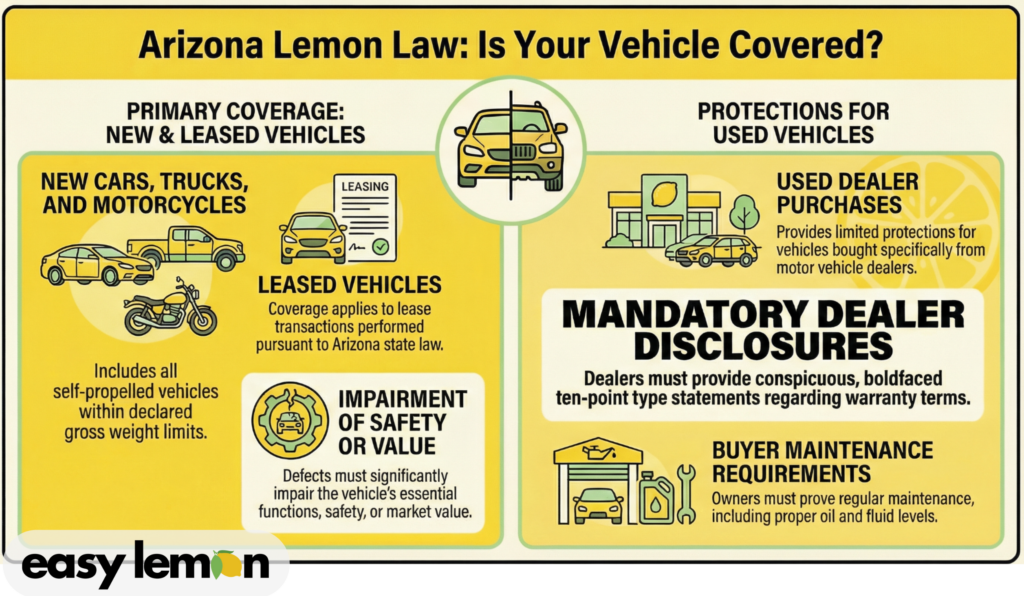
Arizona’s Lemon Law, established under the Arizona Revised Statutes, protects consumers who purchase or lease vehicles from a motor vehicle dealer’s business when defects significantly impair essential motor vehicle functions such as safety, use, or value. Covered vehicles include new cars, trucks, motorcycles, and other self-propelled vehicles within the declared gross weight limits, as well as leased vehicles in a transaction pursuant to state law. When the purchaser exercises their rights, and the manufacturer or seller attempts repairs but fails after a reasonable opportunity, the purchase agreement may become voidable under the car lemon law.
The law also provides limited protections for a used motor vehicle purchased from a used motor vehicle dealer. During the statutory period, the dealer must provide a conspicuous statement printed in boldfaced ten-point type that accurately discloses warranty terms, defects disclosed, and the statement prescribed by law. Arizona’s Lemon Law applies when a defect or nonconformity substantially impairs a vehicle’s use, value, or safety.
The buyer must show they performed regular maintenance, including maintaining adequate oil and other required fluids, unless unusual circumstances apply. If the same problem persists despite repair efforts, the purchaser may seek remedies such as a refund of the purchase price paid, reimbursement of the purchaser’s payments, or replacement, subject to maximum liability and maximum payment limits.
Courts may award attorneys’ fees and apply the remedy prescribed by statute when a dealer or manufacturer fails to comply. Factors such as miles driven, calculating distance, express warranty terms, and extended warranties may affect compensation, but the law ultimately ensures vehicles sold or leased are substantially free from serious defects and that consumers receive meaningful protection when defects remain unresolved.
How Do I File an Arizona Lemon Law Claim?
Filing a claim starts with documenting defects and notifying the manufacturer or motor vehicle dealer fully. The purchaser must allow a reasonable opportunity for repairs, including multiple attempts to fix the same problem. Eligibility for Arizona’s Lemon Law requires reporting defects within the first two yearsor 24,000 miles of delivery.

The law presumes a vehicle is a lemon if it has undergone four or more repairs for the same problem or has been out of service for 30 days or longer. If the implied warranty is breached, the consumer must provide reasonable notice to the seller before seeking other remedies. If the seller attempts to resolve the issue but fails, the consumer may pursue legal action. Below are the steps the consumer can take to properly file a claim.
Step 1: Identify and Document the Defect
The first step is to identify recurring defects that substantially impair the vehicle’s safety, use, or value. Keep detailed records of repair orders, service visits, and communications with the dealer. Documentation is critical in determining whether the dealer complied with warranty obligations or whether unusual circumstances prevented effective repairs.
Step 2: Notify the Manufacturer or Dealer
The purchaser must formally notify the manufacturer or dealer of the defect. This notice should clearly describe the problem and reference the sales agreement or express warranty. In some cases, the dealer told the purchaser about warranty limitations through a bold-faced ten-point disclosure, designed to draw the attention of the purchaser to important terms and conditions.
Step 3: Allow Reasonable Repair Attempts
After notification, the purchaser agrees to give the manufacturer or dealer a reasonable opportunity to repair the defect. This often involves multiple repair attempts for the same issue or extended periods when the vehicle is out of service. If the defect persists despite repair efforts, the legal presumption of a lemon may apply under the relevant subsection of Arizona law.
Step 4: Review Statutory Disclosures and Dealer Obligations
Arizona law requires dealers to provide the following conspicuous statement regarding warranty rights and limitations. If a subsection renders any disclaimer invalid or shows that the dealer failed to meet legal obligations, the purchaser may have stronger grounds for a claim. In certain cases, statutory provisions such as subsection i determine whether the dealer complied with required disclosures and warranty terms.
Step 5: Initiate a Formal Lemon Law Claim
If repairs fail and the defect remains unresolved, the consumer may file a formal Lemon Law claim. Depending on the facts, remedies may include voiding the sales agreement, obtaining a refund, or securing a replacement vehicle. In some cases, the law may require adjustments to compensation, such as deductions based on use or statutory amounts like $25, or provisions under which parties pay one-half of certain costs.
Step 6: Pursue Legal Remedies if Necessary
If the manufacturer or dealer refuses to resolve the claim, the purchaser may pursue legal action. Courts may determine whether the purchase agreement is voidable and apply remedies based on statutory provisions and the facts of the case. Successful claims may result in refunds, replacements, or additional relief depending on the applicable subsection of the law.
Filing an Arizona Lemon Law claim requires careful documentation, proper notice, and patience through the repair process. When a new vehicle or covered mobile dwelling continues to exhibit serious defects despite reasonable repair attempts, the law provides structured remedies to protect consumers. By following each step and understanding statutory requirements, purchasers can effectively assert their rights and seek fair compensation when a vehicle fails to meet legal standards.
The Easy Lemon 5-Step Lemon Law Framework
Based on our experience handling hundreds of Lemon Law claims, we developed a practical framework to help consumers understand their position:
- Defect Identification – Confirm that the issue affects safety, value, or usability.
- Repair Pattern Analysis – Track repeated repairs or extended downtime.
- Warranty Qualification – Determine whether the defect occurred within warranty limits.
- Manufacturer Accountability – Provide formal notice and a final repair opportunity.
- Legal Resolution – Pursue refunds, replacements, or cash compensation.
This structured approach helps consumers evaluate their claims before initiating legal action.
How Can Consumers Strengthen Their Arizona Lemon Law Claims?
Consumers can strengthen their Lemon Law claims by carefully documenting every repair invoice, service report, and communication with the dealer or manufacturer. Reporting defects as soon as they appear helps establish a clear timeline of recurring issues, while avoiding unauthorized repairs protects warranty rights and prevents manufacturers from disputing responsibility. Requesting written explanations when repairs fail can further demonstrate that the defect persists despite reasonable repair attempts.
Seeking advice from a Lemon Law attorney early in the process can also be beneficial, as it helps consumers avoid procedural errors, understand their rights under the law, and build a stronger case. Taking these proactive steps can significantly improve the likelihood of obtaining a refund, replacement, or other compensation under the Arizona Lemon Law.
What Are the Benefits of the Arizona Lemon Law?

Arizona’s Lemon Law offers powerful consumer protections for buyers and lessees of defective vehicles, ensuring they are not forced to keep cars that fail to meet basic standards of safety, performance, or value. One of the primary benefits is the right to a refund or replacement when a manufacturer cannot repair a serious defect after reasonable attempts. Depending on the circumstances, remedies may include recovery of the purchase price, incidental damages, and compensation for diminished value, giving consumers meaningful financial relief.
Another key advantage is the availability of legal recourse for persistent vehicle issues. Consumers who successfully pursue a Lemon Law claim may recover attorneys’ fees, making it possible to obtain professional legal representation without out-of-pocket costs. This structure establishes equity between consumers and manufacturers and promotes fair settlements. In many cases, consumers can also negotiate cash compensation settlements as an alternative to vehicle repurchase or replacement, thereby enhancing the resolution of disputes.
Arizona’s Lemon Law also benefits consumers by reducing the need for lengthy litigation. Most claims are resolved through negotiation or settlement, allowing consumers to secure compensation faster and with less stress. According to multiple studies on U.S. civil litigation, including Lemon Law disputes, about 95% of cases are resolved through settlement before going to trial. Overall, the law ensures accountability for manufacturers, protects consumers from unfair outcomes, and provides clear legal pathways to refunds, replacements, or compensation when vehicles repeatedly fail to perform as promised.
Real Arizona Lemon Law Case Example
In one Arizona case we handled, a client purchased a new SUV that developed repeated transmission failures within the first year of ownership. Despite five repair attempts and more than 40 days out of service, the manufacturer refused to offer a refund or replacement, claiming the defects were “within acceptable limits.”
After filing a Lemon Law claim, we demonstrated that the defects substantially impaired the vehicle’s safety and value. The manufacturer ultimately agreed to repurchase the vehicle and refund the client’s purchase price, taxes, and registration fees, while also paying the client’s attorneys’ fees in full. This case highlights how persistent defects, when properly documented, will result in successful Lemon Law outcomes.
What Challenges Might Arise with the Arizona Lemon Law?
Arizona Lemon Law claims can involve several challenges, most of which relate to proof and documentation. A common issue is demonstrating an unreasonable repair history. Manufacturers may argue that repeated repairs were reasonable under the circumstances and not unusual in the case. Consumers can address this by keeping clear records of repair visits, timelines, and unresolved defects to show that the problem persisted despite multiple attempts to fix it.
Another challenge arises when manufacturers claim the dealer complied with warranty obligations or that defects disclosed resulted from a failure to perform regular maintenance, such as not maintaining adequate oil or other required fluid. To counter this, consumers should retain maintenance records, receipts, and service logs proving that regular maintenance was performed according to the manufacturer’s guidelines.
Disputes may also stem from sales agreement terms, express warranty conditions, or extended warranties. Consumers must show that the vehicle was not substantially free from defects at purchase and that the same nonconformity continued after reasonable repair attempts. Careful review of documentation and timely notification of defects can significantly strengthen a claim and improve the chances of success under Arizona’s Lemon Law.
When a Vehicle May Not Qualify as a Lemon
Not every defective vehicle qualifies under Arizona’s Lemon Law, and some claims may fail depending on the circumstances. A claim may be unsuccessful if the defect is minor and does not significantly affect the vehicle’s safety or value, if the owner failed to perform regular maintenance, or if the issue arose outside the applicable warranty period. Recognizing these limitations enables consumers to establish realistic expectations and evaluate alternative legal remedies when Lemon Law protections do not apply.
Arizona Lemon Law vs Other Legal Remedies
Arizona’s Lemon Law offers robust protections, but it is not the only legal option available to consumers. Lemon Law claims are most effective for new vehicles with repeated defects within warranty limits, while breach of warranty claims may apply when defects fall outside strict Lemon Law criteria, and consumer fraud claims may arise when misrepresentation or undisclosed defects are involved. Each option presents distinct advantages and limitations, thus the optimal approach depends on factors such as the vehicle’s age, warranty status, and defect history.
Why Choose Easy Lemon for Arizona Lemon Law Claims?
Easy Lemon combines legal expertise with a client-focused approach grounded in the Arizona Revised Statutes and practical Lemon Law experience. Our attorneys understand how manufacturers defend claims, how unreasonable repair history is evaluated under circumstances unusual to each case, and when a purchase agreement may become voidable under provisions such as Subsection G.
The Arizona Lemon Law applies to both new and used vehicles, although specific provisions may differ. For used vehicles, the implied warranty of merchantability lasts for 15 days or 500 miles after delivery, whichever comes first, and a used vehicle dealer cannot exclude or modify this warranty during that period. If the implied warranty is breached, the purchaser must give reasonable notice to the seller before seeking other remedies, and in some cases, consumers may pay only twenty-five dollars for up to two repairs, depending on statutory requirements.
We help clients pursue the full range of remedies available under the law, including refunds, replacements, and cash compensation for diminished value and incidental or consequential damages. Since most Lemon Law claims are resolved out of court, our approach focuses on efficient resolution while protecting the rights of every purchaser and ensuring their legal protections are fully enforced.
Why This Arizona Lemon Law Guide Is Different
Unlike generic Lemon Law summaries, this guide is written by attorneys who actively handle Arizona Lemon Law claims and negotiate directly with manufacturers. Our analysis reflects how manufacturers actually defend cases, what documentation they challenge, and where claims succeed or fail in real practice, not just what the statute says on paper. We also explain how Arizona Lemon Law interacts with warranty disclosures, mileage offsets, and dealer obligations that are often overlooked, giving consumers a practical roadmap rather than a surface-level overview.
Are You Ready to Take the Next Step?
If your vehicle continues to suffer from serious defects despite repeated repair attempts, Arizona’s Lemon Law gives you clear legal rights, but enforcing them requires precision, documentation, and timing. At Easy Lemon, our attorneys focus exclusively on Lemon Law claims and know how manufacturers evaluate, delay, and dispute cases.
With several years of experience, our lemon law attorneys at Easy Lemon have helped many clients resolve their lemon law cases. Take action today to resolve your lemon law issues and secure the refund or replacement you deserve. Walk into our office or contact us for a free consultation and let our experienced attorneys fight for you.
Frequently Asked Questions
Below are some frequently asked questions in our experience, concerning the Arizona lemon law. These answers would help enlighten you about the things they cover.
How Does the Arizona Lemon Law Define a ‘Lemon’ Vehicle?
A vehicle is considered a lemon if it has a defect that substantially impairs its use, safety, or value, and the manufacturer cannot fix it after a reasonable number of repair attempts. Arizona law also presumes a vehicle is a lemon if it has undergone multiple unsuccessful repairs for the same problem or has been out of service for an extended period within the warranty timeframe.
What Are My Rights as a Consumer Under the Arizona Lemon Law?
Consumers have the right to a refund, replacement vehicle, or other compensation if a manufacturer fails to repair a qualifying defect after reasonable attempts. They may also recover attorneys’ fees and pursue legal action if the manufacturer or dealer refuses to provide the required remedy.
How Long Do I Have to File a Claim Under the Arizona Lemon Law?
In most cases, defects must be reported, and repair attempts must occur within the first two years or 24,000 miles after delivery of the vehicle, whichever comes first. Filing deadlines may also depend on warranty terms and specific circumstances, so timely action is essential.
Can I Pursue a Claim Under the Arizona Lemon Law if I Bought a Used Car?
Arizona Lemon Law provides limited protection for used vehicles, typically within a short period after purchase and under specific warranty conditions. Used car claims often rely on implied warranty rights or other consumer protection laws rather than full Lemon Law coverage.
What Is the Process for Resolving a Dispute Under the Arizona Lemon Law?
The process usually involves documenting defects, notifying the manufacturer, allowing reasonable repair attempts, and seeking a refund or replacement if repairs fail. If the dispute is not resolved through negotiation, consumers may pursue arbitration or file a lawsuit to enforce their rights.
Legal Disclaimer: This content is provided for informational purposes only and does not constitute legal advice. Lemon Law eligibility and outcomes vary based on individual circumstances, vehicle history, and applicable laws. Reading this article does not create an attorney-client relationship. For legal advice regarding your specific situation, consult a qualified Arizona Lemon Law attorney.

About The Author
Steven Nassi
Steven P. Nassi is the Founder and Managing Partner of Easy Lemon. A seasoned attorney with nearly 25 years of experience, he has handled some of the most high-profile and complex cases in the country. Steven has litigated in state and federal courts in various fields, including consumer protection, construction, insurance, engineering, finance, cyber and more. His reputation is built on skillfully navigating the legal landscape and achieving favorable outcomes for clients.